x




Photographer Victor Lima reveals photographs with light and rare composition of the World Wonder of Nature , at night, with an explosion of colors millions of light years away.
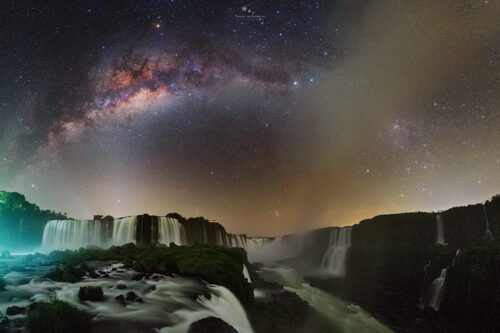
You must have already looked at the sky of your city to admire the celestial bodies and you must have also appreciated, at some point in your life, the Iguaçu Falls , in person or in visual records on the most different media platforms, but few people in the world. world were able to see and record the galaxies, stars and cosmic dust that can be admired, in a unique visual composition on the planet, in the World Wonder of Nature located in the Iguaçu National Park , on the border between Brazil and Argentina.
Photographer Victor Lima was responsible for capturing rare scenes from the sky at Iguaçu Falls . Passionate about astrophotography, he made a first visit to Iguaçu National Park with his family about two years ago. On his second visit, in March 2021, he came to the park with the images and dreams in his head, memorized photographs, and organized, together with the unit's administration, a special release to conduct a photographic expedition at night, outside of office hours. to the public.
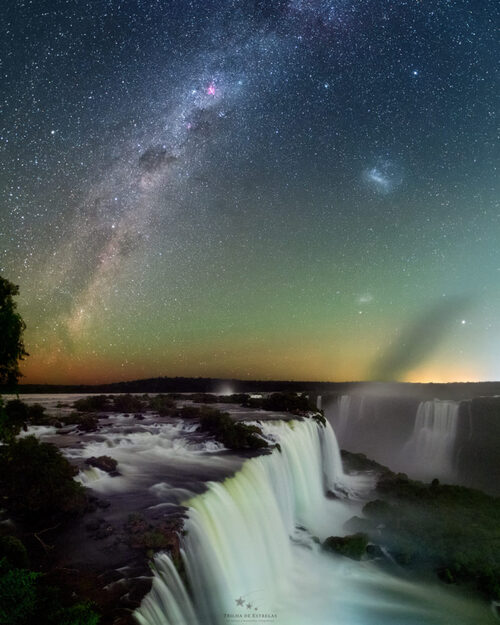
Victor , who stayed at the Hotel das Cataratas , located within the conservation unit, devoted four days and three nights to the catchments. For the photographer, who had the company of 11 photography students, the experience of the sky at the Falls was the best photographic experience ever recorded by all visitors.
It is necessary to read the photographs calmly to identify the stars of the Universe, in the same way that Victor had to wait for the right moment, be patient, look intently, to be able to identify them and register them in the sky of the Falls.
Astronomical sky reading at the Falls
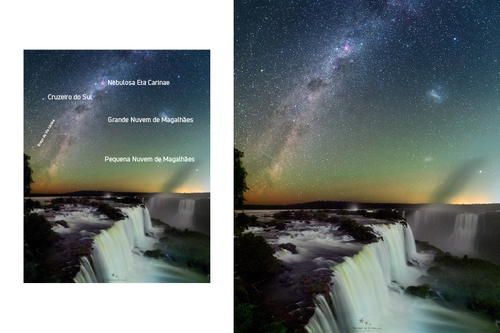
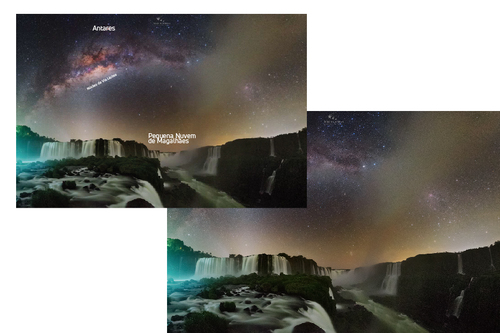
In this photograph we have the arm of the Milky Way (spiral galaxy of which the solar system is a part) on the left side of the image. It is possible to identify in the upper part Cruzeiro do Sul (smallest of all constellations and considered the most important) and the nebula Eta Carinae (magenta), which is one of the largest and most luminous stars in our galaxy; it is not visible to the naked eye. On the right, we can see the large and small Magellanic Clouds, two irregular dwarf satellite galaxies in our galaxy. Both can be seen with the naked eye in the Southern Hemisphere.
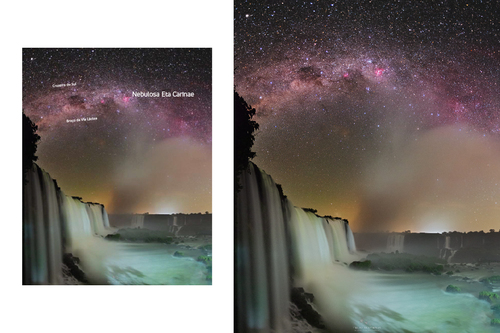
This record shows the Milky Way arm at the top of the image, Cruzeiro do Sul and Eta Carinae (magenta).
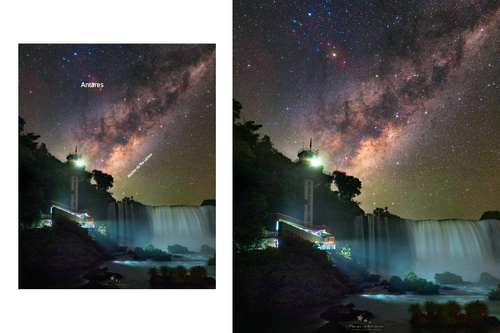
The Milky Way appears diagonally over the Iguazu Falls elevator . In this photograph you can see the emission nebulae (cloud of ionized gas that emits light of various colors), bright clouds of dust (dust that exists in outer space) and interstellar gas, such as the Eagle Nebula (M16), the Omega Nebula (M17), the Lagoa Nebula (M8) and NGC 6357, among others. Above the nucleus of the Milky Way is Antares (red supergiant star in the constellation Scorpius).
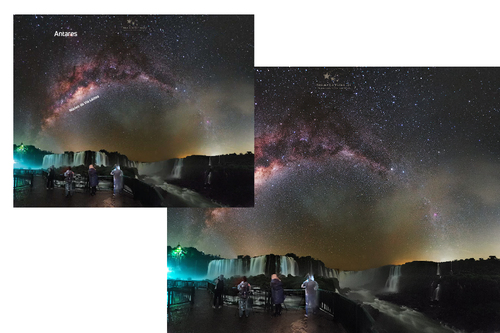
In this image we have the Milky Way arc crossing the sky at Iguazu Falls , passing from Brazil to Argentina, in the photo angle. The people who appear in the portrait are some of the participants in the Photographic Expedition Course organized by the photographer Victor Lima . Another interesting detail above the Milky Way is Antares.
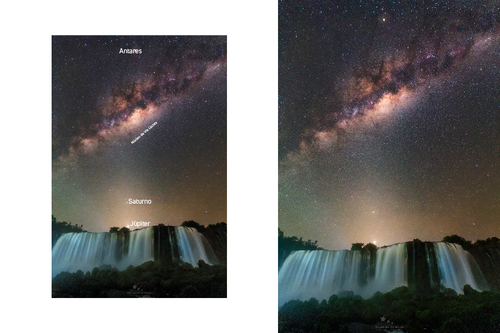
The nucleus of the Milky Way crosses the sky over Salto Santa Maria, in the Iguaçu Falls . The zodiacal light illuminates the horizon above the largest set of waterfalls in the world. Upon the falls, the planets Jupiter and Saturn aligned.
In this record, the Milky Way forms an arc over the Falls . Already above the Devil's Throat, the biggest jump of the Iguaçu Falls , there is the small Magellanic Cloud. Above the nucleus of the Milky Way appears Antares.
Incredible records, isn't it? To capture these scenes, Victor Lima used a Canon 6D full-frame camera and made use of the long exposure technique, when the sensor needs more time to capture the image, and this is usually done in low light environments. The professional supported the camera on a tripod and used a conventional lens. He previously used and abused patience and research on the spot to achieve the results released. The scenes were recorded for three nights, from 10 pm to 4 am.
Text: Cataratas / Iguaçu National Park
Photos: Victor Lima