x




Japan E-Commerce Market Report 2026
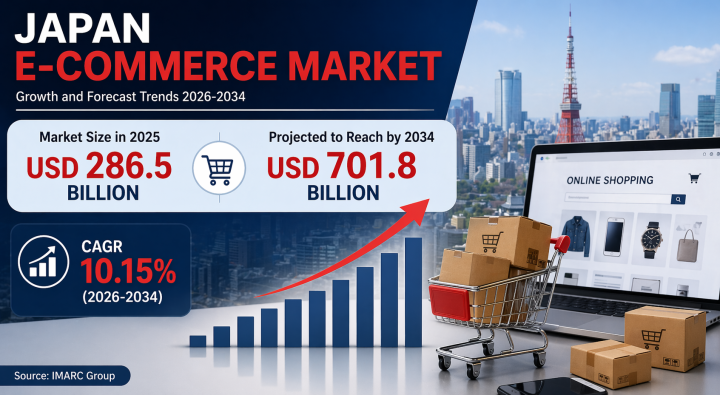
Market Size in 2025: USD 286.5 Billion
Market Forecast in 2034: USD 701.8 Billion
Market Growth Rate: 10.15% (2026–2034)
According to the latest report by IMARC Group, titled "Japan E-Commerce Market: Industry Trends, Share, Size, Growth, Opportunity and Forecast 2026-2034," the Japan E-Commerce market was valued at USD 286.5 Billion in 2025. Looking forward, the market is projected to reach USD 701.8 Billion by 2034, growing at a CAGR of 10.15% during 2026-2034.
Download a Sample PDF of This Report: https://www.imarcgroup.com/japan-e-commerce-market/requestsample
.png)
Japan E-Commerce Industry Trends and Demands in 2026:
The Japanese e-commerce market is a very strong growth market in which consumers of all age groups are shifting more and more from face-to-face sales to digital shopping channels; the market is also growing rapidly through mobile commerce using native smartphone shopping apps; utilization of same-day and next-day delivery logistics infrastructure is expanding in metropolitan and provincial areas; cross-border e-commerce is expanding in foreign consumer goods for inbound and Japanese products for outbound; and the platform ecosystem is becoming more integrated by linking shopping, payments, loyalty programs, and content services. The market covers both home appliances, books, cosmetics, groceries and other product categories with a 34.2% product category share in the clothing, shoes and accessories sector. Business model segments include B2C Business-to-Consumer accounting for 55.7%, B2B, C2C, and more. Strong mobile commerce growth momentum supported by high smartphone penetration and mobile payment in Japan. The expanding same-day and express delivery logistics network is reducing buying frictions and hastening adoption in impulse- and convenience-driven categories. Live commerce and social shopping experiences are emerging as the new engagement and conversion tool in apparel, cosmetics and lifestyle segments. Cross-border e-commerce inbound consumption from international brands is increasing as the Japanese culture is looking increasingly to global premium products. Subscription e-commerce services in the grocery, cosmetics and lifestyle segments are providing continuous revenue for the platform operators.
The market is Japan's consumer adaption evolving from their historically heavy physical retail culture to a digitally enabled omnichannel shopping. Consumers are moving away from purchasing in department stores, specialty retailers, and convenience stores to purchasing digitally on app-based platforms and directly from brands online. Size fit advancements and flexible return policies are lowering the risk in purchasing apparel and fashion on the web. Grocery e-commerce is also developing fast as city dwellers, pressed for time, want more convenience in the form of home delivery. The pace of B2B e-commerce platform adoption is quickening as Japanese companies modernize procurement processes with digital supply chain integration. C2C marketplace platforms are attaining increasing consumer-to-consumer resale and secondhand commerce between electronics, fashion and collectibles. Leading Japanese e-commerce platform players such as Rakuten, Amazon Japan, Yahoo Shopping, and Mercari are making multi-billion investments in logistics, AI based personalization, fintech, content ecosystem etc, with the objective of deepening consumer engagement and broadening addressable commerce categories.
How AI is Reshaping the Future of the Japan E-Commerce Market:
AI-Powered Personalization and Product Discovery: AI analyzes individual consumer browsing history, purchase patterns, search queries, and behavioral engagement signals to deliver hyper-personalized product recommendations, search result rankings, and promotional offer targeting across e-commerce platforms and mobile applications. Machine learning models continuously refine personalization accuracy improving purchase conversion rates, basket size, and repeat visit frequency for Japanese e-commerce platform operators. These capabilities enable Rakuten, Amazon Japan, and other platform leaders to differentiate consumer experience quality, increase customer lifetime value, and reduce customer acquisition cost through improved retention and organic recommendation-driven purchase discovery.
Dynamic Pricing and Inventory Optimization: AI processes real-time competitor pricing data, demand signals, inventory levels, seasonal trend patterns, and margin optimization parameters to dynamically adjust product pricing and promotional discount depth across millions of SKUs at continuous frequency. Machine learning algorithms optimize inventory stocking levels and replenishment timing across fulfillment center networks reducing overstock carrying costs and stockout-driven lost sales. These technologies improve e-commerce operator financial performance, ensure competitive price positioning, and maintain product availability standards that support consumer satisfaction and platform trust metrics critical to retaining Japan's highly quality-sensitive digital shoppers.
Logistics Intelligence and Last-Mile Delivery Optimization: AI optimizes order fulfillment center allocation, carrier selection, delivery route planning, and last-mile scheduling based on package characteristics, delivery address density, time window commitments, and real-time traffic and weather conditions. Machine learning models predict delivery success probability by address and time window enabling proactive redelivery scheduling and recipient communication. These capabilities support same-day and next-day delivery promise reliability across Japan's demanding urban consumer delivery expectation environment, reduce last-mile logistics costs, and improve carrier network efficiency supporting the continued logistics infrastructure investment that underpins Japan's e-commerce growth acceleration.
Japan E-Commerce Market Segmentation:
The market report offers a comprehensive analysis of the segments, highlighting those with the largest Japan E-Commerce market share. It includes forecasts for the period 2026-2034 and historical data from 2020-2025 for the following segments.
Segment Breakdown by Product Category:
Segment Breakdown by Business Model:
Regional Insights:
Competitive Landscape:
The report offers an in-depth examination of the competitive landscape encompassing market structure, key player positioning, leading strategies for success, a competitive dashboard, and a company evaluation quadrant. Additionally, the report features detailed profiles of all major companies in the Japan E-Commerce industry.
Recent News and Developments in Japan E-Commerce Market
April 2026: Rakuten announced major AI personalization engine upgrades across its Ichiba marketplace platform and Rakuten Pay fintech ecosystem, integrating purchase prediction models, real-time behavioral targeting, and cross-service recommendation synchronization aimed at improving conversion rates and increasing Rakuten Ecosystem average revenue per user metrics.
March 2026: Amazon Japan announced expanded same-day delivery coverage across additional suburban prefectures and new ultra-fast delivery service launches in major metropolitan areas, alongside new grocery fulfillment center openings targeting the high-growth fresh and everyday grocery e-commerce category expansion.
Ongoing: Increasing investments in AI-powered personalization and pricing optimization, logistics network same-day delivery capability expansion, live commerce and social shopping format development, B2B e-commerce platform digital procurement integration, cross-border commerce infrastructure, and mobile payment ecosystem deepening continue to reshape the Japan E-Commerce market.
Note: If you need specific information that is not currently within the scope of the report, we will provide it to you as a part of the customization.
About Us:
IMARC Group is a global management consulting firm that helps the world's most ambitious changemakers to create a lasting impact. The company provides a comprehensive suite of market entry and expansion services including thorough market assessment, feasibility studies, company incorporation assistance, factory setup support, regulatory approvals and licensing navigation, branding, marketing and sales strategies, competitive landscape and benchmarking analyses, pricing and cost research, and procurement research.
Contact Us:
Street: 563-13 Kamien
Area: Iwata
Country: Tokyo, Japan
Postal Code: 4380111
Email: sales@imarcgroup.com