x




Japan Frozen Seafood Market Report 2026
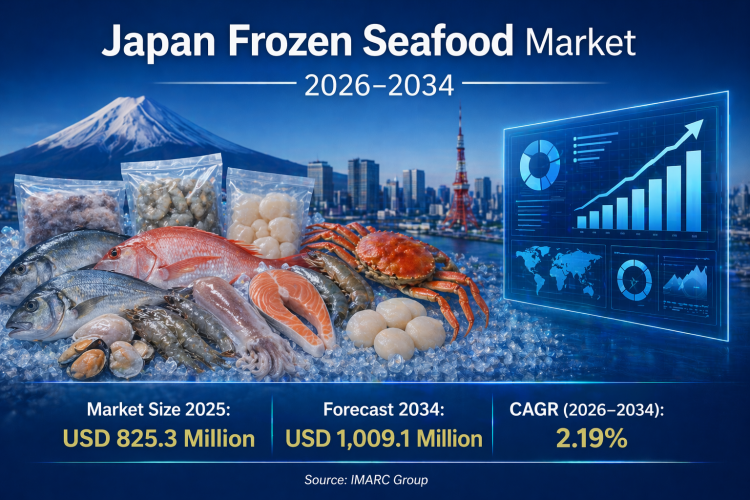
Market Size in 2025: USD 825.3 Million
Market Forecast in 2034: USD 1,009.1 Million
Market Growth Rate: 2.19% (2026-2034)
According to the latest report by IMARC Group, titled "Japan Frozen Seafood Market: Industry Trends, Share, Size, Growth, Opportunity and Forecast 2026-2034," the Japan Frozen Seafood market size reached USD 825.3 Million in 2025. Looking forward, the market is expected to reach USD 1,009.1 Million by 2034, exhibiting a CAGR of 2.19% during 2026-2034.
Request a Free Sample PDF for Detailed Market Insights: https://www.imarcgroup.com/japan-frozen-seafood-market/requestsample
Japan Frozen Seafood Industry Trends and Demands in 2026:
Japan's frozen seafood market is expanding at a measured and consistent pace, driven by Japan's deeply embedded seafood consumption culture, growing adoption of frozen seafood as a convenient, waste-reducing alternative to fresh in busy household and food service settings, and the improving quality and variety of frozen seafood products enabled by advanced freezing technology preserving nutritional integrity and texture. The market encompasses Pacific salmon, bigeye tuna, mackerel, yellowfin tuna, octopus, crabs, trout, cuttlefish, jack and horse mackerel, and other frozen fish types, distributed through supermarkets and hypermarkets, convenience stores, specialty retailers, online channels, and others, serving retail and institutional sectors.
Japan's culinary culture places exceptional emphasis on seafood quality and freshness, making frozen seafood adoption a nuanced consumer proposition requiring IQF and flash-freezing technology to credibly bridge the quality gap with fresh alternatives. Salmon represents a uniquely successful frozen seafood category given Japan's extraordinary per-capita salmon consumption and the high quality of Norwegian, Chilean, and Alaskan salmon available through frozen supply chains. Institutional food service demand — across school lunch programs, hospital catering, corporate cafeterias, and restaurant supply — represents a significant and consistent frozen seafood consumption segment prioritizing supply stability and cost management over premium fresh positioning. Online frozen seafood delivery is expanding as cold chain e-commerce logistics improve, enabling direct-to-consumer premium frozen seafood subscription programs reaching consumers beyond major metropolitan markets.
How AI is Reshaping the Future of the Japan Frozen Seafood Market:
Japan Frozen Seafood Market Segmentation:
The market report offers a comprehensive analysis of the segments, highlighting those with the largest Japan Frozen Seafood market share. It includes forecasts for the period 2026-2034 and historical data from 2020-2025 for the following segments.
Breakup by Type:
Breakup by Distribution Channel:
Breakup by Sector:
Regional Insights:
Competitive Landscape:
The report offers an in-depth examination of the competitive landscape. It includes a thorough competitive analysis encompassing market structure, key player positioning, leading strategies for success, a competitive dashboard, and a company evaluation quadrant. Additionally, the report features detailed profiles of all major companies in the Japan Frozen Seafood industry.
Recent News and Developments in Japan Frozen Seafood Market
April 2026: Maruha Nichiro Corporation announced the expansion of its premium frozen salmon product line incorporating individually quick-frozen portion cuts targeting Japan's growing home meal kit and online grocery delivery channel, responding to consumer demand for convenient, high-quality frozen salmon that maintains comparable texture and flavor to fresh product.
March 2026: Nippon Suisan Kaisha reported expanded institutional food service supply agreements for frozen yellowfin tuna and salmon products across major hospital and corporate catering operators, reflecting growing institutional sector preference for supply-stable frozen seafood over fresh alternatives amid marine resource supply volatility.
February 2026: Kibun Foods announced a new sustainable seafood certification partnership for its frozen mackerel and jack mackerel product ranges, responding to growing Japanese retailer and consumer demand for verified sustainable fishing practice documentation across wild-catch frozen seafood categories.
Note: If you need specific information that is not currently within the scope of the report, we will provide it to you as a part of the customization.
About Us:
IMARC Group is a global management consulting firm that helps the world's most ambitious changemakers to create a lasting impact. The company provides a comprehensive suite of market entry and expansion services. IMARC offerings include thorough market assessment, feasibility studies, company incorporation assistance, factory setup support, regulatory approvals and licensing navigation, branding, marketing and sales strategies, competitive landscape and benchmarking analyses, pricing and cost research, and procurement research.
Contact Us:
Street: 563-13 Kamien
Area: Iwata
Country: Tokyo, Japan
Postal Code: 4380111
Email: sales@imarcgroup.com
Source: IMARC Group