x




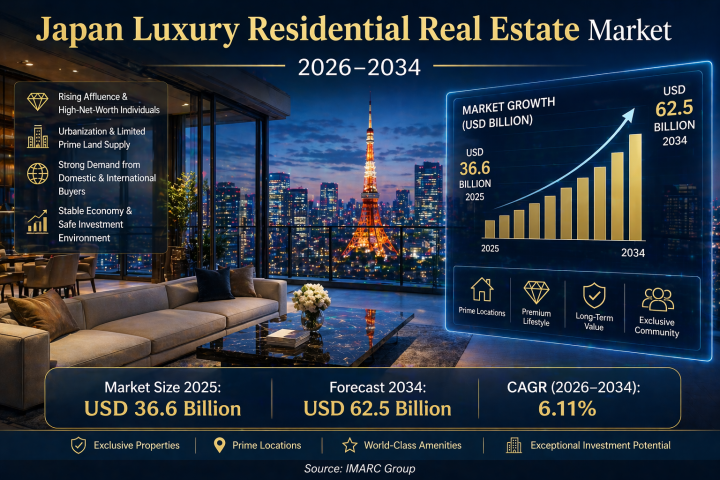
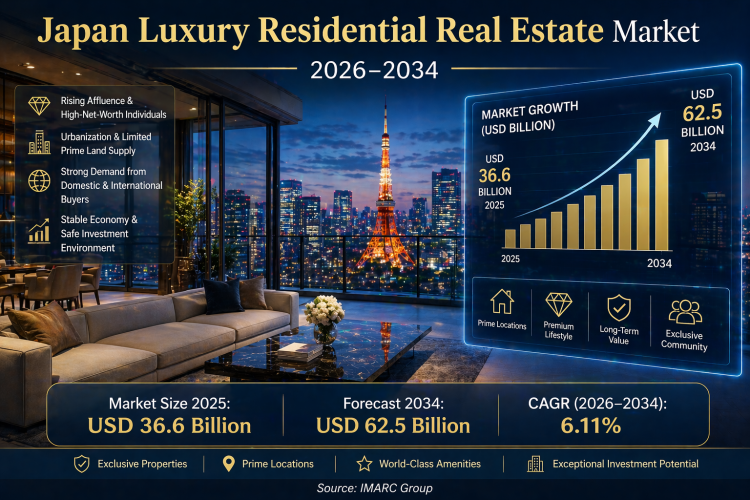
According to IMARC Group's latest research publication, the size of the Japan luxury residential real estate market reached USD 36.6 Billion in 2025. Looking ahead, the market size is projected to reach USD 62.5 Billion by 2034, exhibiting a growth rate (CAGR) of 6.11% during 2026-2034.
Request a Free Sample PDF for Detailed Market Insights: https://www.imarcgroup.com/japan-luxury-residential-real-estate-market/requestsample
How Foreign Investment and Urban Revitalization are Reshaping the Japan Luxury Residential Real Estate Market
Japan's luxury residential real estate market size is experiencing exceptional expansion driven by the sharp appreciation of yen-denominated real estate assets following Japan's currency weakness relative to major international currencies, the arrival of high-net-worth international investors seeking stable asset preservation in Japanese metropolitan markets, and major urban revitalization programs in Tokyo's premium residential neighborhoods that are delivering ultra-premium apartments and condominiums commanding record-breaking price-per-square-meter valuations. Japan's luxury residential market — traditionally dominated by domestic ultra-high-net-worth individuals from manufacturing, real estate, and financial services sectors — is now attracting substantial foreign capital from Asian emerging-market billionaires, Middle Eastern sovereign wealth investors, and European family offices seeking real estate diversification in Japan's stable, yen-denominated investment environment.
The luxury residential real estate market size is simultaneously being influenced by Japan's demographic trends favoring urban concentration — with young professionals, expatriate families, and international retirees increasingly selecting Tokyo, Osaka, and other major metropolitan areas as primary residential locations rather than suburban villa and landed houses in peripheral areas. This urban concentration trend is driving exceptional valuation growth in prime central Tokyo locations including Minato, Chiyoda, and Shibuya wards, where ultra-premium apartments and condominiums are achieving triple-digit year-over-year appreciation rates in certain sub-segments. Simultaneously, Japan's traditional luxury villa and landed houses segment — historically concentrated in affluent suburban municipalities like Setagaya and Meguro — is experiencing relative stagnation as younger wealth holders prioritize urban convenience over suburban privacy and green space.
Japan Luxury Residential Real Estate Market Trends & Drivers
The Japan luxury residential real estate market size is experiencing strong growth driven by foreign capital inflows, yen currency weakness export opportunities, urban revitalization program investment, metropolitan concentration dynamics, and limited supply scarcity in prime central business districts.
Foreign High-Net-Worth Individual Acquisition
Foreign billionaires and ultra-high-net-worth individuals from China, Singapore, Hong Kong, Middle East, and Europe are increasingly acquiring trophy luxury apartments and condominiums in Tokyo's most exclusive addresses — including newly-completed ultra-premium residential towers in Minato and Chiyoda wards that command price-per-square-meter valuations exceeding Tokyo's traditional landed house and villa segments. This foreign acquisition activity is driving market size appreciation in the ultra-premium apartment and condominium segment while simultaneously signaling the internationalization of Japan's luxury residential real estate market beyond the historically domestic-focused ownership pattern.
Tokyo Metropolitan Revitalization and New Supply
Major Tokyo real estate development corporations are undertaking comprehensive urban revitalization programs in premium central wards, delivering ultra-high-density apartment and condominium developments on prime locations that were previously occupied by older residential buildings or commercial structures. These major revitalization projects are introducing unprecedented supply of apartment and condominium units in Tokyo's most desirable neighborhoods — simultaneously expanding total luxury residential supply and elevating neighborhood-level prestige through architectural excellence, premium amenity provision, and architectural significance of the revitalization efforts themselves.
Yen Weakness Currency Dynamics
The sharp depreciation of the Japanese yen relative to USD, EUR, and other major currencies is making yen-denominated luxury residential real estate assets significantly more affordable for foreign investors — effectively discounting Tokyo and Osaka luxury apartments and condominiums by 20-30% relative to historical price levels in foreign-currency terms. This currency-induced affordability advantage is attracting sustained foreign capital inflows into Japan's luxury residential market, supporting market size appreciation through demand expansion from international buyer cohorts.
Japan Luxury Residential Real Estate Market Industry Segmentation
Type Insights:
Japan Luxury Residential Real Estate Market Competitive Landscape
The competitive landscape of the industry has also been examined along with the profiles of the key players.
Key Players:
Recent News and Developments
February 2026:
Mitsui Fudosan announced the completion of 'Tokyo Tower Residences,' an ultra-premium 60-story residential tower in Minato ward with 200 luxury condominium units commanding average price-per-square-meter valuations exceeding 4 million yen ($27,000 USD equivalent) — with 40% of units already pre-purchased by foreign high-net-worth individuals from Asia, Middle East, and Europe within the first pre-sale phase, demonstrating the extraordinary foreign demand underpinning Japan's luxury residential real estate market size appreciation.
December 2025:
Sumitomo Realty & Development reported record annual sales across its luxury apartments and condominiums portfolio, driven by sustained foreign investor demand and the currency-driven affordability advantage that yen depreciation provides to foreign buyers acquiring yen-denominated Tokyo luxury residential assets — with international buyer composition increasing from 25% of unit sales five years prior to over 45% of current-year unit sales.
September 2025:
Japan's Ministry of Land, Infrastructure, Transport and Tourism updated foreign investor taxation on residential real estate transactions, introducing tax incentives for long-term foreign ownership of Japan luxury residential properties to encourage sustained international capital inflow — directly supporting luxury residential real estate market size expansion through policy-driven demand stimulation for both apartments and condominiums and traditional villa and landed house acquisitions by foreign investors.
Ongoing:
Japan's luxury residential real estate market size continues to appreciate as foreign capital inflows accelerate, yen currency weakness sustains foreign investor affordability advantages, and Tokyo's major revitalization programs deliver unprecedented quantities of ultra-premium apartment and condominium supply in the world's most expensive central business district locations — collectively supporting the structural appreciation of Japan's luxury residential real estate market for the foreseeable forecast period.
Note: If you need specific information that is not currently within the scope of the report, we will provide it to you as a part of the customization.
About Us
IMARC Group is a global management consulting firm that helps the world's most ambitious changemakers to create a lasting impact. The company provides a comprehensive suite of market entry and expansion services. IMARC offerings include thorough market assessment, feasibility studies, company incorporation assistance, factory setup support, regulatory approvals and licensing navigation, branding, marketing and sales strategies, competitive landscape and benchmarking analyses, pricing and cost research, and procurement research.
Contact Us:
Street: 563-13 Kamien
Area: Iwata
Country: Tokyo, Japan
Postal Code: 4380111
Email: sales@imarcgroup.com