x




Digital Product Passports Transform Global Supply Chains with Enhanced Traceability Sustainability and Regulatory Compliance
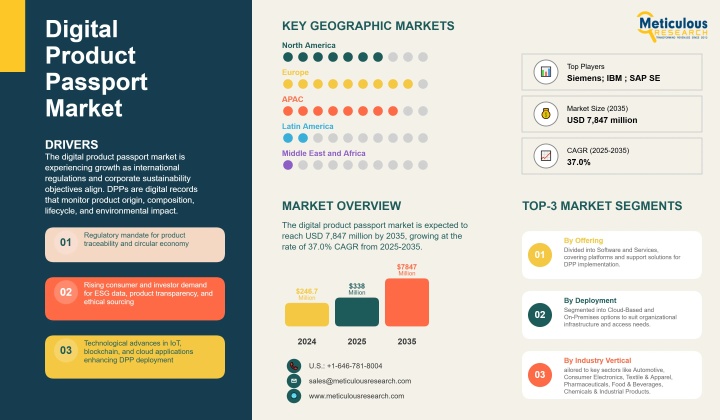
The digital product passport market size was estimated to be USD 338 million in 2025 and is expected to reach USD 7,847 million by 2035, growing at the rate of 37.0% CAGR from 2025-2035.
Digital Product Passports (DPPs) are becoming a game-changer in how we track products from creation to disposal. Think of them as digital ID cards that follow products throughout their entire journey, documenting everything from where materials came from to their environmental impact.
A Booming Market
The numbers tell an impressive story. The digital product passport market was worth $338 million in 2025 and is projected to explode to nearly $8 billion by 2035—that's an incredible 37% growth rate annually. This rapid expansion reflects growing demand for transparency and accountability in global supply chains.
Regulatory Push Drives Adoption
The European Union is leading the charge with its Ecodesign for Sustainable Products Regulation, which will require DPPs for textiles, electronics, and batteries starting in 2026. This isn't just bureaucratic paperwork—it's driving real change. Over 150 companies joined the EU's CIRPASS consortium in 2024 to test these digital passport systems.
Major brands are already jumping on board. H&M and Decathlon are experimenting with DPPs to support circular economy goals, while a World Economic Forum study found that 54% of global supply chain executives are investing in traceability tools to meet environmental and social governance objectives.
Technology Leaders Emerge
Several key players are shaping this market. IBM, SAP, and Circularise are developing blockchain-based solutions that make tracking products more secure and reliable. Circularise's partnership with luxury carmaker Porsche and chemical giant BASF has shown promising results—their pilot program improved supply chain traceability by 22%.
Meanwhile, SAP's Green Token platform has helped companies reduce audit preparation time by 30% by making it easier to share environmental and social data across supply chains. These aren't just theoretical improvements—they're delivering real business value.
Consumer Demand Fuels Growth
Consumers are increasingly conscious about what they buy. An IBM survey revealed that 71% of global consumers are willing to pay more for products with verified sustainability credentials. This shift is pushing retailers to integrate DPPs into product labels and mobile apps, giving shoppers access to detailed information about product origins, materials, and care instructions.
Challenges Remain
Despite the excitement, significant hurdles exist. Different industries use various data formats, making it difficult for systems to work together. The EU's CIRPASS consortium found that 47% of companies struggle with integration challenges due to inconsistent data structures.
Cost is another major barrier, especially for smaller businesses. A 2024 European Innovation Council survey found that 39% of small manufacturers cite expense as their biggest obstacle to adopting DPPs. The investment in hardware, software, training, and ongoing cloud subscriptions can be substantial.
Regional Leadership
Europe dominates the market with 40% share, driven by strong regulations and commitment to circular economy principles. However, Asia-Pacific is rapidly catching up, expected to grow at over 40% annually by 2035 as countries like China, Japan, and India implement their own traceability programs.
The United States, holding 85% of the North American market, is supporting adoption through federal initiatives, including a $50 million Department of Energy pilot program for solar panels and batteries.
Looking Forward
Digital Product Passports represent more than just compliance tools—they're enabling a fundamental shift toward transparency, sustainability, and circular economy principles. As technology improves and costs decrease, these digital identities for products will become as common as barcodes are today, fundamentally changing how we understand and interact with the things we buy.
Download Sample Report Here @ https://www.meticulousresearch.com/download-sample-report/cp_id=6240
Contact Us:
Meticulous Research®
Email- sales@meticulousresearch.com
Contact Sales- +1-646-781-8004
Connect with us on LinkedIn- https://www.linkedin.com/company/meticulous-research