x




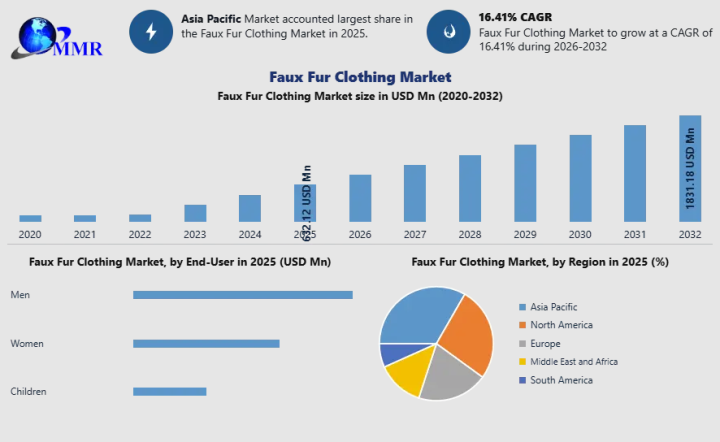
The Global Faux Fur Clothing Market was valued at USD 632.12 million in 2025 and is projected to reach approximately USD 1,831.18 million by 2032, growing at a CAGR of 16.41% during the forecast period from 2026 to 2032. The market is experiencing significant growth due to increasing consumer awareness of animal welfare, rising demand for cruelty-free fashion, changing fashion preferences, and the growing popularity of sustainable alternatives to traditional animal fur.
Intrigued to explore the contents? Secure your hands-on sample copy of the report: https://www.maximizemarketresearch.com/request-sample/147400/
Faux fur clothing, also known as artificial fur clothing, is manufactured using synthetic or alternative textile materials designed to replicate the appearance, softness, and warmth of natural animal fur. These products offer consumers an attractive combination of luxury, affordability, comfort, and fashionable designs without relying on animal-derived materials. Faux fur jackets, coats, vests, scarves, gloves, shawls, and other accessories have become increasingly popular among consumers seeking stylish winter clothing.
The growing influence of social media, celebrity fashion trends, international fashion events, and online shopping platforms is further increasing product visibility. Manufacturers are introducing different colors, textures, patterns, and lightweight designs to attract consumers across various age groups and income categories.
According to Maximize Market Research, the Faux Fur Clothing Market is expected to experience substantial growth throughout the forecast period, supported by technological innovation, expanding fashion retail channels, and increasing preference for cruelty-free clothing.
Growing awareness of animal cruelty and ethical fashion practices is a major factor driving the global faux fur clothing market. Consumers are becoming increasingly conscious of the environmental and ethical consequences associated with the production of traditional animal fur. This shift in purchasing preferences is encouraging manufacturers and fashion retailers to develop animal-friendly alternatives.
Faux fur provides a practical solution for consumers who prefer the luxurious appearance of fur without supporting animal farming and hunting. Several fashion companies are adopting fur-free policies and replacing animal-derived materials with synthetic alternatives across their product portfolios.
The increasing popularity of cruelty-free fashion among younger consumers, particularly Millennials and Generation Z, is expected to create significant opportunities for faux fur clothing manufacturers.
Intrigued to explore the contents? Secure your hands-on sample copy of the report: https://www.maximizemarketresearch.com/request-sample/147400/
The growing demand for fashionable winter apparel is another important factor supporting market growth. Faux fur clothing offers a premium appearance at comparatively affordable prices, making luxury-inspired fashion accessible to a wider consumer base.
Consumers are increasingly purchasing faux fur jackets, coats, vests, and accessories for casual wear, special occasions, and seasonal fashion collections. Fashion brands are responding by introducing products with improved textures, attractive designs, and multiple color options.
The availability of affordable faux fur clothing through online marketplaces and specialty fashion stores is further supporting consumer adoption.
Sustainability has become an important consideration for fashion manufacturers and consumers. Companies are exploring recycled polyester, recycled textile waste, and other alternative materials to manufacture faux fur fabrics.
The use of recycled materials can help reduce dependence on virgin resources and support circular fashion initiatives. Manufacturers are also investing in improved production methods to reduce material waste and increase manufacturing efficiency.
However, the sustainability of faux fur depends on its material composition, manufacturing process, durability, and end-of-life disposal. The development of recyclable and lower-impact synthetic alternatives is expected to remain an important market trend.
Continuous innovation in textile engineering is improving the quality and performance of artificial fur products. Advanced knitting, weaving, dyeing, and finishing technologies allow manufacturers to produce faux fur fabrics with realistic textures, different pile lengths, improved softness, and enhanced durability.
Manufacturers are also developing lightweight, water-resistant, and weather-resistant fabrics to improve product functionality. These developments are expanding the application of faux fur beyond conventional winter clothing into contemporary fashion and lifestyle apparel.
The rapid expansion of e-commerce platforms is creating new opportunities for faux fur clothing manufacturers. Online retail channels allow brands to reach international customers, showcase extensive product collections, and offer personalized shopping experiences.
Social media marketing, influencer collaborations, digital fashion campaigns, and online fashion events are increasing awareness of artificial fur products. The availability of different designs and competitive pricing through online channels is expected to support market expansion throughout the forecast period.
Despite its advantages, the faux fur clothing market faces certain environmental and performance-related challenges. Many conventional faux fur products contain synthetic fibers such as polyester and acrylic, which may contribute to microplastic pollution during washing and disposal.
Additionally, some artificial fur garments may not provide the same insulation properties as high-quality natural fur, depending on their construction and material composition. Fiber shedding, durability concerns, and limited biodegradability can also influence consumer purchasing decisions.
Developing high-performance, recyclable, and environmentally responsible materials will therefore be essential for maintaining long-term market growth.
The global Faux Fur Clothing Market is segmented by Product Type, End-User, Distribution Channel, and Region.
Based on product type, the market is categorized into vests, coats, jackets, shawls, capelets, scarves, gloves, and others.
The Vests and Jackets segment is expected to hold a significant market share during the forecast period. The increasing popularity of fashionable winter apparel, combined with the affordability and versatility of faux fur jackets, is supporting segment growth.
Faux fur jackets are increasingly featured in seasonal fashion collections and are available in various lengths, colors, textures, and styles. These garments provide warmth while offering a luxurious appearance, making them attractive to consumers across different age groups.
The coats segment is also expected to witness considerable demand because of the increasing adoption of fashionable outerwear in colder regions. Meanwhile, scarves, gloves, shawls, and capelets are gaining attention as complementary fashion accessories.
Based on end-user, the market is segmented into men, women, and children.
The women segment is expected to account for a major share of the global faux fur clothing market. Higher product variety, changing fashion preferences, and increasing demand for luxury-inspired winter apparel are supporting this segment.
Women consumers are increasingly attracted to faux fur coats, jackets, vests, and fashion accessories that combine elegance, comfort, and affordability. Fashion designers and retailers are also introducing a wider range of faux fur collections targeting female consumers.
The men's segment is gradually expanding as fashion brands introduce contemporary faux fur jackets and outerwear. Growing interest in experimental fashion, streetwear, and luxury-inspired clothing is creating new opportunities in this category.
The children's segment is also expected to benefit from demand for comfortable, attractive, and affordable winter apparel.
Based on distribution channel, the market is divided into supermarkets/hypermarkets, specialty stores, online channels, departmental stores, and others.
The online channel is becoming increasingly important due to the growing adoption of e-commerce platforms and changing consumer shopping behavior. Online retailers provide access to a wide range of faux fur clothing products, competitive pricing, customer reviews, and convenient home delivery services.
Specialty stores continue to attract customers looking for premium fashion collections, personalized assistance, and product-quality comparisons. Departmental stores and supermarkets/hypermarkets also contribute to market distribution by offering seasonal clothing collections and affordable apparel options.
The increasing integration of digital marketing, social commerce, and omnichannel retail strategies is expected to strengthen distribution opportunities.
Intrigued to explore the contents? Secure your hands-on sample copy of the report: https://www.maximizemarketresearch.com/request-sample/147400/
The global Faux Fur Clothing Market is analyzed across North America, Europe, Asia Pacific, South America, and the Middle East & Africa.
Asia Pacific is expected to hold a significant share of the global faux fur clothing market during the forecast period. The region's large population, expanding middle-class consumer base, growing disposable income, and increasing interest in fashionable winter apparel are supporting market development.
Countries such as China, Japan, South Korea, and India are important markets for fashion and textile manufacturing. The presence of established apparel production facilities and competitive manufacturing capabilities also supports regional growth.
The increasing popularity of international fashion trends, expansion of online retail platforms, and rising awareness of animal-friendly clothing are creating additional opportunities for faux fur manufacturers.
North America represents an important market for faux fur clothing due to increasing consumer interest in ethical fashion, premium apparel, and cruelty-free products.
The United States is a major contributor to regional demand, supported by the presence of established fashion retailers, luxury brands, and online apparel platforms. Growing adoption of fur-free fashion policies among retailers and fashion organizations is encouraging the development of alternative materials.
Canada also contributes to regional demand, particularly for winter jackets, coats, and other cold-weather clothing.
Europe is expected to experience significant market growth due to its established fashion industry and increasing emphasis on animal welfare and sustainable fashion.
Countries such as the United Kingdom, Germany, France, Italy, and Spain are important markets for premium apparel and designer fashion. Several European fashion brands are incorporating faux fur into seasonal collections to address changing consumer expectations.
The region's growing preference for ethical fashion, innovative textile materials, and luxury-inspired clothing is expected to create opportunities for manufacturers.
The South American market is expected to grow steadily, supported by increasing urbanization, changing fashion preferences, and the expansion of organized apparel retail.
Brazil and Argentina are important markets for fashion and lifestyle products. Growing access to international fashion brands and e-commerce platforms is helping increase consumer awareness of faux fur clothing.
The Middle East & Africa region is expected to experience gradual market development. Increasing disposable income, growing demand for premium fashion, and the expansion of luxury retail are supporting opportunities in selected markets.
South Africa and GCC countries represent important regional opportunities for fashion retailers and apparel manufacturers. The demand for faux fur accessories and luxury-inspired apparel is expected to benefit from the growing presence of international fashion brands.
The global Faux Fur Clothing Market is characterized by the presence of international fashion brands, luxury apparel manufacturers, specialty faux fur designers, and mass-market retailers. Companies are focusing on product innovation, sustainable material development, brand positioning, and expanding their global distribution networks to strengthen their competitive positions.
Major companies operating in the market include:
Lulus Inc.
Guess?, Inc.
Patagonia, Inc.
Forever 21, Inc.
Noize Apparel Inc.
Brother Vellies LLC
Uniqlo Co., Ltd.
Kolunsag Muflon Sanayi Limited
Hobbs London
Shrimps
H&M Group
Noisy May
Bartfeld Limited
Bershka
Zara
Nanushka Inc.
AllSaints Retail Limited
ASOS plc
Kering
Jakke
Prada
Chanel
Armani
Dolce & Gabbana
Stella McCartney
Competition in the faux fur clothing market is increasingly influenced by material innovation, product differentiation, brand reputation, and sustainability commitments.
Luxury fashion companies are investing in advanced synthetic materials that closely replicate the appearance and texture of natural fur. Meanwhile, mass-market retailers are expanding affordable faux fur collections to reach a broader consumer base.
Specialized brands such as Shrimps and Jakke are focusing on distinctive textures, contemporary designs, and statement outerwear. Major fashion groups and international retailers are incorporating artificial fur into seasonal collections to respond to changing consumer preferences.
The following industry developments highlight the growing importance of animal-free materials and alternative fashion products:
Stella McCartney – 05 March 2026: The brand debuted its Winter 2026 collection at Paris Fashion Week, featuring advanced faux-mink fur and synthetic apparel, highlighting the growing role of high-quality animal-free alternatives in luxury fashion.
ASICS – 02 January 2026: The company announced its commitment to ending the use of wildlife-derived materials and transitioning toward innovative synthetic and recycled alternatives.
CFDA – 09 December 2025: New York Fashion Week announced a policy to prohibit animal fur at official runway events beginning in September 2026, strengthening the industry's movement toward alternative materials.
GUESS USA – 28 October 2025: The brand introduced a Fall/Winter collection featuring faux fur jackets and gold-toned boleros, reflecting growing demand for bold and statement-making fashion.
Jakke – 09 September 2025: The London-based label relaunched its brand identity with a Fall/Winter collection featuring faux Mongolian fur and contemporary designs.
Shein – 15 May 2025: The global fashion marketplace announced a ban on fur and exotic skins across its platform, encouraging the adoption of synthetic alternatives.
These developments demonstrate how changing fashion policies, consumer expectations, and material innovation are influencing the competitive landscape.
1. What is the global Faux Fur Clothing Market size in 2025?
The global Faux Fur Clothing Market was valued at USD 632.12 million in 2025.
2. What is the expected market size of the Faux Fur Clothing Market by 2032?
The market is expected to reach approximately USD 1,831.18 million by 2032, reflecting strong growth in demand for artificial fur clothing.
3. What is the expected CAGR of the Faux Fur Clothing Market during 2026–2032?
The global market is projected to grow at a CAGR of 16.41% during the forecast period from 2026 to 2032.
4. What are the major factors driving the Faux Fur Clothing Market?
Major growth drivers include increasing awareness of animal welfare, rising demand for cruelty-free fashion, growing disposable income, expanding luxury apparel consumption, technological advancements in textile manufacturing, and the increasing popularity of sustainable fashion alternatives.
5. Which product segment is expected to dominate the Faux Fur Clothing Market?
The Vests and Jackets segment is expected to hold a significant market position due to increasing demand for fashionable winter outerwear, versatile designs, and affordable alternatives to traditional fur garments.
The global Faux Fur Clothing Market is positioned for substantial expansion during the forecast period, driven by increasing awareness of animal welfare, changing fashion preferences, and rising demand for affordable luxury apparel. The transition toward cruelty-free fashion is encouraging manufacturers, designers, and international retailers to introduce innovative artificial fur products.
With the market projected to reach USD 1,831.18 million by 2032 at a CAGR of 16.41%, manufacturers and investors are expected to benefit from emerging opportunities across product categories, distribution channels, and regional markets. Companies focusing on product quality, ethical sourcing, material innovation, and consumer-oriented designs will be better positioned to strengthen their presence in the evolving global Faux Fur Clothing Market.
MAXIMIZE MARKET RESEARCH PVT. LTD.
2nd Floor, Navale IT park Phase 3,
Pune Banglore Highway, Narhe
Pune, Maharashtra 411041, India.
+91 9607365656
sales@maximizemarketresearch.com
About Maximize Market Research:
Maximize Market Research is one of the fastest-growing market research and business consulting firms serving clients globally. Our revenue impact and focused growth-driven research initiatives make us a proud partner of majority of the Fortune 500 companies. We have a diversified portfolio and serve a variety of industries such as IT & telecom, chemical, food & beverage, aerospace & defense, healthcare and others.