x





Japan Luxury Goods Market Report 2026-2034
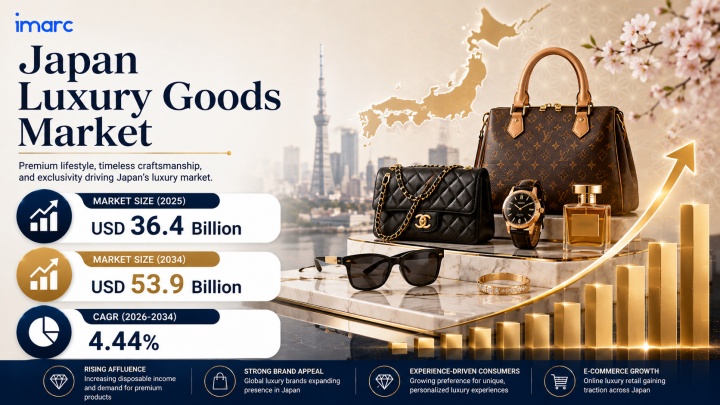
According to the latest report by IMARC Group, the Japan luxury goods market size reached USD 36.4 Billion in 2025. Looking forward, the market is projected to reach USD 53.9 Billion by 2034, exhibiting a CAGR of 4.44% during 2026-2034.
Market Snapshot (2026)
Request a Business Sample Report for Procurement & Investment Evaluation: https://www.imarcgroup.com/japan-luxury-goods-market/requestsample
Japan Luxury Goods Market Trends & Drivers
Japan's luxury goods sector continues to be shaped by a distinctive mix of domestic affluence and international visitor spending, a combination that has made the country one of the most closely watched luxury markets in Asia. Rising disposable income among Japanese consumers is fueling steady demand for high end watches, jewelry, and fashion, while the growing influence of social media and celebrity endorsement continues to amplify aspirational buying behavior, particularly among younger, digitally engaged shoppers. At the same time, evolving consumer expectations around personalization are pushing luxury houses to offer more bespoke and limited edition products rather than standardized collections.
Inbound tourism remains a defining variable for the market, with visitor spending patterns directly influencing quarterly performance across major luxury groups operating in the country. A weaker yen has made Japan an increasingly attractive shopping destination for international travelers, while domestic consumers are simultaneously shifting spending toward jewelry, precious metals, and other assets viewed as stable stores of value amid currency and inflation pressures. The expansion of online retail platforms is further broadening access to luxury goods beyond traditional flagship stores, allowing brands to reach a wider consumer base across the country's regional markets.
Japan Luxury Goods Market Growth Drivers
Key factors supporting the expansion of the Japan luxury goods market include:
Japan Luxury Goods Market Government Support & Regulatory Landscape
Japan's tourism and retail policy environment continues to play a meaningful supporting role in luxury goods demand, particularly through duty free shopping programs and visa facilitation measures that have helped sustain inbound visitor volumes. Tourism promotion efforts coordinated at the national level continue to position Japan as a premier shopping destination for international travelers, reinforcing the connection between tourism policy and luxury retail performance.
Consumer protection and product authenticity regulations also support the integrity of Japan's luxury retail environment, helping maintain consumer confidence in both physical flagship stores and the country's rapidly growing online luxury retail channels. This regulatory stability, combined with Japan's currency dynamics, continues to give international luxury groups confidence in treating the country as a strategic long term market rather than a purely cyclical one.
Impact of AI on the Japan Luxury Goods Market
Investment Opportunities in the Japan Luxury Goods Market
Japan's luxury goods sector presents strong investment potential in categories tied to inbound tourism spending, particularly jewelry, watches, and leather goods, which continue to benefit from favorable currency dynamics and sustained international visitor interest. The jewelry segment in particular has shown standout momentum as domestic consumers increasingly view precious metals and fine jewelry as attractive stores of value.
Online retail expansion also represents a significant growth avenue, as luxury brands work to extend their reach beyond traditional department store and flagship store formats into digitally native shopping experiences. Companies able to combine strong brand heritage with localized, AI enabled personalization capabilities are well positioned to capture demand across both domestic and tourist consumer segments through 2034.
Japan Luxury Goods Market Segmentation
Product Type Insights:
The report has provided a detailed breakup and analysis of the market based on the product type. This includes watches and jewellery, perfumes and cosmetics, clothing, bags/purse, and others.
Distribution Channel Insights:
A detailed breakup and analysis of the market based on the distribution channel have also been provided in the report. This includes offline and online.
End User Insights:
The report has provided a detailed breakup and analysis of the market based on the end user. This includes women and men.
Regional Insights:
Competitive Landscape
The market research report offers an in-depth analysis of the competitive landscape, covering market structure, key player positioning, top winning strategies, a competitive dashboard, and a company evaluation quadrant. Additionally, detailed profiles of all major companies are included.
Recent News and Developments
Future Market Outlook (2026-2034)
The Japan luxury goods market is projected to grow from USD 36.4 Billion in 2025 to USD 53.9 Billion by 2034, reflecting a CAGR of 4.44%. Continued inbound tourism strength, rising domestic demand for jewelry and personalized products, and expanding online retail access will underpin growth throughout the forecast period. AI enabled personalization, authentication technology, and evolving currency dynamics are expected to represent some of the most influential factors shaping the market's trajectory.
Why Buy This Report?
Note: Have specific requirements not covered here? We offer full customization — just share your needs and we'll tailor the report accordingly.
About Us:
IMARC Group is a global management consulting firm that helps the world's most ambitious changemakers to create a lasting impact. The company provides a comprehensive suite of market entry and expansion services. IMARC offerings include thorough market assessment, feasibility studies, company incorporation assistance, factory setup support, regulatory approvals and licensing navigation, branding, marketing and sales strategies, competitive landscape and benchmarking analyses, pricing and cost research, and procurement research.
Contact Us:
Street: 563-13 Kamien
Country: Tokyo, Japan
Postal Code: 4380111
Email: sales@imarcgroup.com
Source: IMARC Group