x




Global Automotive Steel Market: Driving Innovation, Strength, and Sustainability
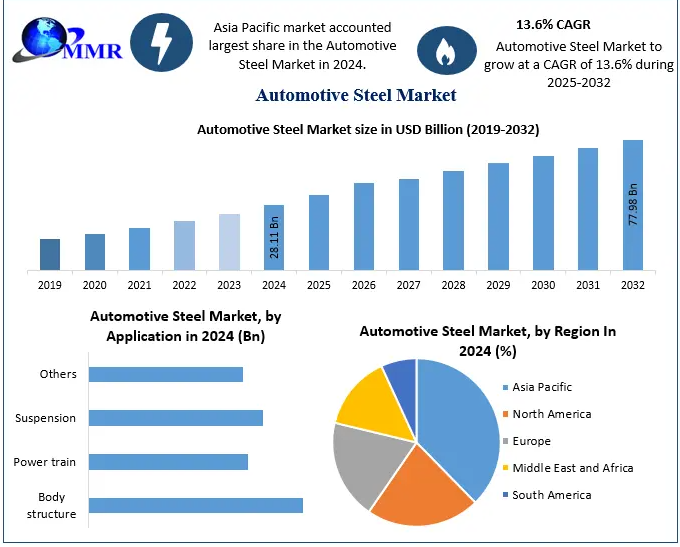
The Automotive Steel Market, valued at USD 28.11 billion in 2024, is forecasted to expand significantly, reaching USD 77.98 billion by 2032 at a CAGR of 13.6%. Despite the growing inclination towards alternative lightweight materials, steel remains the bedrock of automotive manufacturing, thanks to its superior strength, affordability, and recyclability. With a blend of innovation and necessity, the automotive steel market is evolving rapidly to meet the demands of fuel efficiency, vehicle safety, and environmental compliance.
Unlock key market insights by accessing the sample report through the link .@https://www.maximizemarketresearch.com/request-sample/22955/
Steel continues to dominate as a versatile and durable material in automotive construction. It forms the backbone of body structures, powertrains, and suspension systems across vehicle categories. Different steel types, including high-strength steel, dual-phase steel, TRIP steel, and galvanized steel, are used to enhance performance and safety.
Major components manufactured using steel include:
Body frames and panels
Exhaust systems
Bearings and bushings
Suspension arms and radiators
The sector is witnessing a paradigm shift as OEMs and suppliers innovate steel usage—developing ultrahigh-strength steels (UHSS) and advanced cold-forming technologies to balance weight reduction and strength requirements.
Fuel Efficiency and Emission Norms
Reducing vehicle weight by just 10% can improve fuel efficiency by up to 7%, making lightweight steel an attractive choice for automakers striving to meet global CO₂ reduction goals.
Electric Vehicle Boom
EVs are expected to drive demand for electrical and plated steels used in motors and battery enclosures. With EV adoption growing, especially in Europe and Asia, the demand for specialized automotive steel is poised to surge.
Urbanization and Vehicle Sales Growth
The rising disposable income in developing economies and increasing preference for personal mobility are accelerating vehicle production, especially passenger vehicles, thereby boosting steel demand.
Volatility in Raw Material Prices:
A surge in the prices of steel, aluminum, and copper—up to 77% YoY in some cases—is significantly affecting OEMs’ profitability and cost management.
Environmental Regulations:
High CO₂ emissions during steel production pose a regulatory challenge. Programs like ULCOS in Europe aim to halve emissions through next-generation steelmaking methods.
Solid Waste and Byproduct Management:
Steelmaking generates vast amounts of recoverable solid waste. Efficient resource utilization and waste recycling are essential for long-term sustainability.
Electric motors and battery modules require electrical steel grades with high magnetic permeability and low core losses. Companies like Tata Steel and ThyssenKrupp are leading innovations to improve motor efficiency and vehicle performance.
Tata Steel and BHP’s 2023 MoU explores low-carbon steelmaking processes.
ThyssenKrupp's spring-back-free pressing technology improves forming reliability of ultra-high-strength steels.
ArcelorMittal’s investment in low-emission blast furnace alternatives reflects a shift toward greener steel.
Passenger Vehicles dominate due to volume production, especially in India, China, and Southeast Asia.
Increased urbanization and infrastructure growth boost demand for light and heavy commercial vehicles, requiring high-durability steel.
Body Structure leads the market with over 30% share, using advanced high-strength steels to meet crash performance and weight reduction goals.
Powertrain and Suspension applications demand steels with enhanced fatigue strength and temperature resistance.
Dual-phase and Complex Phase steels are gaining traction due to their strength-to-weight ratio.
TRIP steel provides high energy absorption in crash events, enhancing vehicle safety.
Gain Valuable Market Insights by Exploring the Sample Report :https://www.maximizemarketresearch.com/request-sample/22955/
Dominated by China and India, with a combined annual production capacity exceeding 250 million tonnes.
Government infrastructure initiatives and EV production drive growth.
China alone consumes 95% of its steel domestically, and its top producers include:
China Baowu Steel Group (120 MTPA)
Ansteel Group (55.65 MTPA)
Jiangsu Shagang (44.23 MTPA)
Focused on emission control and sustainable steelmaking.
Players like Nucor, U.S. Steel, and ArcelorMittal invest in green steel solutions.
Europe anticipates 4.2 million tonnes of added steel demand from ULEVs alone.
The global automotive steel market is highly consolidated, with established giants competing alongside agile regional producers.
Top Players Include:
JSW Steel, Tata Steel, SAIL (India)
POSCO, Hyundai Steel (South Korea)
Nippon Steel, JFE Holdings (Japan)
Baowu, Hesteel, Jiangsu Shagang (China)
ArcelorMittal, ThyssenKrupp, Nucor, U.S. Steel
Capacity expansions, vertical integration, and joint R&D ventures.
Emphasis on low-emission steel production and advanced automotive-grade steel innovation.
The automotive steel market will be shaped by:
Stringent fuel efficiency and emission norms
Surging EV production
Innovation in advanced high-strength steels (AHSS)
Sustainable manufacturing practices
With the auto industry embracing a carbon-neutral future, steel will remain indispensable—not only for its strength and versatility but also for its recyclability and ability to adapt to next-gen vehicle technologies.
Conclusion
Despite rising materials competition, steel's evolution through advanced alloys and eco-friendly production techniques secures its stronghold in the automotive sector. As demand rises from both ICE vehicles and EVs, strategic innovation, sustainability, and regional capacity building will define the trajectory of the global automotive steel market in the years ahead.