x




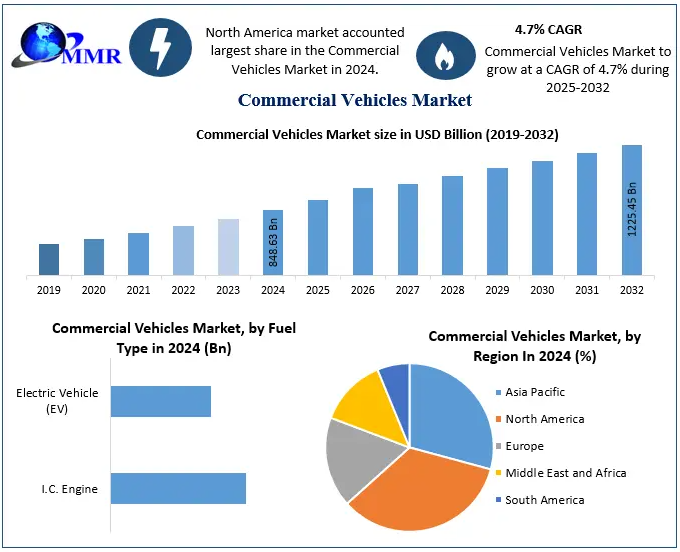
Commercial Vehicles Market Set to Reach USD 1225.45 Billion by 2032 Driven by Electrification, Infrastructure Expansion, and E-Commerce Boom
The Global Commercial Vehicles Market, valued at USD 848.63 billion in 2024, is projected to grow at a CAGR of 4.7% from 2025 to 2032, reaching a market size of USD 1225.45 billion by the end of the forecast period. The growth is fueled by the electrification of fleets, advances in transportation infrastructure, digital innovations, and the accelerating e-commerce sector.
Get A Free Sample Report:https://www.maximizemarketresearch.com/request-sample/112685/
Commercial vehicles (CVs), which include trucks, vans, buses, and coaches, are pivotal to modern transportation systems—serving logistics, construction, mining, and passenger transit sectors. As industries and economies continue to expand, so does the need for efficient commercial vehicle fleets to manage the movement of goods and people.
Electrification is revolutionizing the commercial vehicle landscape. With governments enforcing stringent emissions regulations and offering EV subsidies, businesses are increasingly adopting electric commercial vehicles (ECVs). Technological improvements in battery range and charging infrastructure are making EVs more viable, especially for urban logistics and public transportation.
India’s transport sector contributes ~14% of national CO₂ emissions, with HCVs and LCVs making up over half of that. The urgent need for zero-emission fleets is pushing EV adoption.
The US targets 30% new CV sales to be zero-emission by 2030, and 100% by 2040.
The Inflation Reduction Act in the US supports deployment of up to 1.1 million zero-emission Class 4–8 vehicles by 2030.
This movement is also transforming Mobility-as-a-Service (MaaS) sectors, enabling smarter, cleaner urban transport solutions.
Advanced technologies such as ADAS (Advanced Driver-Assistance Systems), AI-based telematics, and IoT-integrated diagnostics are improving fleet management and safety standards. These solutions support:
Real-time vehicle monitoring
Predictive maintenance
Optimized routing
Fuel efficiency tracking
The integration of digital tools not only reduces costs and downtime but also enhances the driver and customer experience, helping companies remain competitive.
Ongoing infrastructure development projects across North America, Asia Pacific, and emerging economies are boosting demand for heavy-duty trucks and construction-related CVs. With increased investments in roads, bridges, and industrial zones, the requirement for freight and utility vehicles is expected to grow steadily.
India and China are leading this growth in Asia, driven by smart city development and industrial expansion.
In North America, transport infrastructure upgrades and a well-established supply chain ecosystem are key drivers.
The rapid growth of online retail has dramatically increased the demand for light commercial vehicles (LCVs) used in last-mile delivery. As consumer expectations for same-day and next-day deliveries rise, logistics companies are expanding their CV fleets.
The trend is especially prominent in urban and semi-urban areas where cost-effective, fuel-efficient LCVs are favored.
E-commerce players are also investing in EV fleets to align with sustainability goals and reduce operating costs.
Despite a strong growth outlook, several challenges hinder the full-scale adoption of modern CVs:
High operating costs related to fuel, maintenance, and insurance, particularly for small fleet operators.
Global supply chain disruptions impacting production and availability of components.
Initial cost of electric CVs and the requirement for widespread EV charging infrastructure.
Light Commercial Vehicles (LCVs) dominated in 2024 due to their flexibility, affordability, and suitability for both goods and passenger transport. Their role in last-mile logistics, especially in densely populated countries like India, is critical.
Buses and Coaches are growing steadily (CAGR 3.1%) with rising public transportation needs and the increasing adoption of electric buses for eco-friendly urban commuting.
The Logistics segment accounted for the largest market share, driven by global trade and e-commerce.
Passenger transportation is also gaining ground, especially in urban mobility solutions, driven by lower total cost of ownership compared to personal vehicles.
To know about the Research Methodology:-https://www.maximizemarketresearch.com/request-sample/112685/
Largest market share in 2024, driven by the growing need for efficient fleet operations in logistics and freight.
Robust infrastructure, R&D hubs, and exports to over 200 countries enhance the region's market positioning.
The US is aggressively moving toward zero-emission freight corridors under the National ZEV Freight Strategy.
Fastest-growing region, led by increasing demand for CVs in logistics, warehousing, and infrastructure development.
India is a key market with rising EV adoption and extensive CV manufacturing capabilities (e.g., Tata Motors, Mahindra, Ashok Leyland).
China remains the global leader in EV production and exports, accounting for over 65% of global EV manufacturing in 2024.
Pioneering sustainability regulations—with CO₂ emission reduction targets (100% for new cars/vans by 2035).
Home to global CV leaders like Daimler, AB Volvo, and Volkswagen, Europe is heavily investing in advanced manufacturing and zero-emission technology.
General Motors
Tesla
Ford Motor Company
Rivian
GMC
Daimler AG
AB Volvo
Volkswagen AG
Bosch Rexroth AG
Toyota Motor Corporation
Tata Motors
Mahindra & Mahindra
Isuzu Motors
Ashok Leyland
VE Commercial Vehicles
Golden Dragon
These companies are focusing on sustainable product development, partnerships for fleet electrification, and technology integration to stay ahead in an increasingly competitive market.
The Global Commercial Vehicles Market is at a transformative crossroads. Driven by fleet electrification, urban infrastructure growth, technological innovation, and the e-commerce explosion, the sector is poised for robust expansion through 2032.
However, tackling high operating costs, production challenges, and ensuring infrastructure readiness for EVs will be critical to unlocking the market’s full potential. Companies investing in digital ecosystems, zero-emission technologies, and customer-centric models will lead the next era of commercial mobility.