x




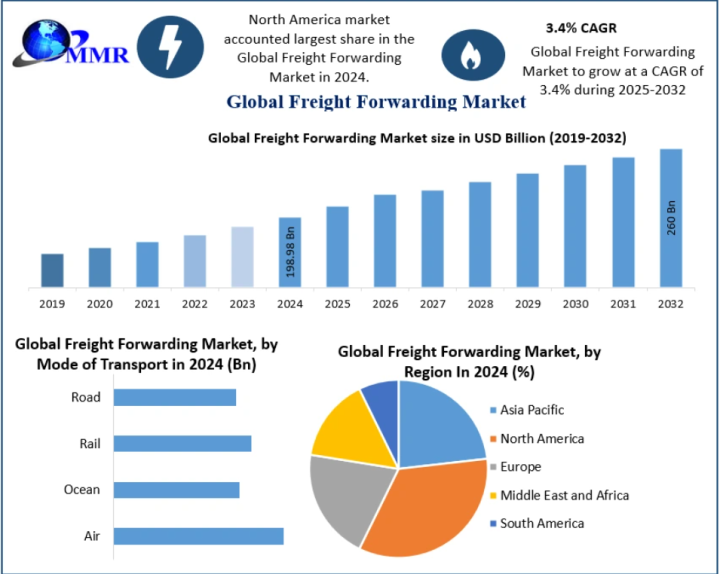
The global Freight Forwarding Market, valued at USD 198.98 billion in 2024, is set to expand steadily over the next decade. With a projected compound annual growth rate of 3.4 percent from 2025 to 2032, the market is expected to reach nearly USD 260 billion by the end of the forecast period. This growth is underpinned by rising international trade, expanding e-commerce, and the integration of advanced technologies such as artificial intelligence in logistics.
Freight forwarding involves the strategic coordination and transportation of goods across international borders, utilizing multiple carriers such as air, ocean, rail, and road. A freight forwarder manages the end-to-end logistics, ensuring that goods are moved efficiently, economically, and in proper condition. Their tasks range from negotiating freight rates and preparing customs documentation to consolidating shipments and tracking container movements.
As globalization continues to evolve, the need for seamless, tech-enabled logistics solutions has become crucial. Freight forwarders play an essential role in supporting global trade by ensuring that goods move on time and at optimal cost.
For in-depth information on this study, visit the following link:https://www.maximizemarketresearch.com/request-sample/148362/
New trade agreements are opening up opportunities for cross-border commerce, driving demand for freight forwarding services. One of the key developments is the Regional Comprehensive Economic Partnership, which eliminates tariffs on 90 percent of goods traded among 15 East Asian and Pacific nations. Trade among these members already exceeds USD 2.3 trillion, and tariff reductions are expected to boost exports by an additional USD 42 billion.
Artificial intelligence is transforming the freight forwarding industry by automating processes and enhancing real-time decision-making. AI helps optimize shipping routes, compare freight rates, and forecast demand. For example, Kuehne + Nagel’s platform eTrucknow uses AI to evaluate shipment data and suggest cost-efficient freight options, streamlining operations for shippers across the Asia Pacific region.
Air freight forwarding witnessed a year-on-year growth of nearly 15 percent in 2022 and is projected to grow at a CAGR of 5.4 percent. Ocean freight, which accounts for the largest share of global cargo transport, is also expanding steadily at around 4.5 percent annually. Pharmaceutical logistics and cross-border e-commerce are expected to drive this upward trend, especially in the Asia Pacific and North America regions.
The global rise in e-commerce is creating massive demand for fast and efficient freight services. Air freight has become especially important for fulfilling online orders, with e-commerce accounting for 15 percent of air freight trade volume and 18 percent of air cargo revenue. By 2022, this figure was expected to rise to 22 percent. Global online retail sales grew by over 27 percent in 2021, reaching USD 4.28 trillion. Major e-commerce-driven markets include China, South Korea, the United Kingdom, and the United States.
One of the key challenges in the freight forwarding industry is the growing shift toward nearshoring and reshoring. As manufacturers move production closer to home to mitigate supply chain risks, the demand for long-distance international shipping may decline in some sectors. This trend, while beneficial for domestic logistics, poses a challenge for global freight forwarders that rely heavily on international trade flows.
Ocean freight currently dominates the market with a 43 percent share. The segment continues to grow due to rising internet penetration, cost-efficiency, improved port infrastructure, and increasing demand from the e-commerce industry. The rising cost of air freight is also prompting companies to turn to maritime options for bulk shipments.
Freight forwarding serves a wide range of industries, including industrial manufacturing, healthcare, automotive, electronics, oil and gas, and food and beverages. Pharmaceuticals saw increased demand during the COVID-19 pandemic and now account for approximately 2.2 percent of traded goods. Cars remain the most traded product globally, with Germany and Japan leading the automotive export sector.
The market is divided into business-to-business (B2B) and business-to-consumer (B2C) categories. B2B remains dominant, but the B2C segment is growing rapidly due to the explosion in e-commerce and cross-border retail transactions.
Freight forwarding services include transportation and warehousing, packaging and documentation, insurance, and various value-added services. The demand for end-to-end logistics solutions is increasing as businesses seek greater visibility and efficiency throughout the supply chain.
To access more details regarding this research, visit the following webpage:https://www.maximizemarketresearch.com/request-sample/148362/
North America accounted for 32 percent of the global freight forwarding market in 2024, led by the United States. The US maintains strong trade relations with over 30 countries, accounting for the majority of its import and export volume. Despite having just 4.5 percent of the global population, the US contributes approximately 20 percent of global GDP, underscoring its dominant role in international trade.
Asia Pacific is the fastest-growing region, thanks to booming trade activity in China, India, and Southeast Asian nations. The region benefits from robust infrastructure development, government support for logistics, and a rapidly expanding e-commerce sector. Trade relationships such as those between India and the US, or India and China, continue to drive freight forwarding growth. Strategic investments such as Kuehne + Nagel’s USD 1.5 billion acquisition of Apex International highlight the growing importance of the region.
European countries like Germany and the Netherlands remain central hubs for freight forwarding in the EU. South America and the Middle East are emerging regions, increasingly targeted for investment due to favorable trade policies and infrastructure modernization.
The freight forwarding market is highly competitive, with several multinational logistics providers offering integrated supply chain solutions. Key players include:
Agility
Bolloré Logistics
CEVA Logistics
Sinotrans India Private Limited
DB Schenker
DHL Global Forwarding
Imerco
Dachser
DSV Panalpina
Expeditors International
Hellmann Worldwide Logistics
Kuehne + Nagel International
Manitoulin Global Forwarding (MGF)
Nippon Express
UPS Supply Chain Solutions
These companies continue to invest in digital transformation, sustainability, and regional expansion to maintain their market positions.
The freight forwarding market is poised for steady growth through 2032, driven by global trade expansion, technological innovation, and the surge in e-commerce. Although geopolitical uncertainties and nearshoring trends may pose challenges, the continued development of smart logistics platforms and integrated supply chain services will help companies adapt and thrive. As the world becomes increasingly interconnected, the role of freight forwarders remains critical in ensuring that goods flow efficiently across borders.