x




Positron Emission Tomography (PET) Scanners Market: Advancing Precision Diagnostics Globally (2025–2032)
Market Overview
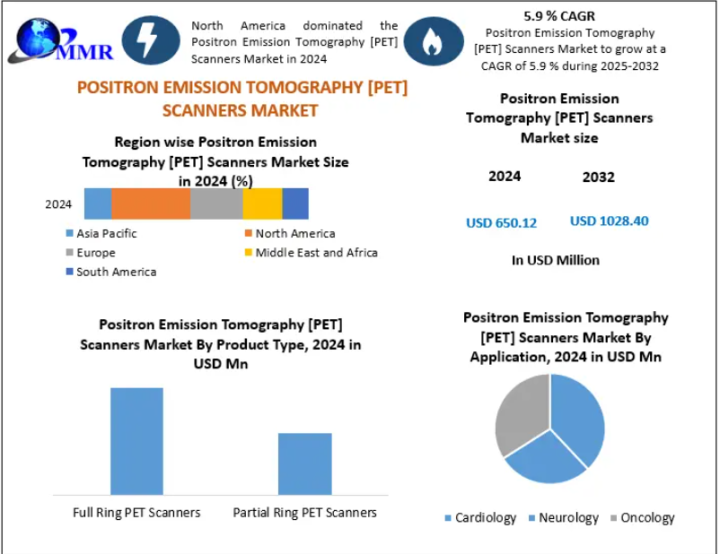
The global Positron Emission Tomography (PET) Scanners Market is experiencing steady growth as advanced diagnostic imaging becomes increasingly critical in modern healthcare. Valued at USD 650.12 million in 2024, the market is projected to grow at a CAGR of 5.9% from 2025 to 2032, reaching nearly USD 1,028.40 million by the end of the forecast period.
PET scanners are specialized medical imaging devices that provide insight into the metabolic and functional activity of tissues and organs. Unlike traditional imaging modalities that reveal structural abnormalities, PET scans use radioactive tracers to detect early disease activity, enabling timely diagnosis and intervention. This makes PET imaging an indispensable tool in oncology, cardiology, and neurology, as well as for clinical research and therapeutic monitoring.
Get a sample of the report@https://www.maximizemarketresearch.com/request-sample/104613/
Market Drivers
Rising Prevalence of Chronic Diseases and Cancer
The increasing incidence of cancer, cardiovascular disorders, and neurological conditions is driving demand for PET scanners. According to the American Cancer Society, over 1.7 million new cancer cases were expected in the United States in 2021, underscoring the urgent need for high-precision diagnostic tools.
Integration with Advanced Imaging Modalities
PET technology is increasingly combined with CT and MRI, enhancing diagnostic accuracy by correlating metabolic activity with anatomical detail. Innovations like the EXPLORER total-body PET scanner have demonstrated the ability to capture high-quality images with lower radiotracer doses, improving patient safety while accelerating scan times.
Government Reimbursements and Healthcare Investments
In many developed nations, Medicare and other insurance coverage for PET scans have expanded accessibility, encouraging hospitals and imaging centers to adopt advanced PET systems. Additionally, growing investments in hospital infrastructure and cancer centers support widespread deployment of PET scanners.
Market Restraints
Radiopharmaceutical Limitations
The primary radiotracer used in PET scans, fluorine-18 labeled deoxyglucose (FDG), has a short half-life of under two hours, limiting its logistical flexibility and diagnostic window. This constraint poses challenges for facilities located far from production centers.
Reimbursement Challenges
Continuous cuts in medical reimbursements and high capital costs of PET scanners can restrict adoption, particularly in smaller clinics and emerging markets.
Segment Insights
By Product Type
By Application
By End User
Get a sample of the report@https://www.maximizemarketresearch.com/request-sample/104613/
Regional Insights
North America – Market Leader
North America dominates the PET scanner market due to advanced healthcare infrastructure, strong awareness of imaging benefits, and supportive reimbursement policies. The United States accounts for a significant portion of the regional market, driven by high cancer prevalence, aging population, and adoption of next-generation PET technologies.
Europe and Asia Pacific – Growth Regions
Europe maintains steady growth, supported by early adoption of innovative PET systems and strong regulatory frameworks.
Asia Pacific is projected to grow at a high CAGR, fueled by expanding hospital networks, rising geriatric population, and increasing investments in medical imaging infrastructure. Countries like China, India, and Japan are emerging as key markets for PET scanner adoption.
Competitive Landscape
The PET scanners market is highly competitive, featuring global leaders focusing on technological innovation, strategic partnerships, and service expansion:
These companies compete through innovation, reliability, regulatory compliance, and regional presence, striving to provide faster, more accurate, and safer imaging capabilities.
Recent Developments
Key Trends
Market Outlook
The Positron Emission Tomography scanners market is set for steady growth, propelled by rising cancer incidence, technological innovation, and an aging global population. As healthcare systems increasingly emphasize early detection, precision diagnostics, and personalized treatment, PET scanners will become an indispensable component of modern medical imaging. Providers who combine innovative imaging technology, operational efficiency, and broad geographic reach are poised to lead the market through 2032.