x




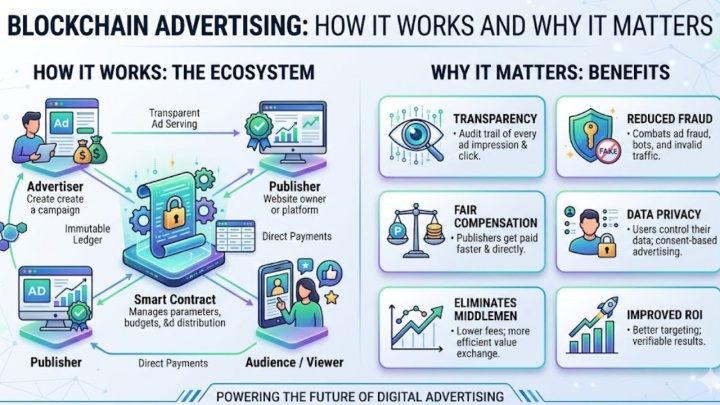
Blockchain Advertising: Why It Matters
Digital ads have a trust problem.
Brands want real users. Publishers want fair pay. Readers want more privacy. The old system often misses all three.
That is why blockchain in advertising keeps getting attention.
It offers a new way to track ad spending, verify impressions, and reduce data abuse. It does not fix every problem. Still, it can improve how ad money moves and how campaigns are measured.
This is the key shift.
A blockchain is a shared digital record. It stores data across many computers. That makes it harder to alter records in secret.
For digital ads, that can help in simple ways:
• clearer campaign records
• fewer hidden middlemen
• better fraud checks
• stronger payment trails
• more user control over data
That is why blockchain advertising is no longer just a theory. It is already showing up in live ad products, crypto-native networks, and privacy-first browsers.
The current ad market is huge. It is also messy.
A single campaign can pass through many hands. Agencies, demand platforms, supply platforms, data vendors, and exchanges may all take a cut. That adds cost. It also makes it harder to know what really happened.
This is where blockchain advertising becomes useful.
A shared ledger can show who placed the ad, who served it, and when payment moved. That does not remove every dispute. It does reduce blind spots.
Privacy is the second problem.
Many users are tired of third-party tracking. They do not want every click turned into a profile. A more privacy-first model can let users opt in, opt out, or choose what they share.
That is a big reason people now search blockchain for advertising and blockchain and advertising together. They want a system that is not built only on hidden tracking.
You can also see how blockchain is improving trust in online payments by supporting more secure transactions in e-commerce systems.
Let’s keep it simple.
A blockchain advertising setup can record ad events in a shared system. Those events may include impressions, clicks, budgets, settlement data, or campaign rules.
That creates a clearer trail.
Smart contracts can also help. A smart contract is code that runs agreed terms automatically. In ads, it can release payment only when certain conditions are met.
For example:
• a campaign goes live
• a verified impression happens
• a click meets quality rules
• payment clears to the publisher
• a report updates for both sides
That is the practical side of blockchain advertising.
The goal is not hype. The goal is cleaner delivery, better reporting, and less fraud. That is the real blockchain impact on advertising.
To understand where this space is heading next, explore how emerging blockchain trends are shaping the future of digital finance.
Privacy is one of the biggest reasons this topic matters.
Many ad systems still depend on large data collection. That can feel intrusive. It can also create legal and trust risks.
A better model gives users more control, which is one of the key benefits of blockchain advertising.
Some new systems try to match ads on the device, not on a central server. Others reward users for opting in. Some simply remove third-party trackers and use first-party or contextual signals instead.
That is why blockchain in digital advertising often overlaps with privacy talk.
You can also explore how blockchain improves financial transparency through concepts like triple-entry accounting in modern systems.
The strongest models do three things:
• limit hidden tracking
• give users a choice
• make data use easier to audit
Readers care about that.
Brands should care too. Trust is now a real performance factor.
Fake clicks waste money.
Bot traffic wastes even more.
Ad fraud is one of the biggest drains in digital media. Brands may pay for impressions that were never seen by a real person. Publishers may also lose trust if buyers think traffic quality is poor.
This is where blockchain ad network models try to stand out.
A shared record can help verify what happened and when. It can also make settlement easier to trace. That does not mean every blockchain-based network is fraud-free. It does mean the audit trail can be much stronger.
That is a meaningful change.
In old ad pipelines, proof may sit across many dashboards. In a cleaner model, more of the record sits in one shared, checkable flow.
That is a real gain for blockchain advertising .
Several live platforms now show how this model can work.
Some focus on privacy. Some focus on ad settlement. Some focus on crypto-native audiences. Together, they show what blockchain advertising platform ideas look like in the real market.
Here are strong examples to watch:
• Brave Ads
• AdEx
• Alkimi
• Adshares
• NYIAX
• Blockchain-Ads
• Coinzilla
• Bitmedia
Each one tackles a different part of the problem.
That matters because blockchain advertising is not one product type. It includes browsers, exchanges, ad networks, programmatic tools, and publisher payment rails.
Brave is one of the clearest live examples.
Its ad model is built around user choice. Users can browse with tracking blocked by default, then opt in to privacy-focused ads if they want.
That is a major change from old web ads.
In the Brave model, ads do not depend on the same third-party tracking logic many users now dislike. The system is better known for privacy, consent, and user rewards.
That makes Brave important to any article about blockchain advertising.
It also shows a broader lesson. A blockchain-linked ad model does not need to look like a normal display network. It can begin with the browser itself.
AdEx has long been one of the better-known names in web3 ad tech.
It focuses on modern ad delivery for crypto and web3 campaigns. The platform has also expanded its product direction in recent years, which keeps it relevant in the current market.
Alkimi takes a different route.
It presents itself as an on-chain ad exchange built to reduce middlemen and create a cleaner supply path. That is a direct answer to one of ad tech’s oldest complaints: too many layers between buyer and publisher.
These two names matter because they push blockchain adtech beyond theory.
They are not talking only about token rewards. They are talking about infrastructure.
Adshares is one of the clearest blockchain-first ad examples.
It positions itself as a full blockchain layer for ad settlement and decentralized ad networks. That gives it a stronger infrastructure angle than many simple crypto traffic sellers.
NYIAX is different again.
It brings a marketplace angle to media contracts and ad inventory management. Its pitch centers on trust and transparency in how advertising agreements are handled.
These examples matter for a simple reason.
They show that blockchain advertising ideas can touch more than banners. They can also affect media trading, settlement logic, and inventory records.
That is where the concept gets more serious.
Not every example needs to rebuild ad tech from scratch.
Some current networks use crypto-native targeting, wallet signals, or web3 audience data to improve campaign performance. That is where names like Blockchain-Ads, Coinzilla, and Bitmedia become relevant.
These platforms focus on reach and targeting.
They help crypto brands find users who already understand wallets, tokens, DeFi, or exchanges. That can improve campaign fit compared with generic mass-market traffic.
This is useful for digital ads for crypto.
A crypto exchange, wallet, or token launch often needs very different audiences than a normal e-commerce brand. A specialized network can help bridge that gap.
That is why these names belong in a modern blockchain advertising discussion.
Brands do not care about buzzwords.
They care about clearer results.
A better blockchain-based ad model can help brands in several ways:
• clearer budget tracking
• fewer hidden fees
• stronger fraud checks
• better publisher verification
• more relevant crypto-native reach
• more privacy-safe audience models
That is the upside.
It also helps brands explain campaign performance to teams, finance staff, and clients. A cleaner audit trail makes media spend easier to defend.
That matters more every year.
Users want fewer creepy ads.
Publishers want fairer revenue.
Blockchain-based models can help both sides when the design is right. Some systems reward users for attention. Some reduce tracker load. Some improve payout logic for publishers.
Those are real gains.
A publisher may benefit from faster settlement and clearer revenue records. A user may benefit from more control, less invasive tracking, or better ad relevance.
This is where blockchain advertising databases become interesting.
The value is not just “stored on chain.” The value is shared proof, cleaner flows, and less room for silent manipulation.
If you want to reach a crypto-focused audience, you can explore ICO Announcement advertising opportunities tailored for blockchain and web3 brands.
This field is not perfect.
Some projects in blockchain advertising are still early. Some overpromise. Some use “blockchain” as a label more than a working advantage.
That is why you should stay careful.
Real limits still exist
• user adoption can be slow
• crypto payments add volatility
• regulation can change
• reporting standards still vary
• some platforms remain niche
• mainstream buyers may resist new tools
So yes, blockchain in programmatic advertising has promise.
No, it is not a finished story.
The better view is this: blockchain can improve parts of digital advertising now, while the wider market catches up over time.
The future of digital ads will not be built on one tool alone.
Still, blockchain has a clear role to play. It can improve transparency. It can reduce fraud. It can give users more control. It can help publishers and brands trust the numbers they see.
That is why blockchain advertising matters.
The strongest proof is no longer only in white papers. It is in live examples like Brave Ads, AdEx, Alkimi, Adshares, NYIAX, Blockchain-Ads, Coinzilla, and Bitmedia.
That is enough to take the topic seriously.
Not because blockchain will replace all ad tech tomorrow. Because it already offers a better path for some of the web’s oldest advertising problems.
To stay updated on how blockchain advertising continues to evolve across industries, you can follow the latest blockchain news and insights from the crypto space.
Disclaimer: This article is for general education only. It is not legal, financial, tax, investment, or marketing compliance advice. Ad-tech rules, privacy law, token use, platform terms, and measurement standards can change quickly. Before using any blockchain advertising platform, review its data practices, targeting rules, payment model, fraud controls, and the laws that apply in your target markets.