x




Market Overview:
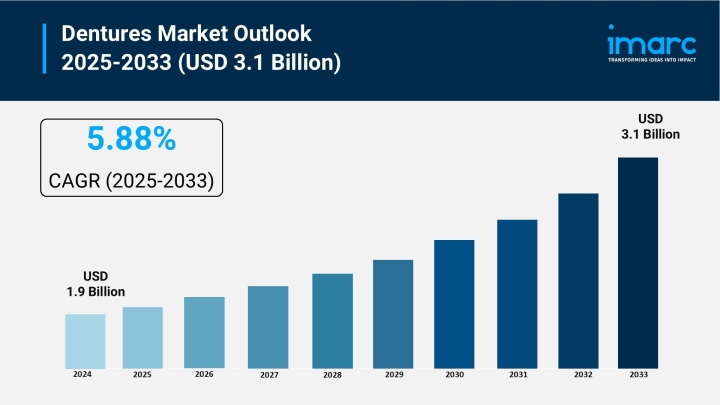
The Dentures Market is experiencing robust growth, driven by Rapidly Aging Global Population, Rising Prevalence of Dental Disorders and Oral Diseases and Technological Advancements in Materials and Manufacturing. According to IMARC Group's latest research publication, "Dentures Market: Global Industry Trends, Share, Size, Growth, Opportunity and Forecast 2025–2033", The global dentures market size reached USD 1.9 Billion in 2024. Looking forward, IMARC Group expects the market to reach USD 3.1 Billion by 2033, exhibiting a growth rate (CAGR) of 5.88% during 2025-2033.
This detailed analysis primarily encompasses industry size, business trends, market share, key growth factors, and regional forecasts. The report offers a comprehensive overview and integrates research findings, market assessments, and data from different sources. It also includes pivotal market dynamics like drivers and challenges, while also highlighting growth opportunities, financial insights, technological improvements, emerging trends, and innovations. Besides this, the report provides regional market evaluation, along with a competitive landscape analysis.
Download a sample PDF of this report: https://www.imarcgroup.com/dentures-market/requestsample
Our Report Includes:
Growth Factors in the Dentures Industry:
The growth of the aging population worldwide is the leading factor driving the global denture market, as older adults are more prone to tooth loss and oral diseases. As life expectancy increases, the demand for partial and complete dentures rises, so that the older population can preserve dentition (functionally and aesthetically). In elderly adults, problems such as bone resorption, the development of inefficient chewing, and diseases that increase the risk of caries are more pronounced. As life expectancy continues to increase in European, Japanese, and North American countries, the demand for improved dentures in these regions is expected to provide long-term growth opportunities for companies involved in denture manufacturing.
Dental disease commonly causes human illness and disability around the world, and millions require prosthetic replacement each year. Poor oral hygiene, lifestyle diseases, and systemic diseases, with diabetes included, are major risk factors for tooth loss. High sugar, refined foods, and tobacco consumption can worsen the oral health status of people of all ages. WHO states about 3.5 billion people across the globe live with some kind of oral disease. Dentures play an important role in restoring oral function and esthetics, and in handling the growing burden of dental disease worldwide, denture use is critical.
The market for dentures has been transformed through digital dentistry, advances in material science, and precision engineering. New highly biocompatible resins, high-performance polymers and lightweight metal frameworks are replacing customary acrylic dentures, reducing the weight of the denture, and increasing comfort and longevity. The introduction of computer-helped design and computer-helped manufacture technologies allows for more accurate dentures requiring fewer adjustment visits. The ability to 3D print dentures for delivery on the same day and reduced production costs are starting to close the divide in affordability and quality. As the technology becomes increasingly utilized in the dental industry, the goal of lower costs and faster turnaround times can be achieved.
Key Trends in the Dentures Market
Digital dentistry is changing how dentures are manufactured and distributed, replacing customary impressions with intraoral scans and using virtual articulation to improve bite alignment. The development of CAD/CAM systems, 3D printing, and AI-based design software has improved speed and precision of denture construction, and reduced need for multiple visits. These technologies allow for customization of fit, comfort, and wear of the prostheses, reduced waste, and better production scaling. The speed, accuracy, and fit also create a benefit for the patient, and represent the future of the manufacturing process and how patients will receive dentures as dentistry continues to move toward digitization.
More patients are opting for implant-supported dentures due to the improved retention, stability and function. Unlike customary removable dentures, an implant-supported denture is attached to the jaw via dental implants. Over time, they can improve chewing, speech, and oral health, through slowing or preventing bone resorption. Dental tourism (travel for dental care) within countries such as Mexico, India, and Turkey has made these implant-supported options more affordable. Younger denture wearers and older people remaining more active, have driven the search for new hybrid options that claim to be more like natural teeth, with improved long-term durability and lifestyle fit.
There is a growing preference for high-end, customized denture solutions tailored to individual needs. Patients are demanding dentures that not only restore function but also deliver superior aesthetics, comfort, and biocompatibility. Premium options include flexible dentures, metal-free alternatives, and lifelike designs crafted with advanced polymers. Cosmetic appeal plays a major role, as patients prioritize natural-looking smiles to improve confidence and quality of life. Denture manufacturers are responding by investing in personalized workflows, leveraging AI-driven design and patient-specific modeling. This customization trend highlights a shift from standard prosthetics to premium, value-driven solutions, especially in affluent urban markets worldwide.
Our report provides a deep dive into the dentures market analysis, outlining the current trends, underlying market demand, and growth trajectories.
Leading Companies Operating in the Global Dentures Industry:
Dentures Market Report Segmentation:
Breakup by Type:
The market is segmented into complete and partial dentures, with complete dentures accounting for the majority of the market share due to their widespread adoption among individuals with full tooth loss.
Breakup by Usage:
Based on usage, the market is divided into removable and fixed dentures, where removable dentures dominate the industry owing to their affordability, convenience, and adaptability.
Breakup by End Use:
Dental clinics represent the largest segment as they serve as the primary point of care for denture consultation, fitting, and ongoing maintenance services.
Market Breakup by Region:
North America leads the global dentures market due to its large aging population, advanced healthcare infrastructure, high healthcare spending, and widespread adoption of advanced dental technologies.
Note: If you require specific details, data, or insights that are not currently included in the scope of this report, we are happy to accommodate your request. As part of our customization service, we will gather and provide the additional information you need, tailored to your specific requirements. Please let us know your exact needs, and we will ensure the report is updated accordingly to meet your expectations.
About Us:
IMARC Group is a global management consulting firm that helps the world’s most ambitious changemakers to create a lasting impact. The company provide a comprehensive suite of market entry and expansion services. IMARC offerings include thorough market assessment, feasibility studies, company incorporation assistance, factory setup support, regulatory approvals and licensing navigation, branding, marketing and sales strategies, competitive landscape and benchmarking analyses, pricing and cost research, and procurement research.
Contact Us:
IMARC Group
134 N 4th St. Brooklyn, NY 11249, USA
Email: sales@imarcgroup.com
Tel No:(D) +91 120 433 0800
United States: +1–201971–6302