x




Market Overview:
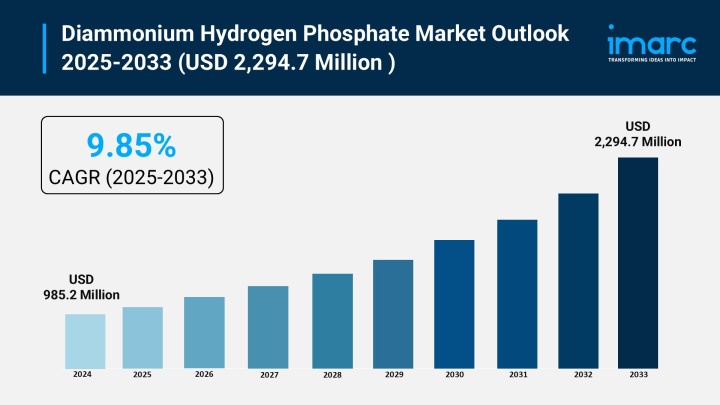
The diammonium hydrogen phosphate market are experiencing rapid growth, driven by government subsidy frameworks and financial support, strategic international supply and trade agreements, and domestic capacity expansion and backward integration. According to IMARC Group's latest research publication, "Diammonium Hydrogen Phosphate Market Report by Application (Fertilizer, Food and Beverages, Fire Retardant, and Others), and Region 2025-2033", The global diammonium hydrogen phosphate market size reached USD 985.2 Million in 2024. Looking forward, IMARC Group expects the market to reach USD 2,294.7 Million by 2033, exhibiting a growth rate (CAGR) of 9.85% during 2025-2033.
This detailed analysis primarily encompasses industry size, business trends, market share, key growth factors, and regional forecasts. The report offers a comprehensive overview and integrates research findings, market assessments, and data from different sources. It also includes pivotal market dynamics like drivers and challenges, while also highlighting growth opportunities, financial insights, technological improvements, emerging trends, and innovations. Besides this, the report provides regional market evaluation, along with a competitive landscape analysis.
Download a sample PDF of this report: https://www.imarcgroup.com/diammonium-hydrogen-phosphate-market/requestsample
Our report includes:
Growth Factors in the Diammonium Hydrogen Phosphate Market
Global government interventions are a primary driver for the diammonium hydrogen phosphate (DAP) market, particularly in agrarian economies where input affordability is a matter of national security. In January 2026, the Government of India significantly enhanced the Nutrient-Based Subsidy for DAP to approximately ₹29,805 per metric tonne, up from the previous season's ₹21,911 per metric tonne. This strategic financial backing is designed to insulate farmers from international price volatility and ensure a steady supply for critical cropping cycles like the Rabi season. Such initiatives are mirrored globally; for example, major consuming regions in Southeast Asia and Africa continue to implement price-capping and direct-to-farmer support programs. These policies stabilize the market by maintaining high consumption rates even when the cost of raw materials—such as phosphoric acid and sulfur—fluctuates in the global commodities market, thereby securing the financial viability of DAP for large-scale agricultural operations.
The reliability of the DAP market is increasingly anchored by long-term bilateral trade agreements that bypass the uncertainties of spot-market fluctuations. A landmark development in early 2026 saw Indian fertilizer giants—including Indian Potash Limited (IPL) and Chambal Fertilisers—secure a five-year contract with Saudi Arabia’s Ma’aden for the annual supply of 3.1 million metric tonnes of DAP. This agreement follows a year where imports from Saudi Arabia had already grown to 1.9 million metric tonnes, reflecting a trend toward consolidated, reliable trade corridors between major producers and high-demand nations. These partnerships are essential for countries with limited phosphate rock reserves, as they ensure a consistent flow of nutrients for staple crops like wheat and corn. By locking in volumes and establishing joint working groups for mineral exploration, these activities provide the structural backbone for global market expansion and supply chain resilience in a geopolitically complex environment.
Major manufacturers are aggressively scaling their internal production capabilities and securing raw material feeds to gain competitive advantages in the DAP sector. In 2026, firms like Madhya Bharat Agro Products are executing substantial capacity expansions, with NPK and DAP targets rising from 240,000 metric tonnes to a proposed 990,000 metric tonnes. Crucially, this growth is supported by a 460% increase in captive sulfuric acid production, which is a vital intermediate for processing phosphate rock. This shift toward backward integration allows companies to minimize dependence on imported intermediates and improve their margin resilience. On a global scale, the industry is witnessing a trend where large players are rehabilitating underutilized units and commissioning new greenfield plants to meet the needs of an expanding population. These corporate activities ensure that the physical availability of high-purity diammonium hydrogen phosphate keeps pace with the increasing nutritional demands of modern, intensive farming systems.
Key Trends in the Diammonium Hydrogen Phosphate Market
A transformative shift is occurring as the industry moves away from traditional bulk granules toward advanced nano-scale fertilizers. Led by innovations from the Indian Farmers Fertiliser Cooperative (IFFCO), nano DAP is gaining rapid traction because it offers significantly higher nutrient use efficiency. While conventional DAP often suffers from low phosphorus mobility in soil, the nano-variant is delivered in a liquid form that plants can absorb more readily through their leaves and roots. In the current 2024–2025 cycle, production targets have reached 200 million bottles of nano DAP, reflecting a massive scaling of this technology. This trend is driven by the need to reduce the sheer volume of material handled and applied, as one small bottle can often replace several bags of traditional fertilizer. Real-world applications show that these formulations not only cut transportation and storage costs but also minimize the environmental runoff that typically plagues conventional phosphate applications.
The application of DAP is no longer a "one-size-fits-all" process, as satellite-guided nutrient management and Artificial Intelligence (AI) become standard in modern farming. In 2026, digital platforms are being used to create field-specific maps that dictate variable-rate applications of DAP based on real-time soil health data. This precision ensures that phosphate is only applied where it is needed most, which is critical since phosphorus tends to remain stationary in the soil profile. Companies are now providing digital advisory services that integrate weather patterns and crop growth models to recommend the exact timing for DAP application. Studies in 2026 indicate that these AI-driven tools can boost crop yields by up to 18% while simultaneously reducing the total volume of fertilizer required. This trend marks a move toward "smart nutrition," where technology serves as a bridge between maximizing agricultural output and maintaining long-term soil health.
While fertilizers remain the dominant segment, diammonium hydrogen phosphate is seeing increased adoption in specialized industrial and food-grade applications. In the wine and brewing industries, DAP is highly valued as a yeast nutrient that ensures complete fermentation, especially in high-gravity environments. Furthermore, its role as a fire retardant is expanding, with the compound being used to treat timber and fabrics, where it acts by forming a protective char layer that inhibits combustion. In 2026, the industrial-grade segment is also seeing growth in metal finishing and water treatment, where DAP serves as a corrosion inhibitor. This trend toward diversification provides a stable secondary revenue stream for producers, as industrial demand is less seasonal than agriculture. As safety regulations tighten globally, the demand for DAP-based flame retardants in the construction and textile sectors continues to rise, making it a versatile chemical beyond the farm.
Leading Companies Operating in the Global Diammonium Hydrogen Phosphate Industry:
Diammonium Hydrogen Phosphate Market Report Segmentation:
By Application:
Fertilizer accounts for the majority of shares on account of its pivotal role in enhancing agricultural productivity with essential nitrogen and phosphorus nutrients.
Regional Insights:
Asia Pacific enjoys the leading position owing to substantial agricultural sector driven by large population, growing food demand, and robust industrial growth requiring DAP for multiple applications.
Note: If you require specific details, data, or insights that are not currently included in the scope of this report, we are happy to accommodate your request. As part of our customization service, we will gather and provide the additional information you need, tailored to your specific requirements. Please let us know your exact needs, and we will ensure the report is updated accordingly to meet your expectations.
About Us:
IMARC Group is a global management consulting firm that helps the world’s most ambitious changemakers to create a lasting impact. The company provide a comprehensive suite of market entry and expansion services. IMARC offerings include thorough market assessment, feasibility studies, company incorporation assistance, factory setup support, regulatory approvals and licensing navigation, branding, marketing and sales strategies, competitive landscape and benchmarking analyses, pricing and cost research, and procurement research.
Contact Us:
IMARC Group
134 N 4th St. Brooklyn, NY 11249, USA
Email: sales@imarcgroup.com
Tel No:(D) +91 120 433 0800
United States: +1-201971-6302