x




Market Overview:
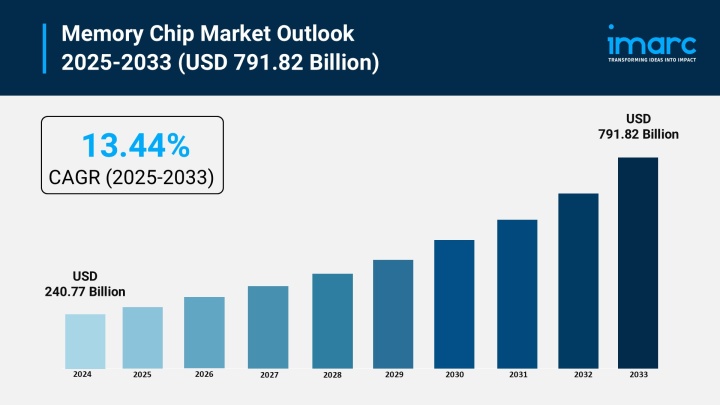
The memory chip market is experiencing rapid growth, driven by the artificial intelligence and data center boom, proliferation of connected devices and digitalization, and government initiatives and automotive electrification. According to IMARC Group's latest research publication, "Memory Chip Market Report by Type (Volatile, Non-volatile), Application (Laptop/PC, Camera, Smartphone, and Others), Sales Channel (OEM, Aftermarket), and Region 2025-2033", the global memory chip market size reached USD 240.8 Billion in 2024. Looking forward, IMARC Group expects the market to reach USD 791.8 Billion by 2033, exhibiting a growth rate (CAGR) of 13.44% during 2025-2033.
This detailed analysis primarily encompasses industry size, business trends, market share, key growth factors, and regional forecasts. The report offers a comprehensive overview and integrates research findings, market assessments, and data from different sources. It also includes pivotal market dynamics like drivers and challenges, while also highlighting growth opportunities, financial insights, technological improvements, emerging trends, and innovations. Besides this, the report provides regional market evaluation, along with a competitive landscape analysis.
Download a sample PDF of this report: https://www.imarcgroup.com/memory-chip-market/requestsample
Our report includes:
Growth Factors in the Memory Chip Market
The exponential growth in Artificial Intelligence (AI) and High-Performance Computing (HPC) is a primary driver for memory chip demand. AI models require massive computational power and, critically, extremely fast memory to handle training and inference processes efficiently. This is spurring unprecedented demand for high-speed, high-capacity memory solutions in data centers. For example, major memory manufacturers are shifting significant production capacity to focus on advanced products like High-Bandwidth Memory (HBM). This specialized memory, which stacks multiple DRAM chips vertically to maximize throughput, has become a core component of leading AI accelerators. Demand from hyperscalers for these high-end server modules is currently driving a record-breaking surge in DRAM revenues, reflecting the central role memory plays in the AI infrastructure buildout. This investment in data center infrastructure underscores the shift toward a data-centric economy.
The continuous global expansion of the consumer electronics segment, particularly in mobile devices and personal computing, relentlessly drives the memory chip market. The pervasive use of smartphones, tablets, and advanced laptops, especially in regions with rapidly developing digital infrastructures, necessitates chips that offer higher performance and superior power efficiency. Modern devices now incorporate vast amounts of data-intensive applications, requiring fast-access volatile memory like Dynamic Random-Access Memory (DRAM) and large-capacity non-volatile storage like NAND flash. The rollout of high-speed 5G network technology globally further fuels this requirement, as it enables faster data consumption and generation at the edge. The demand for memory chips in consumer electronics alone is projected to account for approximately 45 percent of the total market share in the near future, illustrating the sheer volume required to power the digital consumer base.
Government policies across key regions are now proactively supporting domestic semiconductor manufacturing, creating a stable environment for memory chip growth. Programs like the United States' CHIPS and Science Act and Europe's Chips Act have earmarked billions of dollars in grants and tax incentives to expand local fabrication and supply chain resilience. Simultaneously, the automotive sector is undergoing a transformation with the shift to electric vehicles (EVs) and the development of Advanced Driver-Assistance Systems (ADAS). These features, including autonomous driving and sophisticated in-vehicle infotainment, dramatically increase the semiconductor content per vehicle. The automotive sector, which is projected to contribute roughly 15 percent of the memory chip market, requires high-reliability memory solutions, driving significant growth in automotive-grade DRAM and NAND flash solutions that adhere to stringent safety and quality standards.
Key Trends in the Memory Chip Market
A crucial emerging trend is the pervasive integration of High-Bandwidth Memory (HBM) as the preferred solution for acceleration in data-intensive applications. HBM represents a significant architectural shift, moving away from traditional planar memory design toward a stacked, three-dimensional structure. This approach allows for ultra-fast data transfer rates and dramatically higher memory capacity in a compact form. Leading memory manufacturers have significantly increased their HBM capacity allocations, recognizing that this technology is essential for next-generation AI accelerators. For instance, the latest generations of high-performance computing GPUs and custom AI chips are being launched featuring advanced HBM variants, demonstrating an annual increase of 50–100% in DRAM content dedicated to this high-throughput technology. This trend is a direct response to the escalating data requirements of deep learning models.
The market is increasingly prioritizing advanced packaging technologies, often referred to as heterogeneous integration, which involves combining different functional chips (like logic processors and memory) into a single package. This trend is driven by the limits of scaling conventional two-dimensional chips and the need to reduce the physical distance and energy required for data transfer between components. For instance, new product architectures are featuring chips with on-package memory, where DRAM is placed directly beside the CPU or GPU, rather than on the motherboard. This integration minimizes latency and power consumption, which is critical for edge computing devices and advanced microprocessors. This technological shift toward three-dimensional integration is seen as key to unlocking the next major gains in system performance and power efficiency.
A key trend in data center infrastructure is the transition to the NVMe-oF protocol, which is transforming how storage resources are managed. Traditional storage architectures often bottleneck high-performance solid-state drives (SSDs) which rely on NAND flash memory. NVMe-oF allows networked storage devices to communicate over a high-speed fabric, enabling disaggregation of computing and storage resources. This means a server can access memory and storage across a network as if it were locally attached, dramatically improving utilization and flexibility. This trend enhances the value proposition of NAND flash, as it enables the creation of memory-intensive pools of storage accessible by many computers, supporting the growing demand for real-time data analytics and cloud-based services with high input/output operations per second (IOPS).
Our comprehensive memory chip market outlook reflects both short-term tactical and long-term strategic planning. This analysis is essential for stakeholders aiming to navigate the complexities of the memory chip market and capitalize on emerging opportunities.
Leading Companies Operating in the Memory Chip Industry:
Memory Chip Market Report Segmentation:
By Type:
The memory chip market is divided into volatile (DRAM and SRAM) and non-volatile (PROM, EEPROM, NAND Flash, and others) memory types, with volatile memory being the largest segment due to its critical role in computing devices.
By Application:
Laptops/PCs dominate the market, driven by diverse applications and increased demand from remote work and online learning, while cameras and smartphones also represent significant segments.
By Sales Channel:
The market is segmented into OEM, where memory chips are integrated during manufacturing, and aftermarket, where users replace or upgrade memory chips, fostering competition and innovation.
Regional Insights:
Asia Pacific leads the memory chip market, accounting for the largest share, supported by robust demand and advancements in technology across various sectors.
Note: If you require specific details, data, or insights that are not currently included in the scope of this report, we are happy to accommodate your request. As part of our customization service, we will gather and provide the additional information you need, tailored to your specific requirements. Please let us know your exact needs, and we will ensure the report is updated accordingly to meet your expectations.
About Us:
IMARC Group is a global management consulting firm that helps the world’s most ambitious changemakers to create a lasting impact. The company provide a comprehensive suite of market entry and expansion services. IMARC offerings include thorough market assessment, feasibility studies, company incorporation assistance, factory setup support, regulatory approvals and licensing navigation, branding, marketing and sales strategies, competitive landscape and benchmarking analyses, pricing and cost research, and procurement research.
Contact Us:
IMARC Group
134 N 4th St. Brooklyn, NY 11249, USA
Email: sales@imarcgroup.com
Tel No:(D) +91 120 433 0800
United States: +1-201971-6302