x




Market Overview:
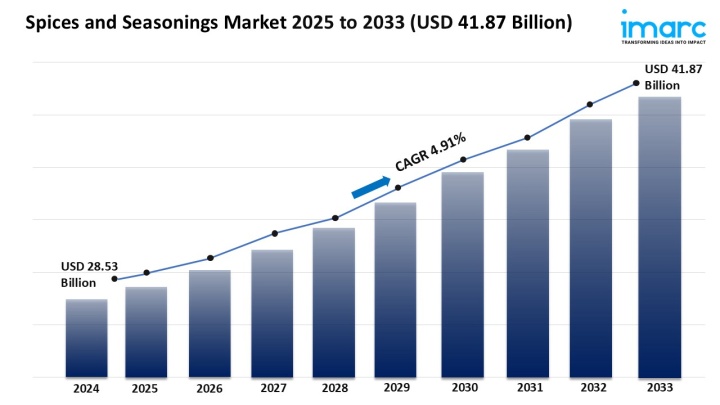
The spices and seasonings market is experiencing rapid growth, driven by consumer-led health and wellness focus, globalization of food culture and ethnic flavors, and rising demand for convenience and ready-to-use products. According to IMARC Group's latest research publication, "Spices and Seasonings Market Size, Share, Trends and Forecast by Product, Application, and Region, 2025-2033, the global spices and seasonings market size was valued at USD 28.53 Billion in 2024. Looking forward, IMARC Group estimates the market to reach USD 41.87 Billion by 2033, exhibiting a CAGR of 4.91% from 2025-2033.
This detailed analysis primarily encompasses industry size, business trends, market share, key growth factors, and regional forecasts. The report offers a comprehensive overview and integrates research findings, market assessments, and data from different sources. It also includes pivotal market dynamics like drivers and challenges, while also highlighting growth opportunities, financial insights, technological improvements, emerging trends, and innovations. Besides this, the report provides regional market evaluation, along with a competitive landscape analysis.
Download a sample PDF of this report: https://www.imarcgroup.com/spices-seasonings-market/requestsample
Our report includes:
Growth Factors in the Spices and Seasonings Market
The market is currently experiencing significant growth fueled by a profound shift in consumer preference toward natural, functional, and health-enhancing ingredients. A major portion of consumers globally is actively seeking out products that offer specific wellness benefits, which directly elevates the demand for spices like turmeric, ginger, and garlic, known for their anti-inflammatory, antioxidant, and immunity-boosting properties. This behavior is driving innovation in the retail sector, where the market for organic spices alone is showing significant growth, which is notably higher than that of conventional varieties in some regions. Furthermore, food manufacturers are increasingly replacing synthetic additives, colors, and preservatives with clean-label spice extracts to align with this health-conscious demand. This substitution has cemented the role of spices as a fundamental ingredient for both flavor and functional nutrition in contemporary diets.
The increasing exposure to global cuisines, driven by international travel, migration, and the pervasive influence of cooking media and social platforms, is a powerful engine for market expansion. Consumers in Western markets are showing a growing willingness to experiment with authentic and bold flavor profiles from cuisines like Indian, Thai, and Mexican. This has translated into a higher demand for previously niche spices such as cardamom, saffron, and various chili peppers, which are now becoming staples in diverse households. For example, the surging popularity of Hispanic flavors in the U.S. has significantly increased the consumption of ingredients like jalapeño pepper and taco seasoning mixes. This continuous culinary exploration compels major spice companies to continually expand their product portfolios to include a wider range of single-origin spices and complex, pre-mixed ethnic blends.
Changing consumer lifestyles, marked by urbanization and busy work schedules, have led to a substantial rise in demand for convenience food options, including ready-to-eat meals, snacks, and ready-to-cook mixes. Spices and seasonings are critical components in these categories, as they deliver the necessary flavor, aroma, and consistency to manufactured food products. The business-to-business (B2B) segment, which supplies food processing houses and restaurant chains, accounts for the largest share of the global market, underscoring the industry's reliance on convenience manufacturing. The growing popularity of pre-mixed spice sachets for specific ethnic dishes, which save time and guarantee a consistent flavor profile, is a clear manifestation of this convenience-driven demand, successfully attracting younger, time-pressed consumer segments like millennials in rapidly developing economies.
Key Trends in the Spices and Seasonings Market
A defining emerging trend is the integration of advanced digital technologies to ensure end-to-end supply chain transparency. Consumer concerns about product authenticity, sourcing ethics, and food safety are driving companies to implement systems that track spices from the farm to the store shelf. Several companies are adopting blockchain technology to record every transaction, processing step, and quality check for sensitive spices like turmeric and pepper. This allows B2B buyers and end consumers to verify the origin, purity, and ethical cultivation practices instantly. The move is also critical for compliance with strict international food safety and import standards, differentiating premium spice producers by offering an unprecedented level of verifiable quality and trust.
The demand for personalized eating experiences is fueling a trend toward highly customizable seasoning solutions. Consumers are moving away from generic blends and seeking tailored flavor profiles for specific dietary needs, such as low-sodium or high-protein meals, or for unique applications like vegan meat alternatives. This trend is manifesting in several ways, including the rise of direct-to-consumer online platforms offering bespoke spice blend kits. Furthermore, advancements in food technology, including AI, are being employed to analyze flavor compounds and consumer preference data to develop novel spice combinations that mimic or enhance the taste of meat in plant-based products, or even to create blends that naturally boost the perception of saltiness without increasing sodium content.
The industry is increasingly adopting cutting-edge processing techniques to maximize the flavor, color, and essential oil retention of spices, treating them as high-value, sensitive ingredients. Traditional methods are being replaced by advanced techniques like cryogenic grinding, where spices are cooled to sub-zero temperatures before milling. This prevents the heat-induced loss of volatile oils, resulting in a much finer, more aromatic, and potent powder. Concurrently, steam sterilization is becoming the standard for microbial decontamination, as it effectively cleans the spice without resorting to chemicals, thus preserving the clean-label status demanded by consumers. These technological improvements are setting a new benchmark for product quality and shelf-life across retail and industrial applications.
Leading Companies Operating in the Global Spices and Seasonings Industry:
Spices and Seasonings Market Report Segmentation:
By Product:
Spices represent the largest segment due to their widespread use across various cuisines across the globe.
By Application:
Meat and poultry products account for the majority of the market share as people use a variety of spices and seasonings to customize the taste of their meat and poultry according to personal preferences and cultural influences.
Regional Insights:
Asia Pacific dominates the market on account of the rich culinary traditions and the incorporation of spices and seasonings in traditional cuisines.
Note: If you require specific details, data, or insights that are not currently included in the scope of this report, we are happy to accommodate your request. As part of our customization service, we will gather and provide the additional information you need, tailored to your specific requirements. Please let us know your exact needs, and we will ensure the report is updated accordingly to meet your expectations.
About Us:
IMARC Group is a global management consulting firm that helps the world’s most ambitious changemakers to create a lasting impact. The company provide a comprehensive suite of market entry and expansion services. IMARC offerings include thorough market assessment, feasibility studies, company incorporation assistance, factory setup support, regulatory approvals and licensing navigation, branding, marketing and sales strategies, competitive landscape and benchmarking analyses, pricing and cost research, and procurement research.
Contact Us:
IMARC Group
134 N 4th St. Brooklyn, NY 11249, USA
Email: sales@imarcgroup.com
Tel No:(D) +91 120 433 0800
United States: +1-201971-6302