x




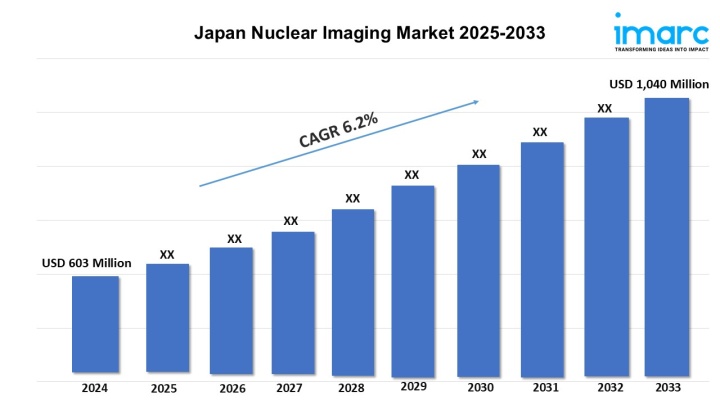
Japan Nuclear Imaging Market Size and Growth Overview (2025-2033)
Market Size in 2024: USD 603 Million
Market Forecast in 2033: USD 1,040 Million
Market Growth Rate 2025-2033: 6.2%
According to the latest report by IMARC Group, "The Japan nuclear imaging market size reached USD 603 Million in 2024. Looking forward, IMARC Group expects the market to reach USD 1,040 Million by 2033, exhibiting a growth rate (CAGR) of 6.2% during 2025-2033."
Download a sample PDF of this report: https://www.imarcgroup.com/japan-nuclear-imaging-market/requestsample
How AI is Reshaping the Future of the Japan Nuclear Imaging Market
Artificial intelligence is revolutionizing nuclear imaging by dramatically improving diagnostic accuracy through automated image analysis, anomaly detection, and quantitative assessment of radiopharmaceutical uptake patterns across diverse clinical applications. Deep learning algorithms trained on millions of SPECT and PET scans can identify subtle abnormalities in cardiac perfusion studies, detect early-stage tumors, and differentiate between benign and malignant lesions with accuracy levels matching or exceeding experienced radiologists. AI-powered image reconstruction techniques reduce radiation exposure while maintaining diagnostic quality by compensating for lower radioisotope doses through sophisticated noise reduction and resolution enhancement algorithms. Machine learning models optimize scanning protocols by predicting optimal timing, positioning, and acquisition parameters based on patient characteristics and clinical indications, thereby improving workflow efficiency and patient throughput.
The integration of AI in radiopharmaceutical development and dosimetry planning is accelerating the discovery of novel imaging agents and personalizing radiation dose calculations for individual patients. Computational models predict how new radioisotopes will distribute throughout the body, identify optimal molecular targets for specific diseases, and estimate radiation exposure to critical organs before clinical trials begin. Natural language processing systems analyze radiology reports, patient histories, and clinical notes to extract relevant information, suggest appropriate imaging protocols, and flag potential contraindications or drug interactions that could affect scan quality or patient safety. Predictive analytics identify patients at high risk for specific conditions who would benefit most from nuclear imaging procedures, enabling more targeted screening programs and earlier disease intervention.
AI-driven quality control systems continuously monitor imaging equipment performance, detecting calibration drifts, detector malfunctions, and image artifacts in real-time to ensure consistent diagnostic quality across examinations. Advanced algorithms automatically segment anatomical structures, measure organ volumes, calculate standardized uptake values, and track disease progression by comparing serial scans, providing quantitative metrics that support treatment planning and response assessment. As nuclear medicine evolves toward precision diagnostics and theranostics where the same molecular targets are used for both imaging and therapy, artificial intelligence is becoming indispensable for integrating complex multi-modal imaging data, genomic information, and clinical parameters to guide personalized treatment strategies throughout Japan's advanced healthcare system.
Japan Nuclear Imaging Market Trends & Drivers
The Japan market of nuclear imaging is prevalently driven by escalating aging population of the country and surging number of age-related CVDs, neurological disorders, and cancer requiring advanced diagnostic imaging for early detection, and treatment monitoring. Japan's universal health insurance scheme and well-developed medical system provide consistent nuclear imaging services within urban and rural medical institutions, and the cost-effectiveness of SPECT and PET scans is increasing clinical acceptance and the frequency of scans. Increasing focus on early cancer detection and personalized oncology therapy planning are fueling demand for FDG-PET scans and a host of disease-specific radiopharmaceuticals that enable molecular understanding of the disease and therapy response.
Advancements in hybrid imaging systems that integrate the functionality of PET or SPECT with CT or MRI technology are improving accuracy by capturing anatomical and functional data simultaneously during a single session. The production of new radioisotopes with enhanced imaging properties, lower radiation dose and disease specific targeting may open novel clinical applications beyond the traditional areas of cardiology and oncology into neurology, orthopaedics and infectious disease. Japan pharmaceutical firms are increasingly pursuing strategic partnerships with global organizations and research institutions to advance the development and commercialization of novel radiopharmaceuticals, and national investments in cyclotron infrastructure and radioisotope manufacturing plants are enabling a strengthening of domestic supply chains and a diminution of reliance on imported imaging agents in the nuclear medicine space in Japan.
We explore the factors propelling the Japan nuclear imaging market growth, including technological advancements, consumer behaviors, and regulatory changes.
Japan Nuclear Imaging Industry Segmentation:
The report has segmented the market into the following categories:
Breakup by Product:
Equipment
Radioisotope:
SPECT Radioisotopes:
PET Radioisotopes:
Breakup by Application:
SPECT Applications:
PET Applications:
Breakup by Region:
Request a Customized Version of This Report for Deeper Insights: https://www.imarcgroup.com/request?type=report&id=16049&flag=E
Competitive Landscape:
The market research report offers an in-depth analysis of the competitive landscape, covering market structure, key player positioning, top winning strategies, a competitive dashboard, and a company evaluation quadrant. Additionally, detailed profiles of all major companies are included.
Recent News and Developments in Japan Nuclear Imaging Market
Future Outlook
The Japan nuclear imaging industry is poised for sustained growth through 2033, driven by demographic trends, technological advancements in hybrid imaging and AI integration, and expanding clinical applications in precision medicine. The development of novel radiopharmaceuticals, improved radioisotope production capabilities, and increasing adoption of theranostic approaches will enhance diagnostic and therapeutic outcomes, solidifying nuclear imaging's essential role in Japan's advanced healthcare delivery system.
Key highlights of the Report:
Note: If you require specific details, data, or insights that are not currently included in the scope of this report, we are happy to accommodate your request. As part of our customization service, we will gather and provide the additional information you need, tailored to your specific requirements. Please let us know your exact needs, and we will ensure the report is updated accordingly to meet your expectations.
About Us:
IMARC Group is a global management consulting firm that helps the world's most ambitious changemakers to create a lasting impact. The company provides a comprehensive suite of market entry and expansion services. IMARC offerings include thorough market assessment, feasibility studies, company incorporation assistance, factory setup support, regulatory approvals and licensing navigation, branding, marketing and sales strategies, competitive landscape and benchmarking analyses, pricing and cost research, and procurement research.
Contact Us:
IMARC Group
563-13 Kamien, Iwata City Country, SHIZUOKA, JP, 4380111
+1-631-791-1145