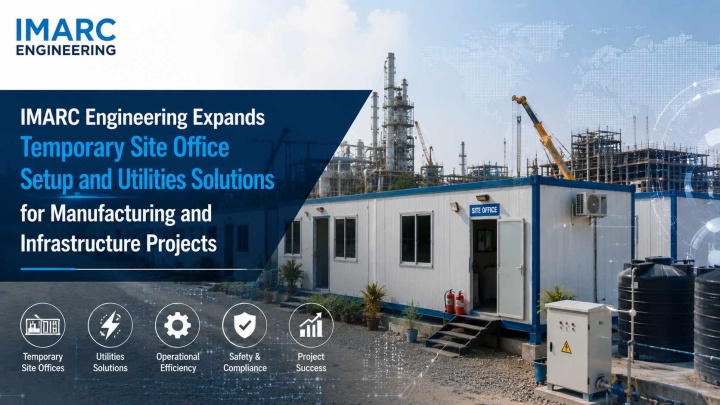
Projects avoid power, water and connectivity failures by sizing utility loads early, arranging backup before the first crew arrives, and phasing temporary infrastructure across the first 90 days. This matters because mobilisation gaps typically cascade into 2-6 months of schedule slippage as teams wait for infrastructure. India’s grid also hit a record peak demand of 270.82 GW on 21 May 2026, so utility stress is no longer limited to remote sites.
Most mobilisation failures are planning failures, not equipment failures. A load estimate is missing, a borewell approval is delayed, or a site is chosen without checking mobile signal. Planning temporary site office setup and utilities during pre-construction lets power, water and data arrive before the work front opens.
What Is the Best Way to Prevent Utility Failures at Project Start?
The most dependable approach follows five steps:
- Estimate power, water and data demand before mobilisation, not after
- Plan a primary source and a backup for every critical utility
- Apply for DISCOM, water and connectivity approvals during pre-construction
- Test every system before peak workforce arrives
- Review capacity at each construction phase
Why Do Utilities Fail During Mobilisation?
Failures usually start with four gaps:
- Late grid connection: Until the DISCOM connection is energised, sites depend on DG sets alone, typically for the first 30-60 days
- Grid stress: Evening supply gaps reached 3,045 MW in June 2026, with northern states accounting for 2,650 MW of that
- Uneven reliability: Average daily supply in FY25 was 22.6 hours in rural areas against 23.4 hours in urban areas, so remote greenfield sites face roughly 1.4 hours of daily outage on average
- Groundwater limits: Of 6,762 assessment units, 730 (10.8%) were classed as over-exploited in the 2025 assessment
How Can Projects Prevent Power Failures?
Power is the highest-risk utility because lighting, welding, offices and IT all depend on it. Typical connected loads by project size are:
- Under INR 50 crore: 50-150 kVA
- INR 50-500 crore: 150-750 kVA
- INR 500-2,000 crore: 750-2,000 kVA
- Above INR 2,000 crore: 2,000-5,000+ kVA
Load usually splits into welding and cutting (25-40%), miscellaneous equipment (25-40%), site lighting (15-25%) and offices (10-15%).
Practical safeguards:
- Apply for the temporary DISCOM connection in pre-construction, not at mobilisation
- Size DG backup against identified critical loads such as offices, safety systems and communications, not a flat percentage of connected load
- Provide higher DG capacity for the first 30-60 days before grid power is energised
- Install earthing as per CEA Safety Regulations 2010 and RCDs on portable equipment circuits
- Put the IT and server room on UPS with proper cooling
- Store diesel as per PESO provisions and manage DG noise under the Noise Pollution Rules 2000
- Run LED site lighting on poles to cut load and maintenance
How Can Projects Prevent Water Shortages?
Water failures interrupt sanitation, canteens and curing, and they also create compliance risk. Typical benchmarks are:
- Potable water: at least 5 litres per worker per day
- Total worker water including sanitation: 25-45 litres per worker per day
- Office and canteen use: 45-70 litres per person per day
At these rates, a 1,000-worker site needs roughly 25,000-45,000 litres a day for workers alone, before concrete curing or dust suppression.
Practical safeguards:
- Plan the source early: municipal connection, tankers, or a borewell that has Central Ground Water Authority approval
- Do not depend on a single borewell in stressed blocks
- Install overhead tanks, typically 5,000-25,000 litres, to buffer supply interruptions
- Test drinking water against IS 10500 before it reaches workers
- Provide chemical or bio toilets from day one, before permanent civil work is ready
- Build drainage with silt control and monsoon-sized storm drains
- Collect concrete wash water in settling ponds before disposal
How Can Projects Prevent Connectivity Failures?
Connectivity is often an afterthought, yet drawings, approvals, CCTV and reporting all depend on it. The national picture is improving but uneven:
- India had 5,18,854 5G base stations and 20,40,850 4G base stations as of 31 December 2025
- BharatNet covers 2,22,341 gram panchayats, of which 2,14,904 are service-ready
- In Q1 2026, India had 126.80 internet subscribers per 100 people in urban areas against 48.31 in rural areas
- 5G fixed wireless subscribers reached 13.21 million in July 2026, and 50.31% of them were in rural areas
Practical safeguards:
- Test mobile signal strength at the office, gate and work fronts before fixing the layout
- Use two independent links, for example fibre or 5G FWA from one operator and a different operator as failover
- Keep a satellite or alternate backhaul option for remote sites
- Provide structured cabling and a dedicated IT room instead of ad hoc routers
- Put UPS on network equipment, so a power dip does not also become a data outage
- Keep CCTV and gate systems on a separate backed-up circuit
What Should the First 90 Days of Mobilisation Include?
- Days 1-30: Perimeter security, DG-based power, tanker water, chemical toilets, owner and PMC offices, and a first internet link
- Days 30-60: Contractor offices, temporary storage, access roads, and testing of backup switchover
- Days 60-90: DISCOM connection energised, water storage commissioned, and a second data link live
Enabling infrastructure typically costs 2-5% of total project cost, while well-planned temporary infrastructure supports 15-25% higher construction productivity than reactive setup. Both figures justify early planning.
Which Compliance Requirements Apply to Site Utilities?
- The OSH Code 2020 came into force on 21 November 2025, and the OSH (Central) Rules 2026 were notified on 8 May 2026 through G.S.R. 345(E)
- Chapter XI covers building and construction worker welfare, including drinking water and sanitation
- A canteen is mandatory for 100+ workers, and a creche is mandatory where 50+ workers are employed
- Electrical safety follows CEA regulations, fuel storage follows PESO, and drainage follows SPCB conditions and NGT norms
How Can IMARC Engineering Help?
IMARC Engineering is an EPCM advisory firm that supports industrial projects from concept to commissioning. Its team assists with load and demand estimation, temporary power and DG planning, water source and storage planning, sanitation and drainage, site network planning, office layout, storage and access design, and phased transition to permanent utilities. This keeps mobilisation on the planned date and prevents early-stage failures from spilling into the construction schedule.
Conclusion
Power, water and connectivity failures at mobilisation are predictable and preventable. Projects that size loads early, secure approvals in pre-construction, build redundancy into each utility and phase infrastructure across the first 90 days start on schedule. With grid demand at record levels and rural connectivity still uneven, a documented utility plan is now a basic requirement for every industrial site.
Get in Touch With Our Team: https://www.imarcengineering.com/contact?service=temporary-site-office-setup-and-utilities
Contact Us:
IMARC Engineering
Phone: +91-120-433-0800
Email: sales@imarcengineering.com
India: C-130, Sector 2, Noida, Uttar Pradesh 201301
LinkedIn: https://www.linkedin.com/showcase/imarc-engineering/