x




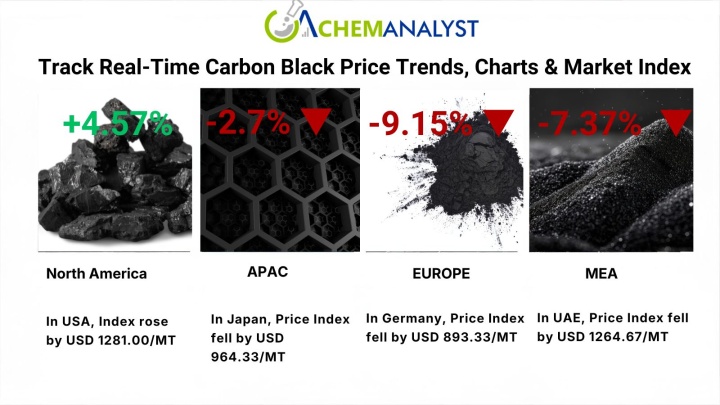
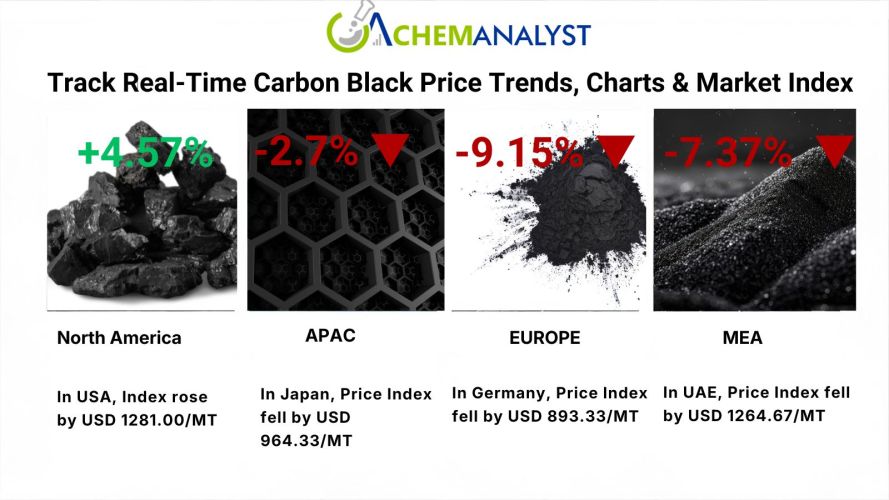
The global carbon black market entered 2026 with mixed pricing signals across major regions, as reflected in the latest Price Trend, Chart, and Index 2026 data. While North America recorded firm gains supported by domestic demand, Asia-Pacific and Europe experienced downward corrections due to ample supply and logistical adjustments. Meanwhile, the Middle East and Africa (MEA) region reflected softer sentiment amid balanced-to-long supply conditions.
Latest Carbon Black Price Trend: - https://www.chemanalyst.com/Pricing-data/carbon-black-42
Carbon black, a critical raw material used in tire manufacturing, rubber goods, plastics, coatings, and inks, remains highly sensitive to feedstock costs, downstream industrial demand, trade flows, and regional supply constraints. The first quarter of 2026 highlighted these dynamics clearly, with notable divergences across the United States, Japan, Germany, and the United Arab Emirates.
North America: U.S. Market Posts Quarterly Gains
In North America, the carbon black market demonstrated resilience during the quarter. In the United States, the Carbon Black Price Index rose by 4.57% quarter-over-quarter, reflecting supportive domestic demand and relatively steady feedstock dynamics.
The average carbon black price in the U.S. stood at approximately USD 1,281.00 per metric ton (MT) during the quarter, based on delivered mixes. This increase signaled a stable downstream demand environment, particularly from the tire and automotive sectors.
Key Drivers in the U.S.
The Carbon Black Price Trend and Chart for North America indicate a moderate but firm upward slope, suggesting that the market avoided oversupply while sustaining industrial consumption.
APAC: Japan Faces Price Correction Amid Ample Imports
In the Asia-Pacific region, pricing sentiment was comparatively softer. In Japan, the Carbon Black Price Index fell by 2.7% quarter-over-quarter, reflecting ample import supply and moderate domestic consumption.
The average carbon black price in Japan was approximately USD 964.33 per MT on a CFR Tokyo basis during the quarter. This marked a notable divergence from the upward trajectory observed in the United States.
Carbon Black Price Index 2026:- https://www.chemanalyst.com/Pricing-data/carbon-black-42
Factors Impacting Japan’s Carbon Black Market
The Price Trend and Index 2026 data show a slight downward correction rather than a sharp collapse, suggesting that the Japanese market remains fundamentally stable despite temporary oversupply.
Europe: Germany Experiences Steeper Decline
Europe recorded the most significant quarter-over-quarter price correction among the regions analyzed. In Germany, the Carbon Black Price Index declined by 9.15%, reflecting tightening logistics pressures and market imbalances.
The average carbon black price in Germany stood at USD 893.33 per MT during the quarter, particularly during tight December availability.
Underlying Causes in Germany
The Carbon Black Price Chart for Germany illustrates a sharper downward adjustment compared to APAC, indicating deeper structural adjustments within the European market.
Despite the quarterly drop, the market did not experience a collapse. Instead, the correction appears to be a recalibration following prior tightness.
MEA: UAE Market Reflects Ample Supply
In the Middle East and Africa region, pricing sentiment mirrored Europe’s softness but was less severe in scale. In the United Arab Emirates, the Carbon Black Price Index fell by 7.37% quarter-over-quarter.
The average carbon black price in the UAE was approximately USD 1,264.67 per MT, reported on a Jebel Ali basis.
Market Influences in the UAE
While prices declined, the relatively high absolute price level compared to Germany indicates that the UAE market continues to reflect strong logistical positioning and regional demand fundamentals.
Observations:
This divergence reflects the localized nature of carbon black supply-demand fundamentals, even within a globally traded commodity framework.
Role of Feedstock and Energy in 2026
Carbon black production relies heavily on heavy aromatic oils and other petroleum derivatives. As such, crude oil price movements indirectly shape production costs.
While global oil markets remained volatile, feedstock cost fluctuations were not extreme enough during the quarter to trigger major supply disruptions. Instead, regional demand variations played a larger role in determining price movements.
Energy costs remain particularly relevant in Europe, where industrial electricity and gas prices continue to influence operational margins.
Demand Outlook for 2026
Looking ahead, several themes are likely to shape the Carbon Black Price Trend and Index 2026:
Strategic Implications for Market Participants
For producers, the 2026 pricing environment underscores the importance of regional diversification and feedstock risk management. Companies operating in North America may benefit from stronger domestic pricing, while European producers may face margin pressure.
For buyers, particularly tire manufacturers and rubber processors, regional price arbitrage opportunities may emerge depending on freight and trade conditions.
Traders and distributors must monitor not only absolute price levels but also index momentum and inventory cycles.
Conclusion
The Carbon Black Price Trend, Chart, and Index 2026 reveal a market shaped by regional divergence rather than uniform global movement. The United States demonstrated resilience with a 4.57% quarterly increase, while Japan, Germany, and the UAE experienced varying degrees of correction.
At an average of USD 1,281.00/MT in the U.S., USD 964.33/MT in Japan, USD 893.33/MT in Germany, and USD 1,264.67/MT in the UAE, the data underscore how localized supply-demand fundamentals drive pricing behavior.
As 2026 progresses, stakeholders must closely track feedstock costs, automotive production trends, logistics efficiency, and trade flows. The carbon black market remains structurally essential to industrial manufacturing, ensuring that pricing dynamics will continue to reflect broader macroeconomic and sector-specific developments.
In a year defined by recalibration rather than volatility, the Carbon Black Price Trend and Index 2026 provide valuable insight into how regional fundamentals shape global commodity pricing trajectories.
Contact US:
Email-id: sales@chemanalyst.com
Phone no: +1-(332) 258 - 6602
Address: 420 Lexington Avenue, Suite 300
New York, NY
United States, 10170