x




The global glyoxal market witnessed moderate upward momentum across key regions during the latest quarter, supported by tightening supply conditions, balanced demand recovery, and evolving trade dynamics. Glyoxal, a versatile dialdehyde widely used in textiles, paper, oil & gas, and chemical intermediates, continues to experience price fluctuations influenced by feedstock costs, regional supply constraints, and downstream consumption trends.
Latest Glyoxal Price Trend: - https://www.chemanalyst.com/Pricing-data/glyoxal-1568
In North America, Asia-Pacific (APAC), and Europe, glyoxal prices demonstrated consistent quarter-over-quarter growth, reflecting a combination of supply-side pressures and stable to improving demand fundamentals.
Global Market Overview
The glyoxal market remained relatively stable but firm during the quarter, with prices increasing across major regions:
These increases highlight a synchronized upward trend globally, albeit at varying intensities, driven by region-specific factors such as import dependency, industrial demand, and export dynamics.
North America Glyoxal Market Analysis
Price Trend and Market Dynamics
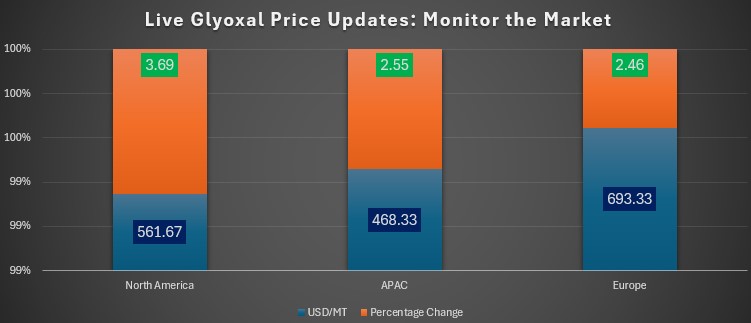
In the United States, glyoxal prices rose by 3.69% quarter-over-quarter, marking the strongest increase among the three regions analyzed. The average price during the quarter stood at approximately USD 561.67 per metric ton (MT).
This upward movement was primarily driven by:
Supply-Side Constraints
North America relies partially on imports to meet glyoxal demand. During the quarter, reduced import volumes—due to global shipping challenges and production constraints in exporting countries—tightened domestic availability.
Producers in the United States attempted to stabilize supply through inventory adjustments and increased utilization rates. However, the limited inflow of imports kept upward pressure on prices.
Glyoxal Price Index 2026: - https://www.chemanalyst.com/Pricing-data/glyoxal-1568
Demand Trends
Demand remained steady across major application sectors:
The balance between stable demand and constrained supply resulted in gradual but firm price increases.
Asia-Pacific Glyoxal Market Analysis
Price Trend and Market Dynamics
In China, glyoxal prices increased by 2.55% quarter-over-quarter, with the average price reaching approximately USD 468.33/MT.
Compared to North America, the price rise was more moderate but still indicative of strengthening market fundamentals.
Demand-Driven Growth
The key driver in China was firm overall demand, supported by:
China, being both a major producer and consumer of glyoxal, experienced a relatively balanced market scenario.
Production and Supply Conditions
Unlike North America, China maintained steady production levels, ensuring consistent domestic supply. However, several factors contributed to price increases:
These factors collectively pushed prices upward, albeit at a controlled pace.
Export Influence
China’s role as a key exporter influenced both regional and global pricing. Strong export orders, particularly from Europe and Southeast Asia, tightened domestic supply slightly, contributing to price firmness.
European Glyoxal Market Analysis
Price Trend and Market Dynamics
In Germany, glyoxal prices rose by 2.46% quarter-over-quarter, with an average price of approximately USD 693.33/MT, the highest among the regions analyzed.
Supply Tightness and Export Activity
Europe experienced tightening supply conditions, driven by:
Germany, as a major chemical manufacturing hub, saw strong export demand, which reduced domestic availability and supported higher prices.
Cost Pressures
European producers faced elevated operational costs, including:
These cost pressures were partially passed on to buyers, contributing to the upward price trend.
Demand Landscape
Demand in Europe remained stable, with key industries including:
While demand growth was not exceptionally strong, the supply-side constraints ensured that prices continued to rise.
Key Observations
Key Factors Influencing Glyoxal Prices
Glyoxal production is closely linked to upstream petrochemical derivatives. Fluctuations in feedstock prices directly impact production costs, influencing market pricing.
Global shipping delays, container shortages, and geopolitical factors have affected supply chains, particularly in import-dependent regions.
Stricter environmental policies, especially in China and Europe, have limited production capacities and increased compliance costs.
End-use industries such as textiles, paper, and chemicals play a crucial role in determining glyoxal demand. Stable industrial activity has supported consistent consumption levels.
Export-oriented markets, particularly in Europe and China, have seen reduced domestic availability due to strong overseas demand.
Market Outlook and Pricing Intelligence (2026)
Short-Term Outlook
In the near term, glyoxal prices are expected to remain firm to slightly bullish, supported by:
Medium-Term Forecast
Looking ahead into 2026, several trends are likely to shape the glyoxal market:
China and other Asian countries may increase production capacity, potentially easing global supply constraints.
If energy prices stabilize in Europe, production costs may moderate, reducing upward pressure on prices.
Rising industrialization in Southeast Asia and Latin America could drive additional demand for glyoxal.
Increasing focus on environmentally friendly chemicals may influence production processes and pricing structures.
Strategic Insights for Market Participants
For Buyers
For Producers
For Investors
Conclusion
The global glyoxal market is currently characterized by moderate price increases across all major regions, driven by a mix of supply constraints, stable demand, and evolving trade dynamics.
North America experienced the strongest price growth due to import limitations, while Asia-Pacific maintained steady production and moderate price gains. Europe, on the other hand, recorded the highest price levels, influenced by cost pressures and export activity.
As the market moves into 2026, the interplay between supply expansion, energy costs, and global demand will play a critical role in shaping glyoxal price trends. Stakeholders must remain agile and informed to navigate this evolving landscape effectively.
Contact US:
Email-id: sales@chemanalyst.com
Phone no: +1-(332) 258 - 6602
Address: 420 Lexington Avenue, Suite 300
New York, NY
United States, 10170