x




The global Vitamin C (ascorbic acid) market has entered 2026 under sustained pricing pressure, shaped by structural oversupply, evolving demand patterns, and shifting global trade dynamics. Across key regions—North America, Asia-Pacific (APAC), and Europe—prices have declined notably, reflecting a synchronized downturn driven primarily by Chinese export dominance and cautious procurement behavior worldwide.
Latest Vitamin C Price Trend:- https://www.chemanalyst.com/Pricing-data/vitamin-c-1258
Global Market Overview: A Supply-Heavy Landscape
Vitamin C is a critical commodity in the pharmaceutical, nutraceutical, food, and beverage industries. However, the global market has increasingly become supply-driven rather than demand-driven, with China maintaining its position as the dominant global producer and exporter.
Recent industry data highlights that China exported approximately 224,000 tonnes of Vitamin C in 2025, marking a sharp increase in volume despite falling prices. This imbalance—rising output alongside declining prices—has become the defining characteristic of the current market cycle.
The result is clear:
Even as demand from pharmaceuticals and nutraceuticals remains stable, it has not been sufficient to absorb the growing inventory levels, leading to consistent downward pressure on prices globally.
North America: Price Decline Amid Elevated Imports
In North America, particularly the United States, the Vitamin C market witnessed a notable decline in Q4 2025.
Key Highlights:
The decline was primarily attributed to increased inflows of competitively priced Chinese material, which saturated the market and reduced urgency among buyers.
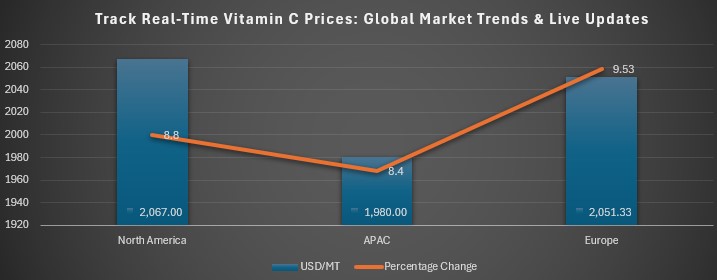
Vitamin C Price Index 2026:- https://www.chemanalyst.com/Pricing-data/vitamin-c-1258
Market Dynamics:
Interpretation:
The North American market reflects a buyer-dominated environment, where procurement strategies are cautious and price-sensitive. Import dependence on China continues to define pricing trends, leaving little room for domestic price recovery in the short term.
APAC (China): The Epicenter of Price Pressure
China remains the global price setter in the Vitamin C market. In Q4 2025, the domestic market experienced continued downward pressure.
Key Highlights:
Core Factors Driving the Trend:
Chinese manufacturers operated at full capacity across key provinces, including Shandong and Hebei, leading to significant inventory accumulation.
Despite strong shipment volumes, export prices continued to decline, indicating intense competition and reduced pricing power.
Feedstocks such as corn starch and intermediates remained stable, limiting production cost fluctuations and enabling producers to sustain lower pricing.
Prices stabilized toward the end of the quarter but remained within a narrow band due to balanced buying and selling activity.
Historical Context:
The current downturn is part of a broader trend:
This prolonged correction underscores a structural imbalance between supply and demand.
Interpretation:
China’s dominance ensures that global price direction is largely dictated by its production and export strategies. As long as high operating rates persist, the global market will remain under pressure.
Europe: Weak Demand Amplifies Price Decline
Europe, particularly Germany, mirrored the global downward trend but with additional pressure from subdued procurement.
Key Highlights:
Market Dynamics:
European buyers adopted a wait-and-watch approach, delaying purchases in anticipation of further price corrections.
Low-cost imports from China intensified competition, forcing European suppliers to adjust prices downward.
High stock levels reduced the need for immediate replenishment, further weakening demand.
Currency fluctuations and tariff considerations added complexity to price discovery and procurement decisions.
Interpretation:
Europe represents a demand-constrained market, where even moderate consumption levels fail to offset the impact of oversupply. The result is a sharper price decline compared to other regions.
Key Observations:
Price Index blocked- Understanding the Downtrend
The Vitamin C Price Index reflects not just price levels but also market sentiment, supply-demand balance, and cost structures.
Key Drivers of Index Decline:
Excess production capacity continues to outweigh global demand, leading to persistent price corrections.
With minimal volatility in raw material prices, producers lack justification for price increases.
Even with high export volumes, declining prices indicate competitive pressures and reduced margins.
Global buyers are delaying purchases, expecting further price drops, which reinforces the downward cycle.
Chart Representation (Conceptual)
If visualized in a price trend chart for 2025–2026, the Vitamin C market would show:
This trend reflects a transition from rapid correction to gradual stabilization.
2026 Outlook: Stabilization with Limited Upside
Looking ahead to 2026, the Vitamin C market is expected to move toward gradual stabilization, though significant price recovery remains uncertain.
Positive Indicators:
Limiting Factors:
Market Sentiment:
Industry reports suggest that Vitamin C prices remain low but stable, with only modest recovery expected in the near term.
Strategic Insights for Stakeholders
For Buyers:
For Producers:
For Traders:
Conclusion
The global Vitamin C market in 2026 is characterized by price suppression, supply dominance, and cautious demand behavior. Across North America, APAC, and Europe, declining price indices highlight a market struggling to absorb excess supply.
China’s continued production strength and export competitiveness remain the central force shaping global pricing. While signs of stabilization are emerging, the path to recovery will depend on inventory correction, supply discipline, and incremental demand growth.
Contact US:
Email-id: sales@chemanalyst.com
Phone no: +1-(332) 258 - 6602
Address: 420 Lexington Avenue, Suite 300
New York, NY
United States, 10170