x





The decoded idea: define it as one number — minutes back per pound. Estimate the minutes a tool honestly saved you last month, divide by what it costs, and you have a score you can rank the whole stack by. It's deliberately crude. Crude and consistent beats sophisticated and never-done, and this review takes ten minutes a month.
The practical move: the monthly scoring run. For each tool in your stack, three steps:
1. Estimate honestly. "The writing assistant drafts five client emails a week, saving maybe ten minutes each" → about 200 minutes a month. Where you're unsure, estimate low — optimism is how zombie tools survive.
2. Divide by cost. 200 minutes on a £15 plan is roughly 13 minutes per pound. Do it for everything, including the tools bundled inside other tools.
3. Rank and act. High scorers (10+ minutes per pound is a decent bar, but set your own) earn deeper use — more workflows, better briefing. Middling scores get one month of retraining: better prompts, custom instructions, a proper job description. Zeros get cancelled today, without a farewell tour.
One score deserves a footnote rather than a cancellation: the tool that saves few minutes but prevents expensive errors, or takes a dreaded task off your mind. Fewer errors counts. Calmer weeks count. Note that value in words next to the number — truthfully, not as a rescue story for a tool you're sentimentally attached to.
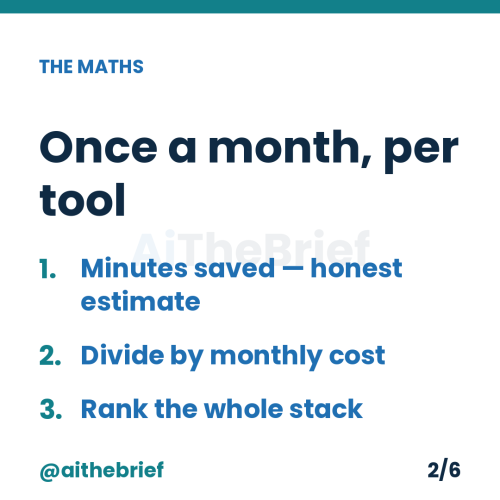
Slide from this week's carousel — the whole review in three steps.
The responsible-AI note (vet → disclose → verify). Keep the arithmetic honest in both directions. Time you spend checking a tool's output counts against its score, not for it — a drafting tool whose numbers you must triple-check may be a net negative wearing a productivity costume. Switching costs are real too: the learning curve of a replacement belongs in the maths before you migrate. And when a tool does get cancelled, close the loop properly — export your data, delete what the vendor holds, and revoke any access it had to your accounts. A cancelled subscription with a live API key is not cancelled. As ever with money-adjacent frameworks: this is an operating discipline, not financial advice.
Where founders get this wrong. Counting novelty as saving — the first week with any new tool feels fast; score it in month two, when the honeymoon has worn off. Scoring in December — an annual review means eleven months of paying for zeros; monthly is the cadence that catches drift. And letting the number decide alone — the score ranks candidates for attention; you still make the call, because you know context the arithmetic doesn't.
What this looks like after a month. The first run usually finds one obvious zero (cancel), one surprise star (use it deeper), and one awkward middle case (retrain, then re-score). The stack gets smaller and the remaining tools get better briefed — which raises their scores again. That's the quiet flywheel: measurement doesn't just trim the stack, it teaches you to run what survives properly.
This week's closer.
One decoded AI move, every week. Follow @aithebrief on Instagram for the daily version, or subscribe free on Substack for the deep one.