x




Here's a quiet experiment: scroll your AI chat history and count how many times you've typed some version of "I run a small business that…", "keep it short and plain", or "no, less formal than that". For most founders it's dozens of times a month — the same briefing, re-typed forever, because every chat starts from zero.
That repetition has a cost beyond the seconds it takes. When you skip the briefing (and on busy days you always do), the tool defaults to answering for everyone — beige copy, hedge-everything advice, American spelling, five paragraphs where one would do. Generic in, generic out. Then founders conclude the tool is mediocre and go shopping for a new one, which arrives equally unbriefed.
The decoded idea: the fix has been sitting in the settings page all along. Every major AI tool now has custom instructions — a standing brief the model reads before every conversation — and most have memory that can hold your defaults between chats. Five minutes of setup replaces the thousand re-explanations you were going to type this year. It's the highest-leverage five minutes in AI, and it's free.
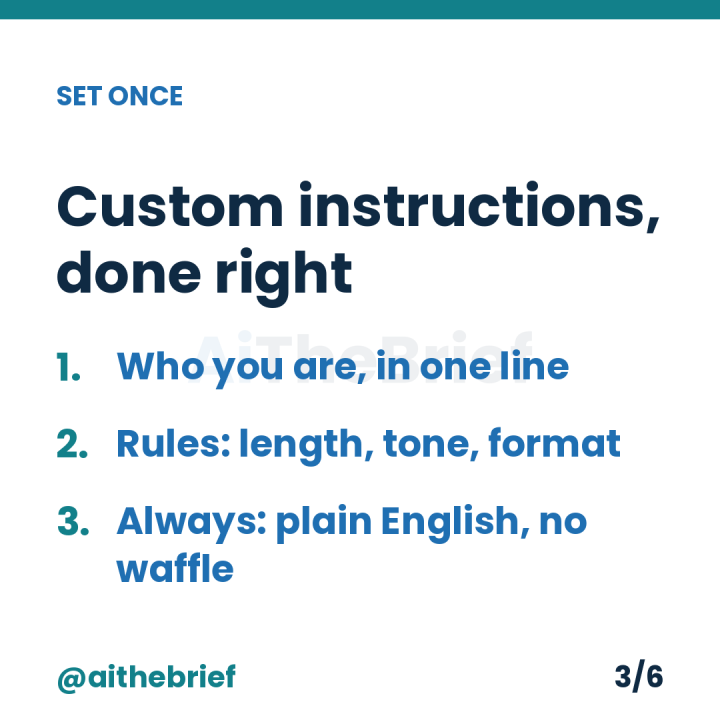
The practical move: write the standing brief. Open your tool's custom-instructions (or personalisation) settings and fill in three blocks:
1. Who you are — one line. "We run [business type] helping [audience] with [outcome]." That single sentence kills the worst genericism: the tool stops writing for an imaginary corporation.
2. Output rules. The corrections you make constantly, written once: "Default to short answers. Plain English, British spelling. No hype words, no exclamation marks, no bullet-point walls unless asked. Give the direct answer first, the caveats after."
3. Standing preferences. The judgement calls you've already made: "When drafting client-facing text, keep claims verifiable. When unsure of a fact, say so rather than guessing. Always show working for any calculation."
Then teach the memory your defaults — your audience, your offer, your voice dos and don'ts — by stating them once in a chat and confirming the tool has saved them. From then on, correct it once and the correction sticks, instead of re-litigating tone every Tuesday.

Slide from this week's carousel — the five-minute setup.
The responsible-AI note (vet → disclose → verify). A standing brief is context, and the rule for context is: context in, secrets out. Your one-liner, your audience, your tone — safe. Client names, contract terms, unreleased numbers, anything you'd redact for a stranger — never, because memory features can retain what you'd rather they forgot. While you're in the settings, do the two-minute vet: check whether your chats are used for model training (turn it off if you can), and set retention to something you'd defend. The settings page giveth an hour; it can also quietly collect what shouldn't be collected.
Where founders get this wrong. Writing a memoir — custom instructions have a length limit for a reason, and a 900-word brief dilutes itself; keep it under 150 words of rules the model can actually follow. Setting and forgetting — your business changes, and a brief written in January quietly mis-briefs by July; skim it monthly. And expecting magic — instructions raise the floor (fewer terrible drafts), not the ceiling; the specific ask still does the heavy lifting.
What this looks like after a month. Prompts get shorter because the preamble lives in settings. First drafts land closer to your voice, so editing time drops — most founders reclaim a genuine hour a week, more if they write daily. And something subtler: your outputs become consistent with each other. The email, the caption and the proposal stop sounding like three different people, because for the first time, the same brief sits behind all of them.

The closer from this week's carousel.
One decoded AI move, every week. Follow @aithebrief on Instagram for the daily version, or subscribe free on Substack for the deep one.