x





Every founder swears they need more time, and almost none can say where the current time goes. That's not a character flaw — it's an accounting gap. Money gets a ledger; hours get a vibe. And so the same week that "had no time" somehow contained forty minutes of hunting for a file, an hour of rewriting emails that are 80% identical to last week's, and a report assembled by hand for the fortieth time.
Those hours weren't spent. They were leaked — and leaks, unlike expenses, never appear on any statement.
The decoded idea: you can't automate what you haven't measured. Before choosing tools or workflows, run a short, honest audit of where the week actually goes. Most solo founders who do this find eight to twelve leaked hours on the first pass — a full working day, already paid for, waiting to be claimed back. The audit is the boring step everyone skips, which is exactly why it works.
The practical move: the 3-day time audit. For three working days, keep a running note (paper, phone, anywhere) with one rule: log every task that takes more than ten minutes, with a rough duration. No categorising, no judgement, just the log. At the end of day three, paste the whole thing into your AI tool:
"Here's a 3-day log of my working time.
1) Group it into recurring task types with estimated weekly hours.
2) Mark which tasks repeat every week.
3) Of those, circle the ones that need no judgement — same steps every time, no client-facing decisions.
Rank that circled list by hours per week."
That circled, ranked list is your automation queue. Work it in order: highest minutes first, one automation per week — invoice reminders, file naming, report assembly, the email you've written ninety times. Anything client-facing or judgement-heavy stays human; that's not a limitation, it's the design.
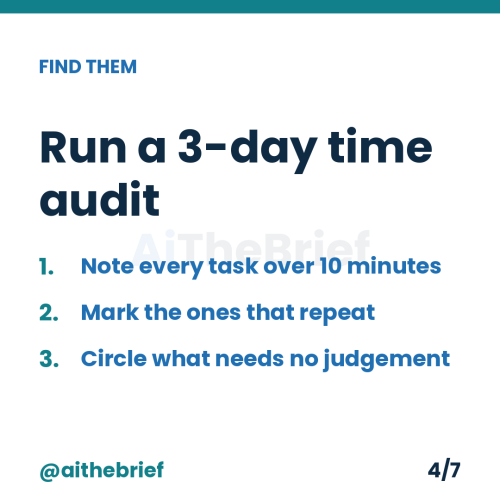
Slide from this week's carousel — the audit that finds the leaks.
The responsible-AI note (vet → disclose → verify). The audit itself is low-risk — it's your own time data — but scrub client names before pasting; "proposal for K." works as well as the full name. The governance moment comes next, when you automate: vet any new tool's data policy before it touches real workflows, keep the old manual method alive as a backup for the first fortnight, and verify outputs on a schedule (automation earns autonomy; it doesn't start with it). And one honesty rule for the maths: the time you'll spend checking an automation counts against its saving. Ten hours found minus two hours of babysitting is still a fine trade — as long as you counted both.
Where founders get this wrong. Auditing a perfect week — you behave differently when observed, so log a normal, slightly chaotic week, not a performance. Automating the annoying instead of the expensive — the task you hate isn't always the task that costs most; the ranking exists to overrule your mood. And doing the audit but not the queue — a diagnosed leak that stays unfixed is just better-documented waste; one automation per week is the pace that actually ships.
What this looks like after a month. Week one, the audit surprises you (it's never the tasks you'd have guessed). Weeks two to four, the first three automations land, and the reclaimed day starts arriving weekly. Spend it deliberately — sales, the backlog, or genuinely off. That last option counts: buying back an hour and immediately refilling it with busywork is just leaking with extra steps.
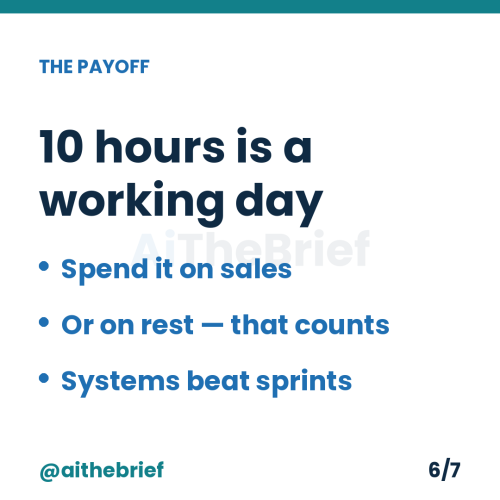
The payoff slide.
One decoded AI move, every week. Follow @aithebrief on Instagram for the daily version, or subscribe free on Substack for the deep one.