x



Have you ever wondered how scientists measure tiny particles that are too small to see with the human eye? In industries such as pharmaceuticals, food processing, chemicals, and nanotechnology, understanding particle behavior is essential. This is where particle size and zeta potential analyzers play a crucial role. These advanced instruments help researchers measure particle size, stability, and surface charge accurately. Choosing the right analyzer can improve product quality, reduce testing errors, and save valuable time. This guide explains everything you need to know before making a purchase, helping you select the best solution for your laboratory needs.
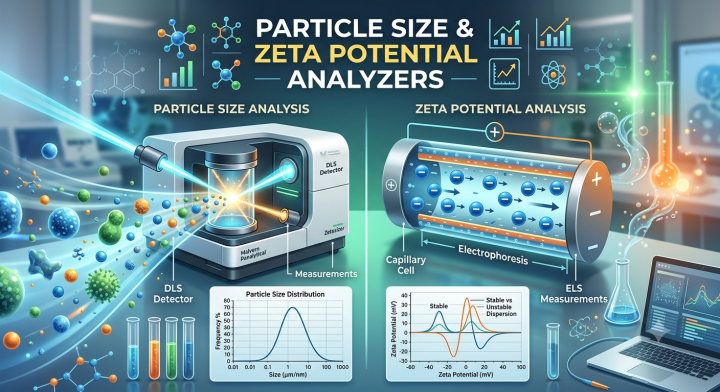
Particle size and zeta potential analyzers are scientific instruments used to measure the size of particles and their electrical charge in a liquid or suspension.
Particle size refers to how large or small a particle is. Zeta potential measures the electrical charge around a particle. This charge affects how particles interact with each other and whether they remain stable or clump together.
These measurements are important in many industries. For example:
Pharmaceutical companies use them to develop effective drug formulations.
Food manufacturers use them to improve texture and shelf life.
Chemical companies use them to maintain product consistency.
Nanotechnology researchers use them to study nanoparticles.
Modern particle size and zeta potential analyzers often combine both measurements into one system, making testing faster and more efficient.
Understanding particle characteristics helps businesses create better products and maintain quality standards.
Some key benefits include:
Improved Product Quality
Accurate particle measurements help ensure consistent product performance. This is especially important in pharmaceuticals and specialty chemicals.
Better Stability Analysis
Zeta potential measurements show whether particles will remain evenly distributed or begin to aggregate over time.
Faster Research and Development
Scientists can make informed decisions quickly when they have reliable particle data.
Regulatory Compliance
Many industries must follow strict quality guidelines. Reliable measurements support compliance and documentation requirements.
Because of these advantages, particle size and zeta potential analyzers have become essential tools in modern laboratories.
Choosing the right instrument requires careful evaluation. Here are the most important factors to consider.
Firstly, check the particle size range the instrument can measure.
Different applications require different ranges. Nanoparticle research may need measurements below 100 nanometers, while industrial applications may require larger particle analysis.
Always choose a system that matches your sample requirements.
Different analyzers use different technologies.
Common methods include:
Dynamic Light Scattering (DLS)
Laser Diffraction
Electrophoretic Light Scattering (ELS)
Understanding the technology helps ensure accurate results for your specific application.
Not all instruments can analyze every sample type.
Consider whether you work with:
Liquids
Emulsions
Suspensions
Nanoparticles
Biological samples
A versatile analyzer can handle multiple sample types and provide greater flexibility.
Reliable data is critical.
Look for instruments with proven accuracy and strong repeatability. Consistent results reduce uncertainty and improve confidence in research findings.
Modern particle size and zeta potential analyzers include advanced software.
Good software should offer:
Easy operation
Automated reporting
Data storage
Regulatory compliance support
User-friendly software can significantly improve laboratory productivity.
Consider long-term maintenance needs.
Some systems require frequent calibration and servicing, while others are designed for minimal upkeep.
Choosing a low-maintenance instrument can reduce operational costs over time.
A reliable supplier is just as important as the instrument itself.
Look for providers that offer:
Technical support
Installation services
User training
Preventive maintenance
Strong customer support ensures smooth operation and minimizes downtime.
Many buyers focus only on price. However, this can lead to costly mistakes later.
Ignoring Application Requirements
An analyzer may have excellent specifications but still be unsuitable for your samples.
Always evaluate your actual testing needs before purchasing.
Choosing Based on Price Alone
Low-cost systems may lack accuracy, software features, or technical support.
Instead, focus on overall value and long-term performance.
Overlooking Future Needs
Laboratory requirements often change over time.
Choose particle size and zeta potential analyzers that can support future projects and expanded testing capabilities.
Skipping Vendor Evaluation
Not all suppliers provide the same level of service.
Research customer reviews, support availability, and industry reputation before making a decision.
If you want to learn more about particle size and zeta potential analyzers, several trusted resources can help.
Scientific Journals
Peer-reviewed journals provide detailed research and application studies.
Industry Associations
Organizations related to pharmaceuticals, chemicals, and nanotechnology often publish technical guidelines and best practices.
Manufacturer Resources
Leading instrument manufacturers provide educational materials, webinars, and application notes that explain testing methods and industry trends.
Scientific Conferences
Industry conferences offer opportunities to learn about new technologies and emerging applications.
Online Training Programs
Many suppliers now provide virtual training courses that help users understand particle analysis techniques and instrument operation.
Staying informed about industry developments can help laboratories make smarter investment decisions and maintain competitive advantages.
Selecting the right particle size and zeta potential analyzers is an important decision for any laboratory. The right instrument can improve product quality, increase testing efficiency, and support accurate research results.
Before making a purchase, evaluate factors such as measurement range, technology, software capabilities, maintenance needs, and vendor support. By understanding your requirements and avoiding common mistakes, you can choose a solution that delivers reliable performance for years to come.
Start researching trusted suppliers today and invest in technology that supports your laboratory's long-term success.
Particle size analysis measures the size of particles, while zeta potential analysis measures the electrical charge around particles. Together, these measurements help determine product stability and performance.
Industries such as pharmaceuticals, biotechnology, food and beverage, chemicals, cosmetics, and nanotechnology commonly use these instruments for quality control and research.
Consider your sample type, measurement range, required accuracy, software features, maintenance needs, and supplier support. Choosing an analyzer that matches your application requirements will provide the best results.