x




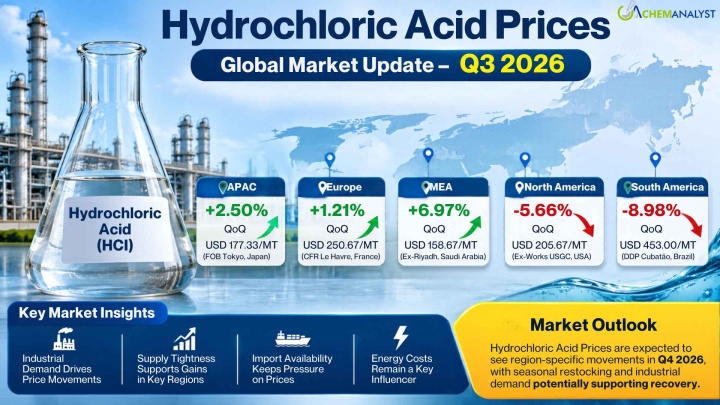
According to ChemAnalyst, The global Hydrochloric Acid Prices experienced mixed regional movements during the third quarter of 2026, with prices increasing across Asia-Pacific (APAC), Europe, and the Middle East and Africa (MEA), while North America and South America recorded declines. The market remained influenced by variations in chlor-alkali operating rates, industrial consumption, electricity costs, international trade flows, freight availability, and downstream procurement activities. Temporary supply disruptions in Saudi Arabia and stronger export enquiries in Japan supported regional price increases, whereas comfortable inventories and increased import availability placed downward pressure on prices in the Americas.
During July–September 2026, the Hydrochloric Acid Price Index in APAC increased by 2.50% quarter-over-quarter (Q-o-Q), with the average price reaching USD 177.33/MT on an FOB Tokyo, Japan basis. Europe registered a relatively moderate increase of 1.21%, with prices averaging USD 250.67/MT on a CFR Le Havre, France basis. Meanwhile, MEA witnessed the strongest regional increase of 6.97%, bringing the average price to USD 158.67/MT on an Ex-Riyadh, Saudi Arabia basis.
In contrast, North American Hydrochloric Acid Prices declined by 5.66% Q-o-Q, averaging USD 205.67/MT on an Ex-Works USGC, USA basis. South America recorded a sharper decrease of 8.98%, with the average price standing at USD 453.00/MT on a DDP Cubatão, Brazil basis.
Overall, the third-quarter market reflected a combination of localized supply tightness and regional oversupply. While higher industrial procurement and production-cost pressures supported prices in selected markets, expanding merchant availability and weaker downstream consumption limited global price momentum.
Global Hydrochloric Acid Prices: Q3 2026 Regional Overview
Book A Demo for Hydrochloric Acid Prices: https://www.chemanalyst.com/Pricing-data/hydrochloric-acid-61
Hydrochloric Acid Prices in APAC
The Asia-Pacific Hydrochloric Acid market recorded a moderate upward movement during Q3 2026, supported by stronger export enquiries, increased steel pickling requirements, and improving semiconductor-related procurement. In Japan, the Hydrochloric Acid Price Index increased by approximately 2.50% quarter-over-quarter, with the average price reaching USD 177.33/MT on an FOB Tokyo basis.
During July and August, market conditions remained relatively balanced as chlor-alkali and vinyl chloride monomer (VCM) producers maintained operating rates above 85%. Since hydrochloric acid is generated as a by-product of several chemical manufacturing processes, higher operating rates supported merchant acid availability across the region. Coastal inventories also remained above seasonal averages, allowing exporters to fulfil international orders without significant supply interruptions.
However, electricity tariffs remained elevated due to higher liquefied natural gas (LNG) costs, increasing production-related expenses and encouraging suppliers to maintain firm selling offers. Export enquiries from Taiwan and Vietnam strengthened during September, providing Japanese suppliers with alternative sales opportunities and supporting pricing stability.
The market experienced additional support towards the end of the quarter as steel pickling demand remained steady and semiconductor manufacturers resumed selective restocking. These developments helped strengthen Hydrochloric Acid Prices in September, although the absence of major plant outages limited the possibility of a sharper increase.
Why Did Hydrochloric Acid Prices Change in September 2026 in APAC?
Hydrochloric Acid Prices in APAC strengthened moderately in September due to improving industrial enquiries and stronger export activity. However, elevated chlor-alkali and VCM operating rates maintained sufficient by-product acid availability, preventing a substantial supply shortage.
Higher electricity and LNG costs encouraged producers to defend their margins, limiting aggressive discounting. Meanwhile, stable steel pickling consumption and selective semiconductor restocking provided additional support to market sentiment.
Hydrochloric Acid Prices in Indonesia
In Indonesia, the hydrochloric acid market experienced improving procurement activity during September as nickel-leaching projects increased their industrial acid requirements. Demand from the country's expanding nickel processing industry supported merchant hydrochloric acid consumption compared with earlier subdued months.
At the same time, Chinese exporters tightened spot availability as some chlor-alkali facilities prioritised chlorine consumption for PVC production. Reduced export parcel availability contributed to firmer regional procurement sentiment, particularly among Indonesian industrial buyers dependent on imported acid.
Hydrochloric Acid Prices in South Korea
South Korea experienced relatively balanced hydrochloric acid supply conditions during Q3 2026. Chinese and Japanese exporters continued supplying the market, although two East China loading reductions temporarily removed approximately 3,000 tonnes of material from the export market during mid-September.
The appreciation of the South Korean won helped importers manage landed procurement costs, reducing the immediate impact of firmer regional offers. Consequently, buyers maintained a cautious purchasing approach, limiting the ability of exporters to implement substantial price increases.
Hydrochloric Acid Prices in Europe
The European Hydrochloric Acid market registered a modest increase during Q3 2026, with the regional price index rising by 1.21% quarter-over-quarter. The average price reached USD 250.67/MT on a CFR Le Havre, France basis.
During July, market conditions remained relatively firm as higher electricity surcharges increased production-related expenses for chlor-alkali manufacturers. Additionally, some Dutch producers diverted volumes towards captive vinyl chloride production, limiting merchant hydrochloric acid availability in selected markets.
The situation gradually changed during August and September as German and Belgian suppliers maintained sufficient export availability. Increased regional shipments improved import availability in France, allowing buyers to negotiate more competitive landed prices. The improved supply situation also reduced the need for importers to secure material at premium spot rates.
European electricity prices continued influencing producer selling strategies throughout the quarter. However, normal operating conditions across membrane-cell facilities ensured consistent by-product hydrochloric acid generation, preventing significant supply disruptions.
Demand conditions remained mixed. Manufacturing activity in France weakened, with the Purchasing Managers' Index remaining below the 50-point expansion threshold. Reduced steel pickling activity after the summer period also limited incremental industrial acid consumption.
Meanwhile, improved terminal operations at Le Havre supported smoother import arrivals and inventory replenishment. Looking ahead, seasonal restocking and planned maintenance activities are expected to influence supplier offers during Q4 2026.
Why Did Hydrochloric Acid Prices Change in September 2026 in Europe?
Hydrochloric Acid Prices in Europe experienced limited upward movement during September as increased German and Belgian export availability improved regional supply conditions. Greater import volumes reduced purchasing urgency among French buyers and weakened supplier negotiating power.
Currency movements also influenced market economics, as euro depreciation affected dollar-denominated export margins. Furthermore, normal port operations and manageable vessel waiting times supported prompt deliveries, allowing importers to negotiate more competitive prices.
Hydrochloric Acid Prices in Germany
In Germany, hydrochloric acid prices initially strengthened during July due to comparatively restricted by-product availability following lower chlor-alkali and chlorine production.
However, the market experienced softer conditions in August as merchant inventories remained comfortable and downstream industrial buyers maintained cautious procurement strategies. Suppliers consequently offered greater transactional flexibility to maintain sales volumes.
Hydrochloric Acid Prices in the UK
The United Kingdom experienced relatively firm hydrochloric acid pricing during July as restricted import arrivals at Immingham reduced prompt availability.
Northwest European chlor-alkali manufacturers also prioritised captive caustic soda requirements, limiting merchant hydrochloric acid exports. However, supply availability improved during August, reducing the earlier tightness and allowing buyers to secure material under more competitive conditions.
Hydrochloric Acid Prices in MEA
The Middle East and Africa region recorded the strongest upward movement in Hydrochloric Acid Prices during Q3 2026. In Saudi Arabia, the price index increased by 6.97% quarter-over-quarter, with the average price reaching USD 158.67/MT on an Ex-Riyadh basis.
The primary factor behind this increase was temporary supply disruption following the outage at Nama Chemicals. The production interruption reduced merchant-grade hydrochloric acid availability, particularly in the Eastern Province, creating short-term tightness in the prompt market during September.
Earlier in the quarter, distributor inventories remained relatively comfortable, allowing sellers to offer competitive prices and protect customer relationships. However, the temporary reduction in available volumes tightened the market and encouraged suppliers to revise their offers upwards.
On the production side, subsidised natural gas and electricity helped Saudi Arabian chlor-alkali producers maintain relatively stable operating costs. This limited cost-driven inflation and prevented the market from experiencing additional upward pressure from energy expenses.
Demand from oilfield acid-stimulation programmes and industrial steel pickling activities also supported September procurement. Meanwhile, congestion at Jeddah port increased regional transportation and routing uncertainty, although domestic truck transportation between Riyadh, Jubail, and Yanbu remained operational.
Why Did Hydrochloric Acid Prices Change in September 2026 in MEA?
The increase in Hydrochloric Acid Prices during September was primarily associated with the temporary Nama Chemicals outage, which reduced merchant-grade supply and tightened prompt availability.
At the same time, renewed acid-stimulation programmes and improving industrial procurement increased immediate consumption. Although subsidised energy costs helped producers control manufacturing expenses, regional logistical challenges added some transactional risk to the market.
Hydrochloric Acid Prices in the United Arab Emirates
In the United Arab Emirates, hydrochloric acid demand strengthened during September as acid-stimulation programmes accelerated and galvanizing-related procurement improved.
Importers increased their enquiries to secure material for industrial and oilfield applications. However, freight quotations remained broadly stable, while the UAE dirham's peg to the US dollar limited exchange-rate-related fluctuations in landed procurement costs.
Consequently, changes in product availability and regional demand remained the primary factors influencing hydrochloric acid pricing.
Hydrochloric Acid Prices in South Africa
South Africa experienced additional cost and logistical pressures during September. Higher environmental compliance expenditure increased fixed operating costs for suppliers, encouraging firmer merchant hydrochloric acid offers.
Furthermore, congestion at Durban port extended vessel turnaround times and tightened prompt material availability. These logistical constraints supported stronger FOB Durban quotations and contributed to firmer regional market sentiment.
Hydrochloric Acid Prices in North America
North America recorded a downward trend in Hydrochloric Acid Prices during Q3 2026, with the regional price index declining by approximately 5.66% quarter-over-quarter. The average price reached USD 205.67/MT on an Ex-Works USGC basis.
The market experienced increasing supply availability as Canadian and German exporters redirected surplus merchant hydrochloric acid towards Los Angeles during September. These additional import volumes improved West Coast availability and increased competition among suppliers.
Domestic chlor-alkali operating rates also normalised during the quarter, allowing producers to increase merchant hydrochloric acid allocations. Since hydrochloric acid is generated as a co-product of chlor-alkali manufacturing, higher operating rates contributed to a more comfortable regional supply balance.
Demand conditions remained relatively weak, particularly from the oil and gas industry. Hydraulic-fracturing contractors reduced acid call-offs, lowering hydrochloric acid consumption for oilfield applications. This reduced demand coincided with improving import availability, creating additional downward pressure on spot prices.
Distributors also rebuilt tank inventories as imported cargoes arrived without major logistical disruptions. With sufficient stocks available, buyers avoided urgent spot purchases and adopted a more cautious procurement strategy.
Stable freight rates and functional port operations further supported competitive landed import offers. Consequently, domestic suppliers faced increased competition from imported material, limiting their ability to maintain higher selling prices.
Why Did Hydrochloric Acid Prices Change in September 2026 in North America?
Hydrochloric Acid Prices declined in September as Canadian and German exporters increased merchant acid availability along the US West Coast. Additional imports created comfortable supply conditions and reduced the urgency among distributors to purchase domestic material.
Reduced oilfield acidising demand further weakened consumption, while stable freight rates and smooth port operations prevented logistical disruptions from supporting prices.
Hydrochloric Acid Prices in Canada
In Canada, hydrochloric acid supply remained relatively stable during Q3 2026. Producers maintained consistent operating schedules, while Chemtrade's North Vancouver extension helped reduce concerns regarding production interruptions.
Higher caustic soda operating rates also supported additional co-product hydrochloric acid availability. This increased merchant volumes in the Vancouver market and placed pressure on regional selling offers.
Hydrochloric Acid Prices in South America
South America recorded the steepest regional decline in Hydrochloric Acid Prices during Q3 2026. In Brazil, the price index decreased by 8.98% quarter-over-quarter, with the average price reaching USD 453.00/MT on a DDP Cubatão basis.
The Brazilian market remained under pressure due to abundant import availability and relatively weak downstream industrial demand. Suppliers from the United States and Europe continued offering competitive export cargoes, increasing the availability of hydrochloric acid in the domestic market.
The additional supply allowed Brazilian distributors to maintain sufficient inventories throughout the quarter. Southeastern terminal stocks finished Q3 slightly above seasonal norms, encouraging distributors to offer discounts to clear available material and manage inventory positions.
Demand from the fertiliser and automotive industries remained relatively subdued. Reduced activity across fertiliser-related production chains limited hydrochloric acid consumption in phosphate processing, while weaker automotive manufacturing affected steel pickling requirements.
Currency fluctuations also influenced import economics during the quarter. Although movements in the Brazilian real affected landed procurement calculations, exporters absorbed a significant portion of the currency-related changes to preserve their competitiveness in the Brazilian market.
Meanwhile, stable chlor-alkali operating rates across major exporting countries ensured consistent merchant hydrochloric acid availability. The absence of major origin-side production disruptions prevented any significant supply-side tightening.
Despite the downward trend, expectations of industrial restocking and gradually improving downstream activity could provide moderate support to the Brazilian hydrochloric acid market towards the end of 2026.
Request A Demo online for Hydrochloric Acid Prices: https://www.chemanalyst.com/ChemAnalyst/PricingForm?Product=Hydrochloric%20Acid
Why Did Hydrochloric Acid Prices Change in September 2026 in South America?
Hydrochloric Acid Prices in Brazil declined during September as increased availability of US and European export cargoes exceeded immediate spot demand. The resulting supply surplus encouraged distributors to reduce their selling offers to maintain inventory turnover.
Furthermore, weaker demand from phosphate processing and steel pickling limited consumption. Comfortable terminal inventories and normal vessel operations allowed importers to replenish stocks without paying additional logistical premiums.
Key Factors Influencing the Global Hydrochloric Acid Market in Q3 2026
Several interconnected factors shaped global Hydrochloric Acid Prices during the third quarter of 2026.
Chlor-Alkali Production and By-Product Availability
Hydrochloric acid is generated as a by-product of several industrial chemical manufacturing processes, particularly chlorination and chlor-alkali-related value chains. Changes in chlorine and VCM production rates directly influence merchant acid availability. Higher operating rates generally increase available volumes, while plant outages can tighten regional supply.
Energy and Manufacturing Costs
Electricity and natural gas prices influence the operating economics of chlor-alkali producers. Higher energy tariffs in Japan and Europe encouraged suppliers to defend their margins, while subsidised energy costs in Saudi Arabia limited additional cost-driven price pressure.
Downstream Industrial Demand
Steel pickling, semiconductor manufacturing, metal processing, nickel leaching, phosphate fertiliser production, and oilfield acid stimulation remain important consumption channels. Variations in these industries influenced regional procurement requirements during Q3 2026.
International Trade and Import Availability
Trade flows played an important role in determining regional price movements. Increased German and Belgian exports supported European availability, while Canadian and German cargoes added supply to North America. Similarly, competitive US and European export offers contributed to weaker Brazilian prices.
Logistics and Inventory Management
Port congestion, vessel waiting times, transportation costs, and terminal inventory levels influenced prompt availability. Distributors with comfortable inventories were better positioned to negotiate lower prices, whereas temporary supply disruptions in Saudi Arabia strengthened seller negotiating power.
Hydrochloric Acid Price Forecast: Outlook for Q4 2026 and Early 2027
The global Hydrochloric Acid market is expected to experience mixed regional price movements during Q4 2026 and early 2027, depending on industrial procurement, chlor-alkali operating rates, and international trade availability.
In APAC, Hydrochloric Acid Prices may experience modest upward movement as year-end procurement activities and post-monsoon industrial operations support inventory replenishment. Stronger demand from metal processing and selected semiconductor-related applications could provide additional support. However, comfortable by-product availability may limit significant price increases.
In Europe, seasonal restocking and planned maintenance activities could strengthen supplier offers towards the end of the year. Nevertheless, continued import availability from Germany and Belgium may prevent substantial price escalation, particularly if downstream manufacturing activity remains weak.
The MEA region could witness a gradual recovery as distributors replenish inventories following temporary supply disruptions. Demand from oilfield acid stimulation, industrial cleaning, and metal processing is expected to remain an important market driver. However, stable domestic energy costs may help contain production-related price pressure.
In North America, the market may continue experiencing relatively soft pricing conditions if oilfield acidising demand remains subdued and imported merchant volumes remain competitive. Periodic inventory replenishment could provide temporary support, although comfortable domestic supply may restrict sustained increases.
South America may experience a modest recovery if fertiliser production and automotive manufacturing activity improve. However, the availability of competitive US and European imports and comfortable distributor inventories could continue limiting upward price momentum.
Overall, the global Hydrochloric Acid market is likely to remain regionally differentiated. Supply availability, industrial operating rates, energy costs, and downstream procurement strategies will remain the primary factors shaping market direction through early 2027.
Conclusion
The third quarter of 2026 highlighted significant regional differences in the global Hydrochloric Acid market. APAC, Europe, and MEA recorded price increases, supported by improving procurement activity, production-cost pressures, and temporary supply disruptions. Conversely, North America and South America experienced declining prices due to increased import availability, comfortable inventories, and weaker downstream consumption.
Moving into Q4 2026, the market outlook will largely depend on chlor-alkali production levels, international trade flows, energy prices, and recovery in major industrial consuming sectors. While selected regions may experience moderate price recovery, abundant merchant supply and cautious purchasing behaviour could continue restricting significant global price increases.
About Us:
Welcome to ChemAnalyst, a next–generation platform for chemical and petrochemical intelligence where innovation meets practical insight. Recognized as “Product Innovator of the Year 2023” and ranked among the “Top 100 Digital Procurement Solutions Companies,” we lead the digital transformation of the global chemical sector. Our online platform helps companies handle price volatility with structured analysis, real-time pricing, and reliable news and deal updates from across the world. Tracking over 500 chemical prices in more than 40 countries becomes simple and efficient with us.
Contact Us:
Address:
420 Lexington Avenue, Suite 300 New York, NY 10170 United States
Phone: +1 332 258 6602
Email: sales@chemanalyst.com
Website: https://www.chemanalyst.com/
LinkedIn: https://www.linkedin.com/company/chemanalyst/
Facebook: https://www.facebook.com/ChemAnalysts/
Twitter: https://x.com/chemanalysts
YouTube: https://www.youtube.com/@chemanalyst
Instagram: https://www.instagram.com/chemanalyst_