x




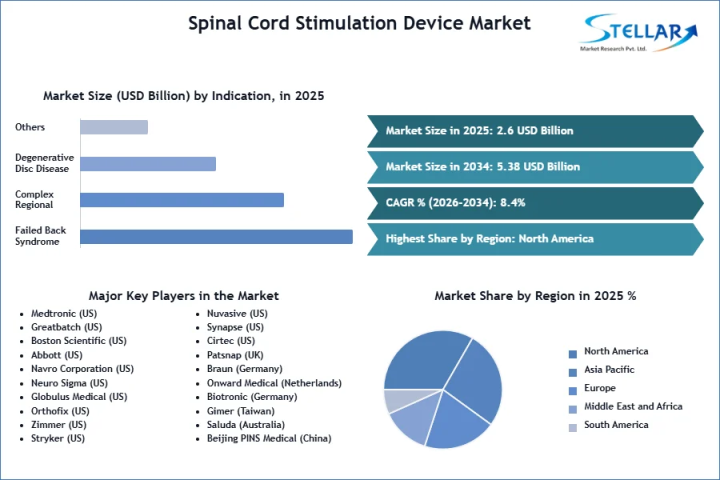
The global Spinal Cord Stimulation Device Market is undergoing a profound paradigm shift, evolving from static paresthesia-based therapies into adaptive, AI-driven, real-time closed-loop neuromodulation platforms. According to a comprehensive research study published by Stellar Market Research, the market was valued at USD 2.60 Billion in 2025 and is projected to reach USD 5.38 Billion by 2034, expanding at a CAGR of 8.4% over the forecast period (2026–2034).
The surging global demand is driven by the growing clinical movement toward non-opioid interventional pain management, rising incidence of Failed Back Surgery Syndrome (FBSS), and favorable Medicare and private insurance coverage that reimburses up to 80–85% of SCS trial and implantation procedures.
Key Findings from the Report
Valuation & Growth: The market stands at USD 2.60 Billion in 2025 and will attain USD 5.38 Billion by 2034 (8.4% CAGR).
Dominant Product Segment: Rechargeable SCS Devices captured the largest revenue share (~66%), driven by extended 10–15 year battery lifespans, reduced lifetime replacement surgeries, and lower total cost of care.
Fastest-Growing Product Segment: Miniaturized & Closed-Loop IPGs, utilizing closed-loop ECAP feedback algorithms, are growing rapidly as clinicians transition from population-based protocols to patient-specific pain signatures.
Dominant Indication: Failed Back Surgery Syndrome (FBSS) accounts for over 31% of total clinical indications, followed by Complex Regional Pain Syndrome (CRPS) and Peripheral Neuropathies.
Dominant End User: Hospitals command over 55% procedure volume, while Ambulatory Surgical Centers (ASCs) represent the fastest-growing site of care due to outpatient cost containment and minimally invasive percutaneous lead techniques.
Regional Leadership: North America leads the global landscape, supported by efficient FDA clearance pathways, robust specialized pain clinic networks, and high insurance reimbursement.
Fastest-Growing Region: Asia-Pacific is projected to achieve the highest CAGR through 2034, fueled by expanding healthcare infrastructure, localized manufacturing in China and India, and rising awareness of neurostimulation alternatives.
Clinical Migration Away from Opioid Dependency: Heightened global regulatory scrutiny and legislative mandates targeting opioid over-prescription are compelling healthcare providers to prioritize interventional non-drug therapies like SCS for refractory neuropathic pain.
Breakthrough Waveform & Closed-Loop Innovations: Multi-waveform capability (combining tonic, burst, and 10 kHz high-frequency stimulation) allows physicians to customize treatment without surgical revisions, significantly boosting long-term therapy success rates.
Expanded Healthcare Coverage & Favorable Reimbursement: High reimbursement rates from public systems like Medicare (covering 80–85% of procedure costs) and major private insurers drastically lower financial barriers for patient adoption.
High Upfront Surgical & Device Costs: Initial implantation procedures range between USD 21,000 and USD 58,000 in major developed markets, limiting access in cost-sensitive or underinsured patient demographics.
Trial Period Attrition & Implantation Risks: Biological risks such as lead migration, dural puncture, biological scarring, or failure during the initial 5 to 7-day trial phase continue to cause patient drop-outs prior to permanent implantation.
AI-Driven Pain Mapping & Closed-Loop Sensing: Modern IPGs dynamically measure physiological spinal responses microsecond-by-microsecond, utilizing machine learning algorithms to auto-adjust impulse amplitude during patient movement.
Full-Body MRI Compatibility: Manufacturers are standardizing 1.5T and 3.0T full-body MRI-conditional labeling, eliminating historical barriers where implanted devices prevented patients from undergoing diagnostic scans.
Device Miniaturization: Advanced micro-electronics are reducing pulse generator footprints by up to 95% compared to legacy architectures, enabling less invasive subcutaneous pocket creation and improved aesthetic/comfort outcomes.
ESG & Battery Efficiency: Long-life lithium-ion and wireless inductive charging systems lower medical device waste by minimizing the need for repeat battery-replacement surgeries.
North America: Remains the dominant global revenue contributor. Growth is anchored by leading specialized pain clinics, rapid clinical integration of FDA-cleared devices, and favorable reimbursement structures across the U.S. and Canada.
Europe: Driven by high precision surgical standardizations in Germany, Switzerland, and the UK, alongside favorable health technology assessments (HTA) such as NICE guidelines supporting high-frequency SCS adoption.
Asia-Pacific: Highlights the highest compound annual growth rate. Increasing healthcare spending, expanding aging populations in Japan and China, localized component manufacturing, and rising medical tourism accelerate regional market adoption.
Latin America & MEA: Emerging markets exhibiting steady momentum as private healthcare infrastructure develops and interventional pain specialists increase across urban medical centers.
Medtronic plc (2024): Received FDA clearance for its Inceptiv™ closed-loop rechargeable spinal cord stimulator, incorporating real-time ECAP sensing algorithms to auto-adjust stimulation impulses based on patient body movements.
Abbott Laboratories (2024): Expanded its neuromodulation suite by launching new directional lead features and patient-controlled mobile applications, improving stimulation targeting for complex lower limb neuropathies.
Boston Scientific Corporation (2024): Advanced clinical trials and commercial rollouts for its WaveWriter Alpha™ SCS systems, emphasizing personalized combination therapy that merges paresthesia-free and paresthesia-based waveforms simultaneously.
Nevro Corp. (2024): Secured expanded regulatory approvals and clinical endorsements for its proprietary 10 kHz HF10™ therapy platform targeting non-surgical refractory back pain (NSRBP) and painful diabetic neuropathy (PDN).
Saluda Medical (2025): Scaled global commercial operations for its Evoke® System, accelerating hospital system adoption of smart ECAP closed-loop spinal stimulation platforms across North America and Europe.
The global spinal cord stimulation market is moderately consolidated among a core group of medical technology leaders alongside disruptive specialized innovators:
Medtronic plc (Pioneer in MRI-compatible, long-battery, and closed-loop neuromodulation systems)
Abbott Laboratories (Leading provider of sub-perception and wireless clinical management solutions)
Boston Scientific Corporation (Frontrunner in multi-waveform combination therapies and directional leads)
Nevro Corp. (Dominant player in high-frequency 10 kHz paresthesia-free pain management)
Saluda Medical Pty Ltd. (Innovator in bio-feedback closed-loop ECAP technology)
Stimwave LLC (Specialist in ultra-miniaturized wireless micro-stimulator platforms)
Strategic priorities across these vendors focus heavily on R&D investments, physician education programs, clinical trial generation for expanded indications (such as diabetic neuropathy), and value-based procurement contracts.
"We are witnessing a structural transition in neuromodulation from fixed-output electrical delivery to intelligent, bio-adaptive systems," stated a Senior Research Analyst at Stellar Market Research. "The convergence of closed-loop ECAP sensing, AI-driven waveform selection, and ultra-miniaturized hardware is resolving the historical issue of therapeutic tolerance. As healthcare systems actively seek non-opioid solutions for chronic back pain and neuropathies, spinal cord stimulators are cementing their role as an essential, cost-effective interventional standard of care."
Over the forecast period through 2034, the Spinal Cord Stimulation Device Market will be defined by ongoing miniaturization, digital health integration, and indication expansion. As clinical evidence grows for treating conditions beyond FBSS—such as diabetic peripheral neuropathy, upper limb pain, and visceral pain—the addressable patient pool will expand significantly.
Furthermore, shifting procedures toward Ambulatory Surgical Centers (ASCs), paired with remote digital programming via smartphone apps, will streamline therapy delivery, lower procedure costs, and drive sustained long-term volume growth worldwide.
Stellar Market Research is a multifaceted market research and consulting company with professionals from several industries. Some of the industries we cover include medical devices, pharmaceutical manufacturers, science and engineering, electronic components, industrial equipment, technology and communication, cars and automobiles, chemical products and substances, general merchandise, beverages, personal care, and automated systems. To mention a few, we provide market-verified industry estimations, technical trend analysis, crucial market research, strategic advice, competition analysis, production and demand analysis, and client impact studies.
Address
Phase 3, Navale IT Zone, S.No. 51/2A/2, Office No. 202, 2nd floor, Near, Navale Brg, Narhe, Pune, Maharashtra 411041
Email
sales@stellarmr.com
Mobile
+91 9607365656