x




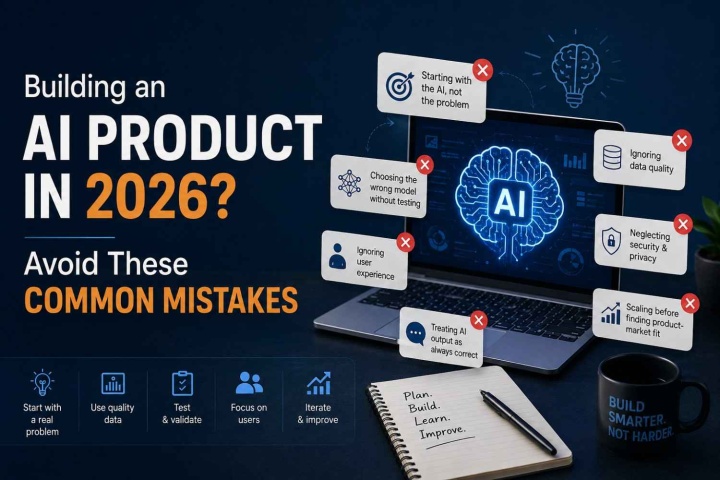
Building an AI product sounds easier than ever. There are powerful models, ready-made APIs, and better development tools everywhere. Yet many AI products still fail before they find real users. The problem is often not the technology. It is poor planning, weak product decisions, or unclear user needs. In 2026, launching an AI product takes more than connecting an AI model to an app. You need the right data, product strategy, architecture, and user experience.
If you are planning an AI product this year, avoiding a few common mistakes can save time, money, and months of rework.
One of the biggest mistakes is choosing a model before defining the problem. Teams often begin with questions like, “How can we use GPT?” or “Where can we add AI?” These questions sound useful, but they put technology first.
For example, an AI support tool should not exist simply because chatbots are popular. It should solve a clear support problem, such as reducing response time or helping agents find answers faster.
AI products can grow in scope very quickly. A simple idea can soon include chat, automation, analytics, recommendations, voice features, image generation, and multiple integrations. That creates unnecessary complexity.
Instead, start with a focused product scope. Build the smallest useful version that proves your core idea. This is where experienced ai product development services can help teams define the first release and avoid unnecessary features.
Your first version should answer three basic questions:
If the answer is yes, you can expand with confidence.
An AI model is only part of the product. The data behind it can have an even bigger impact on the user experience. Poor data can lead to weak recommendations, inaccurate answers, and inconsistent results. This becomes especially important when your product uses company documents, customer records, product catalogs, or industry-specific information.
Before development begins, review your data carefully. Check its accuracy, structure, freshness, and access rules. If you plan to use retrieval-augmented generation (RAG), for example, document chunking, indexing, embeddings, and retrieval quality all matter. A powerful language model cannot fix a poor retrieval pipeline.
There is no single AI model that is perfect for every product. A model may perform well in one use case but struggle with another. Cost, latency, context length, reasoning ability, privacy, and output quality can all affect your decision. Do not choose a model simply because it is popular.
Test different models against your actual use cases. Create a small evaluation set and compare their results. Measure accuracy, response time, cost, and failure rates.
This process can also prevent unnecessary spending. In some cases, a smaller model can deliver the required result at a much lower cost.
A technically impressive AI product can still feel frustrating. Users should not have to guess what to ask, wait too long for basic responses, or repeat information several times. AI interactions should feel natural and predictable. Design the experience around the user's workflow, not around the model's capabilities.
Clear prompts, useful suggestions, editable outputs, loading states, error handling, and simple controls can make a major difference.
When working with ai product development services, UX should be part of the process from the beginning. It should not be added after the AI system is already built.
AI products often process sensitive business or customer information. That makes security a product requirement, not an optional feature. Teams should think about data access, authentication, encryption, retention, third-party APIs, prompt injection, and unauthorized actions.
You should also understand how external AI providers handle submitted data. Your product architecture should match your privacy obligations and business requirements.
Strong security planning becomes much harder after launch. It is better to build these controls into the system from day one.
Another common mistake is treating launch as the finish line.
It is not. Real users will expose problems that internal testing misses. They may use features differently than expected. They may find confusing workflows or request capabilities you never considered.
Track meaningful product signals after launch. Look at usage, retention, task completion, user feedback, failed AI responses, and support requests. Then improve the product based on evidence.
The best ai product development services focus on continuous product improvement rather than treating development as a one-time project.
It is tempting to build a highly scalable AI architecture from day one. But early products rarely need massive infrastructure. If you do not yet know whether people want the product, excessive scaling can waste valuable resources.
Start with an architecture that is reliable and flexible enough for early growth. Improve scalability as usage and demand become clearer. Your priority should be learning quickly. Once the product proves its value, scaling becomes a much better investment.
Successful AI products are rarely built by chasing every new model or trend. They come from making smart choices about the problem, users, data, technology, and business model. Most importantly, keep the product focused. In 2026, AI technology is moving fast. Your advantage does not come from using every new capability. It comes from knowing which capability actually matters to your users.
For businesses exploring an AI product idea, Tech Formation can help turn that idea into a practical development roadmap while keeping the focus on real user value.