x




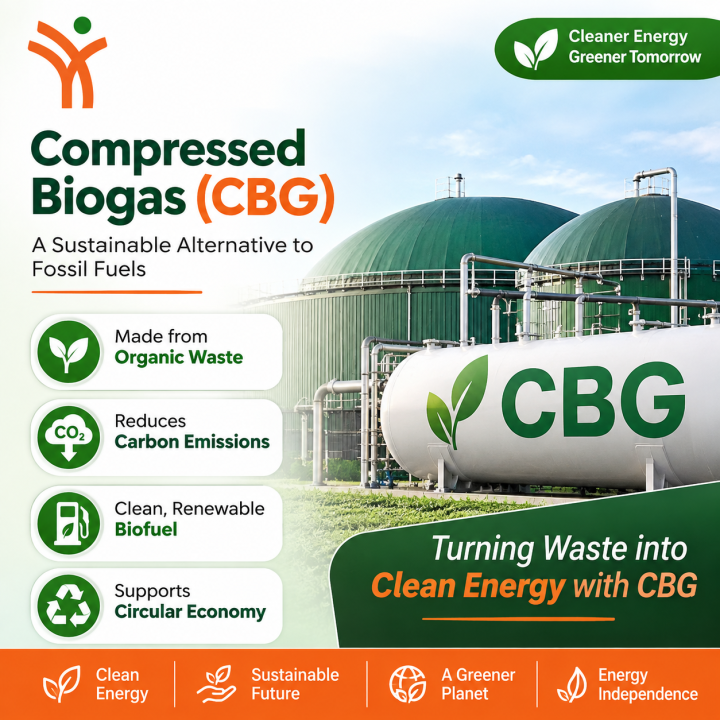
The demand for clean and renewable energy is increasing rapidly in India. At the same time, agricultural waste, animal manure, food waste, and other organic waste are creating major waste management challenges. A CBG plant provides a practical solution by converting organic waste into a clean and useful fuel called Compressed Biogas (CBG).
CBG is becoming an important part of India's renewable energy and waste-to-energy sector. But what exactly is a CBG plant, and how does it work? Let us understand the complete process in simple terms.
A Compressed Biogas plant is a facility that converts biodegradable organic waste into biogas and then purifies and compresses it to produce CBG. Feedstock can include agricultural residues, cattle dung, food waste, poultry waste, and other suitable organic materials.
The process starts with anaerobic digestion, where microorganisms break down organic matter in an oxygen-free environment. This produces raw biogas containing methane, carbon dioxide, moisture, and other impurities.
The raw biogas is then purified to increase its methane concentration. After upgrading and compression, the final product is known as Compressed Biogas or CBG. CBG can be used as a renewable alternative to conventional natural gas-based fuels.
The CBG production process generally involves several important stages:
Organic waste is collected and prepared before entering the plant. Stones, plastics, metals, and other unwanted materials are removed. Depending on the feedstock, the material may also be shredded, mixed, or homogenised.
Proper feedstock preparation helps improve digestion efficiency and protects the equipment.
The prepared organic material is transferred into an anaerobic digester. Inside the sealed digester, microorganisms break down the organic matter without oxygen.
This biological process generates raw biogas, which mainly contains methane and carbon dioxide along with small amounts of hydrogen sulfide, moisture, and other impurities.
Raw biogas cannot be directly considered CBG. It needs to be cleaned and upgraded to remove unwanted gases and moisture.
Different technologies can be used for biogas purification, including water scrubbing, Pressure Swing Adsorption (PSA), and membrane separation. These systems reduce carbon dioxide, hydrogen sulfide, moisture, and other contaminants.
After purification, the high-methane gas is compressed under high pressure. This produces Compressed Biogas (CBG), which can then be stored in suitable cylinders or cascades and transported for different applications.
The digestion process also produces a nutrient-rich by-product called digestate. After suitable processing, it can be used as an organic fertiliser or soil-conditioning material, depending on its quality and applicable requirements.
A typical CBG plant in India may include:
All these components work together to ensure efficient and safe CBG production.
CBG has several applications because its properties are similar to natural gas after proper purification. It can be used as:
This makes CBG useful for both the energy and transportation sectors.
A well-designed CBG plant can provide several environmental and economic benefits:
India is increasingly focusing on renewable energy, circular economy practices, and sustainable waste management. Government initiatives such as the SATAT scheme have also helped increase attention toward Compressed Biogas projects. Koshish India highlights CBG as part of its broader biogas and waste-to-energy solutions.
With suitable feedstock, proper technology, and efficient plant management, a CBG project can convert a waste management challenge into a renewable energy opportunity.
A CBG plant is more than just a renewable energy facility. It combines organic waste management, biogas production, gas purification, and fuel generation in one system. From agricultural waste and animal manure to food waste, suitable organic materials can be converted into valuable CBG.
As India moves toward cleaner fuels and a circular economy, Compressed Biogas plants can play an important role in creating sustainable energy while supporting better waste management and resource recovery.
Domestic Biogas , Commercial Biogas , BioGas , Sewage Water Treatment Plant , Effluent Water Treatment Plant , Zero Liquid Discharge Water Treatment Plant