x




Chemically modifying the ends of the molecules opens the door to glass that could decompose with organic waste.
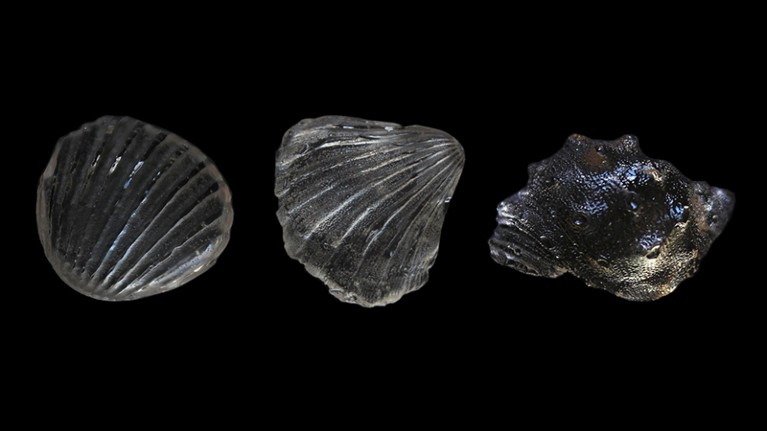
Researchers have modified amino acids and peptides and then coaxed it into a transparent glass. Here they demonstrate moulding it into sea-shell shapes.Credit: R.Xing et al./Science Advances (CC BY 4.0)
Researchers have transformed amino acids and peptides — the building blocks of proteins — into glass, according to a study published in Science Advances1. Not only is the biomolecular glass transparent, but it can be 3D printed and cast in moulds. The paper suggests that the glass biodegrades pretty quickly, but wouldn’t be suitable for applications such as drinks bottles because the liquid would cause it to decompose.
“Nobody ever tried this with biomaterials in the past,” says Jun Liu, a materials scientist at the University of Washington in Seattle. “It’s a good discovery.”
Standard glass is made using inorganic molecules, mainly silicon dioxide. The ingredients are melted down at high temperatures and then rapidly cooled. Glass can be recycled easily, but despite this, a substantial amount ends up in landfill, where it can take thousands of years to break down.
But amino acids are readily broken down by microorganisms, meaning that instead of sitting for years in a dump, the nutrients in biomolecular glass could, in principle, rejoin the ecosystem.
“The development of renewable, benign and degradable materials is highly appealing for a sustainable future,” says Xuehai Yan, a co-author of the study and a chemist at the Chinese Academy of Sciences in Beijing.
Typically, when amino-acid chains, known as peptides, are heated, the molecules start to split up before they melt. Yan and his colleagues modified the ends of the amino acids to change how they assemble and stop them from breaking up. After melting these modified amino acids, the researchers rapidly supercooled them — a process that takes molecules to below their freezing point while allowing them to retain its liquid arrangement. The researchers then further cooled the substance to solidify it into glass. It stayed solid when it returned to room temperature.
This method prevents the amino acids and peptides from forming a crystalline structure when they solidify, which would make the glass cloudy, although the authors note that in some cases the glass was not completely colourless.
When the researchers exposed the biomolecular glass to digestive fluids and compost, it took between a few weeks and several months to break down, depending on the chemical modification and amino acid or peptide used.
The glass is just a lab curiosity at this stage: “This is a very fundamental study,” says Ting Xu, a materials scientist at the University of California, Berkeley. However, she says it opens a new path for materials researchers to explore.
Because it can biodegrade, the glass would not be appropriate for use in environments that are very humid or wet, Xu says. Organic chemical bonds tend to be weaker than inorganic bonds, so she speculates that the peptide glass would be less rigid than standard glass. But she says that this property could be beneficial in flexible, miniature devices, such as the lenses of a microscope.