x





The sand drawings of Vanuatu follow principles from a branch of mathematics known as graph theory
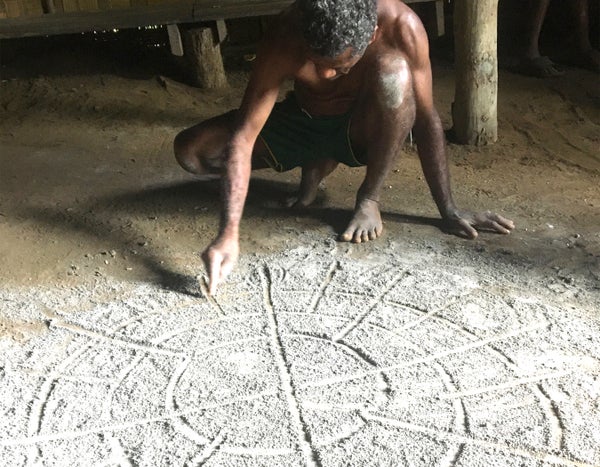
In Vanuatu, before making a sand drawing, the artist traces a grid that can be circular (pictured) or rectangular.
Credit:
Alban Da Silva
Mathematics
In October 2015 my time training mathematics teachers at a French high school in Port Vila, Vanuatu, was coming to an end. The principal invited me to share kava, a traditional drink in the country. As every social scientist in Vanuatu discovers, sharing kava is a fruitful opportunity for learning. This beverage, which is made from the roots of a tree of the same name, relaxes the drinker and loosens the tongue.
This first encounter with kava was also my introduction to sand drawing. That evening, one of the trainees took out a large board covered with very fine sand. After carefully flattening the surface, he drew a grid of horizontal and vertical lines. Then he began tracing furrows in the sand without ever lifting his finger. When the artist finished, he explained in the language Bislama, “Hemia hem i wan fis i ronwe i stap unda ston from i kat wan sak,” meaning “It is a fish that hides under a stone to escape the shark.”
The fluidity of the line, mixed with the effects of kava, plunged me into a state of wonder. The technique reminded me of the classic challenge to draw a complex figure with a single stroke, without lifting one’s pen or going over the same line twice. It also called to mind a “Eulerian graph” in mathematics, which involves a trail that traverses every edge exactly once while starting and ending at the same point.
As I considered these ideas, an intern approached me and whispered, “Where is the mathematics in this drawing, teacher?” Though he could not have known it, that remark would go on to shape the next six years of my life, including my doctoral work on sand drawing. One question particularly inspired me: How were such drawings created?
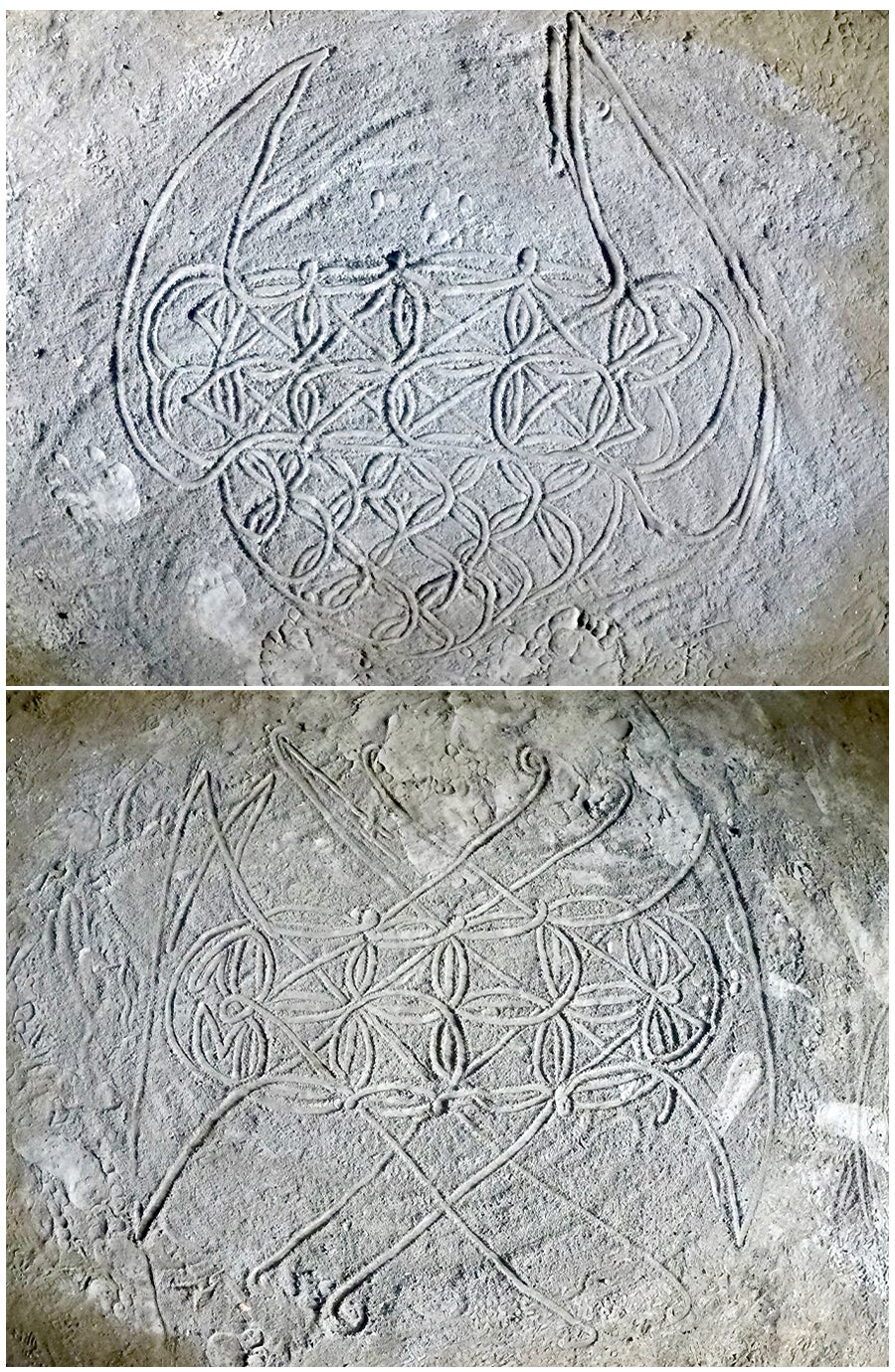
Sand drawings are complex figures drawn with a single finger stroke. Credit: Alban Da Silva
My investigation took me further than I could have imagined. By watching expert sand artists, learning about their methods, collecting drawings and history and exploring the work of 20th-century ethnologists, I have developed a mathematical model of sand drawing. My work shows that these artworks can be modeled as the result of algorithms and operations of an algebraic nature. Indeed, mathematical language turns out to be appropriate for describing the work of sand drawing experts. Furthermore, sand drawing can help us understand the relationships that Vanuatu societies maintain with their environment.
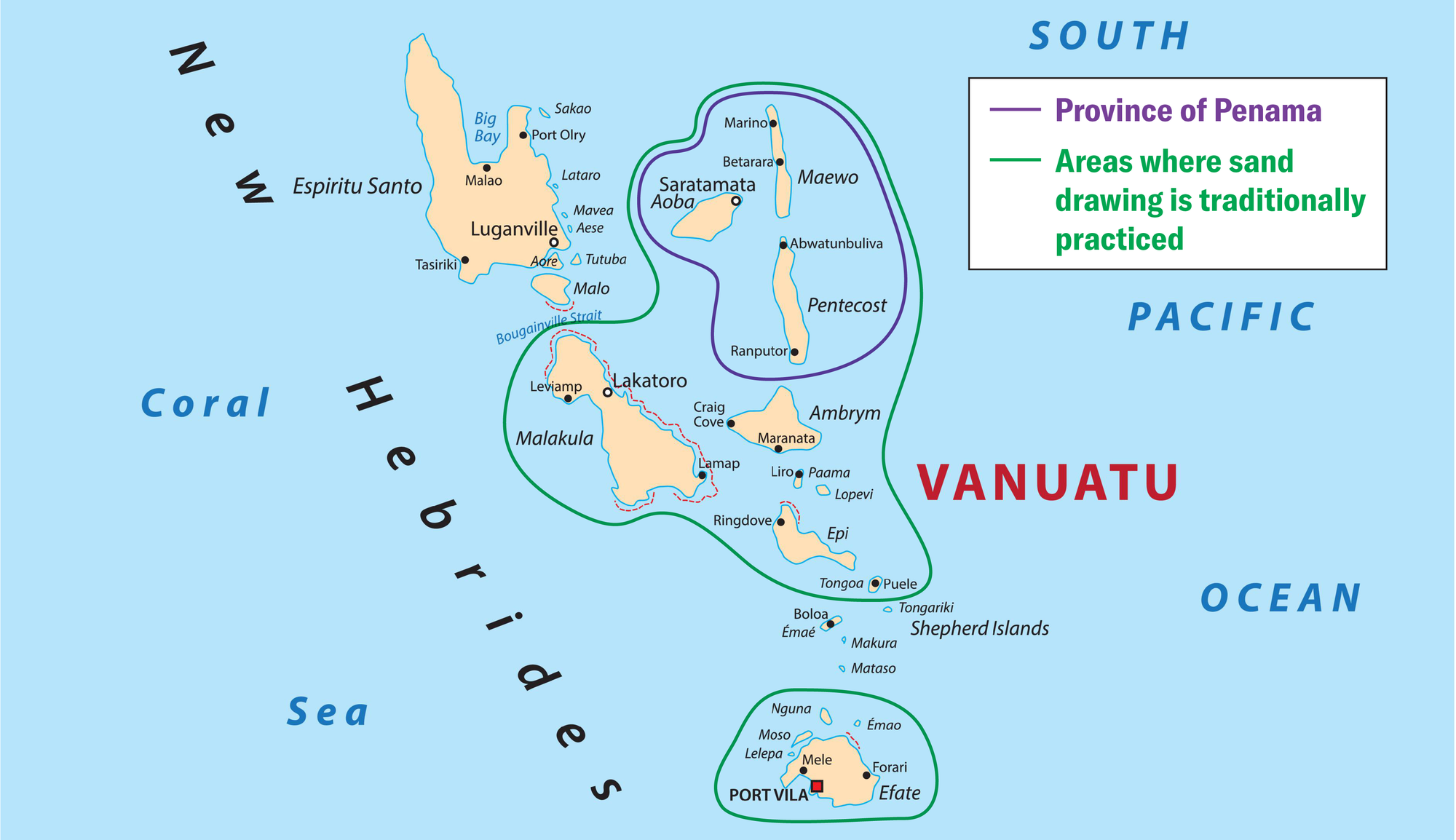
A map shows a portion of the archipelagic country of Vanuatu. Ethnomathematician Alban Da Silva studied sand drawing in the nation’s province of Penama, specifically on the islands of Maewo and Pentecost. Credit: Rainer Lesniewski/Alamy Stock Vector (map); Amanda Montañez (green and purple outlines and key)
Cultures vary in the north and south of the country and even within the same island. The sand drawing practice is widespread only in some central islands, for example. Although the tradition is reminiscent of drawings done on soil in Tamil Nadu, India, it is unique in many ways. In 2008 UNESCO classified the sand drawing of Vanuatu as part of the intangible cultural heritage of humanity.
My research is based on two field surveys that were conducted on Maewo Island in 2018 and Pentecost Island in 2019 and that particularly focused on drawings made by people in the Raga region (pronounced “Ra-ra”) on northern Pentecost Island. These islands, along with Aoba Island, constitute the province of Penama and are bound by common traditions, which greatly facilitated my research.
“Sand drawing,” or sandroing, as it is known in Bislama, is probably thousands of years old. Traditionally, it consists of a person drawing a continuous, closed line with their finger in beaten earth, sand beaches or ashes. (The words “continuous” and “closed” have the same meaning here as in mathematics: a drawing in the sand is similar to the closed continuous curve of a plane.) This drawn line is constrained by a composite grid of lines or dots. The grid can be rectangular or circular.
Although it is difficult to know how many designs are in use, it is clear that, over time, new ones appear, and others disappear. A system very close to intellectual property protects these drawings, making access to this traditional knowledge sometimes sensitive and challenging.
These artworks are multidimensional in their significance. Some iconic drawings of animals, insects or plants are closely linked with the beliefs, cosmogonies, social organization or even traditions of these societies—which are grouped together under the generic name of kastom. The drawings can also support narratives; they reveal the ethical or political dimensions of societies in central Vanuatu. In many cases, each design bears a vernacular name related to these different aspects.
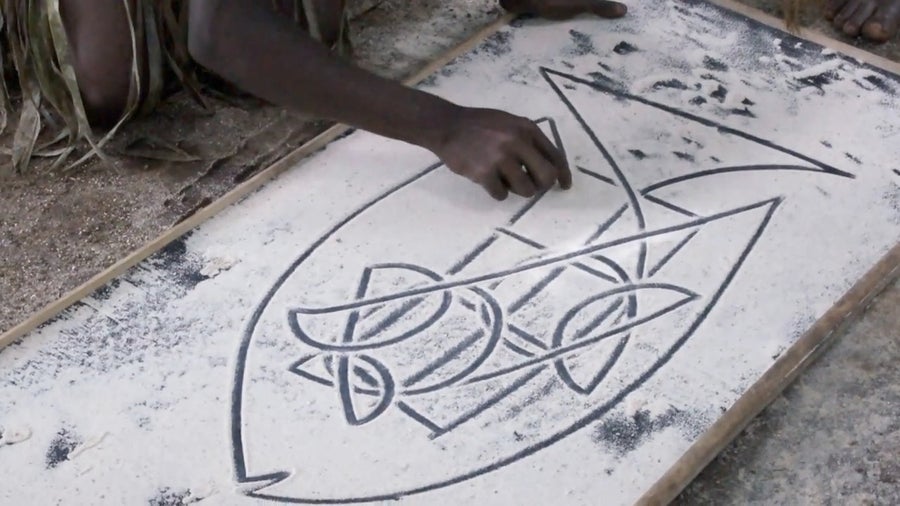
A sand drawing evokes a fish hiding under a stone to escape a predator. Credit: Alban Da Silva
Today these societies recognize this practice as a traditional graphic art that helps people recall ritual, religious and environmental knowledge. In addition, Jief Todali, a chief whom I met in the Raga region, explained to me that the artists are spokespeople: “Before the arrival of the tuturani [the white foreigners], the people of northern Pentecost did not know how to speak. They expressed themselves through drawings that they traced on the ground with their fingers. Instead of people, the rocks, the stones, the ground of the hills and valleys, the wind, the rain, the water of the sea spoke. But now the situation is reversed. It is the people who speak, and the earth, the wind, the rain and the sea are silent. Now [the people from the Raga region] sometimes say, ‘We have to speak for the land because it can no longer speak for itself.’”
Finally, this ephemeral art—each drawing is erased once it is finished—stimulates storytelling. Practitioners generally pair their drawings with the telling of a tale, and the most gifted ones are able to do this while drawing. It is not uncommon for them to appeal to the imagination of spectators by adding details related to their history, including familiar places, characters, animals and even vegetables.