x






If elected president, economist Javier Milei has pledged to eliminate government spending on research and shut down the environment and health ministries.
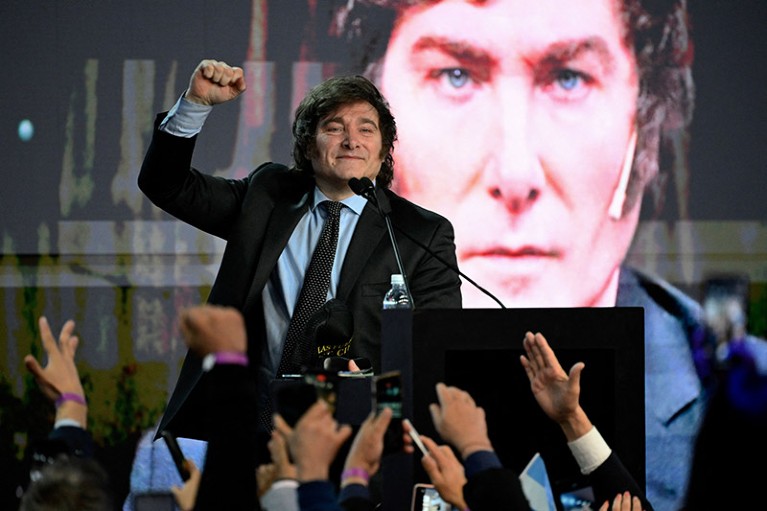
Javier Milei, a libertarian politician and economist, has risen to prominence in Argentina owing to a financial crisis.Credit: Luis Robayo/AFP via Getty
Scientists in Argentina are on edge as the country’s presidential election, slated for 22 October, approaches. Current front runner Javier Milei has promised to shut down the country’s main science agency, the National Scientific and Technical Research Council (CONICET), which provides funding for about 12,000 researchers at 300 institutions across Argentina.

Bolsonaro’s troubled legacy for science, health and the environment
The libertarian candidate — who has been likened to outspoken populist leaders such as former US president Donald Trump and former Brazilian president Jair Bolsonaro — has said that shutting down CONICET, with its 80-billion-peso annual budget (about US$400 million at the time the budget was set), could help to end Argentina’s fiscal crisis. He also thinks that investment in scientific research should come from private, rather than public, sources.
During the presidential primary elections in August, Milei’s party won 30% of the vote, whereas the party of Patricia Bullrich, a conservative candidate and former security minister, received 28%. The party of current economic minister Sergio Massa, who has more centrist views, received 27%. (Serving President Alberto Fernández is stepping down; he has lost the support of his party after missteps during his administration.)
The scientific community in Argentina, which has Latin America’s third-largest economy, is alarmed at the possibility of Milei’s presidency. The country’s National Academy of Exact, Physical and Natural Sciences in Buenos Aires issued a statement saying “there is no future without State investment in science” and pointing out that “in the most developed countries...scientific research receives a strong investment from the State”.
“Science is not an artistic hobby for our society, but a way to end poverty and finally develop the country,” says Jorge Aliaga, a physicist at Hurlingham National University in Buenos Aires. “It must be a priority”.
Milei is a relative newcomer to Argentine politics, having become a lawmaker in the lower chamber of the country’s Congress only in 2021. Previously, he was an economic adviser to firms including Aeropuertos Argentina 2000, which manages airports in the country. He has also won notoriety as a guest on talk shows discussing economics and his services as a tantric sex coach. His rise was precipitated by eight years of economic turmoil in Argentina: the country owes billions to creditors such as the International Monetary Fund; annual inflation has reached more than 120%; and 40% of the population is living in poverty.
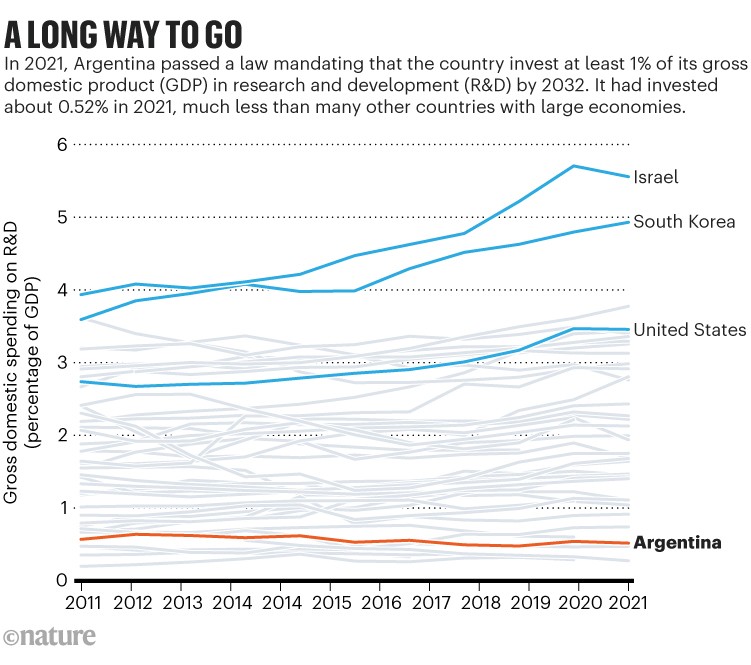
Source: Main Science and Technology Indicators/Organisation for Economic Co-operation and Development
To tame the crisis, Milei has proposed not only privatizing science, but also closing the environment and health ministries, and abolishing the current public-health and education systems. The anti-establishment politician has even floated the idea of allowing people to sell their own organs for profit. On environmental issues, he is equally provocative, calling climate change “a socialist hoax”, and saying that a company should be able to pollute a river as it sees fit. “From his perspective, any regulatory intervention by the state represents an attack against market freedom and, therefore, against individual freedom,” says Maristella Svampa, a sociologist at the CONICET-funded Center for Documentation and Research of Left-Wing Culture in Buenos Aires.
Milei has tapped into the public’s angst. He is currently leading the polls, although electoral experts don’t necessarily trust the figures, and his competitors still hope to win the upper hand. Bullrich has also proposed cutting government spending, but she has vowed to keep CONICET running. By contrast, Massa has pledged to raise Argentina’s science budget, in keeping with a law passed in 2021 mandating that the country invest at least 1% of its gross domestic product (GDP) in science and technology by 2032. In 2021, Argentina invested about 0.52% of its GDP in research and development, according to the Organisation for Economic Co-operation and Development in Paris. By contrast, countries including Israel or South Korea, which are considered healthy investors in science, contribute about ten times more (see ‘A long way to go’).
If Milei becomes president, say sources who spoke to Nature, researchers will leave the country to seek jobs. They will be able to make a living elsewhere because they are talented, Aliaga says. But “losing scientists is a problem for the country”.
“No government can afford to destroy science,” says Carlos Frasch, a molecular and cell biologist now retired from a CONICET-funded institute that is part of the National University of San Martín. Frasch points to a long line of scientific achievements in Argentina, including Nobel prizes won by its researchers, a locally developed COVID-19 vaccine that is in late-stage testing and a strong nuclear-power sector. The country could have a bright future, given the number of brilliant young people working in the country, but they “should not be lost by emigration”, he says.

Sergio Massa (left) and Patricia Bullrich (right) will run against Milei on 22 October to become Argentina’s next president.Credit: Tomas Cuesta/Getty
Because of economic crises that have long dogged Argentina, brain drain is a regular threat. Hyperinflation in the late 1980s and a banking crisis in 2001 drove thousands of scientists to seek work in Europe and the United States. Even so, Argentina still has one of the best ratios of researchers to inhabitants in Latin America, Aliaga says. In 2014, for instance, it had about 1,200 researchers for every one million inhabitants. By contrast, Brazil had about 890 for every one million people. “In that sense, Argentina has better numbers than Brazil and Mexico,” Aliaga adds.