x





The re-entry of the OSIRIS-REx sample canister is the most closely observed of its type in history.
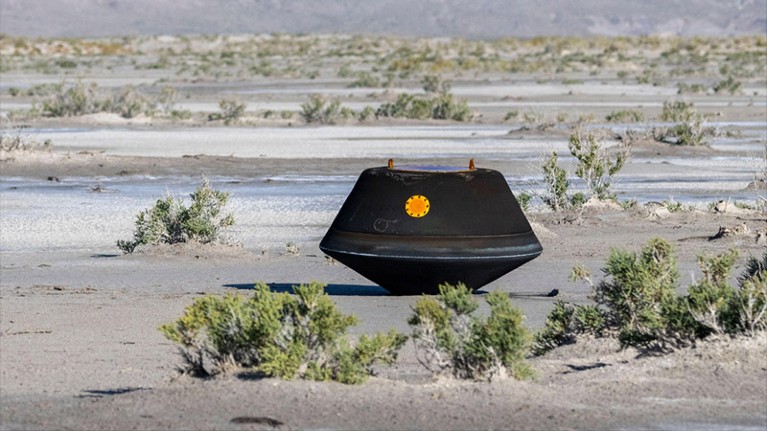
The OSIRIS-REx capsule rests on the desert floor in Utah after its long return trip from asteroid Bennu.Credit: Keegan Barber/NASA via Alamy
Physicist Jennifer Inman has observed the aerodynamics of many spacecraft, including NASA’s space shuttles, as they launched and landed. But on 24 September she had the chance to study a rarity: the return of a capsule carrying samples from a distant world.
That container was NASA’s OSIRIS-REx capsule, bearing fragments of a far-off asteroid. Before landing in Utah, it carved a small but blazing path in the skies of the western United States — becoming one of the fastest human-made objects to ever enter the atmosphere.
Inman and her team at NASA’s Langley Research Center in Hampton, Virginia, were among many researchers who positioned aeroplanes, balloons, seismometers and other equipment along the trajectory. All hoped to capture the capsule’s faster-than-sound passage, which offered the chance to collect data on phenomena that occur when meteors slam into the atmosphere. “It’s very rare to have something where we know when it’s going to be, where it’s going to be, and what it’s made of,” Inman says.
“This is the most-instrumented hypersonic re-entry in history,” adds Elizabeth Silber, a physicist at Sandia National Laboratories in Albuquerque, New Mexico, who coordinated most of the teams. Results are still being analysed, but it’s already clear that the researchers have captured a wealth of data, from a quiet but distinctive double sonic boom to an infrasound signal that might have slammed off the ground and bounced upwards as the capsule re-entered.
The findings can help scientists to better understand the energetics of incoming meteors1, such as the 18-metre-wide asteroid that exploded above Chelyabinsk, Russia, in 2013 with more than 30 times the energy of the Hiroshima bomb. The OSIRIS-REx capsule essentially serves as a human-made fireball to help scientists gauge the risks that asteroids might present, says Eleanor Sansom, a planetary scientist at Curtin University in Perth, Australia.
“We can’t replicate the types of environments that the capsule experiences in laboratories on Earth,” Inman says. So observing its re-entry gives physicists valuable information about the conditions in which high-speed missions return from space — and about how well engineers need to build heat shields to ensure that returning capsules survive.
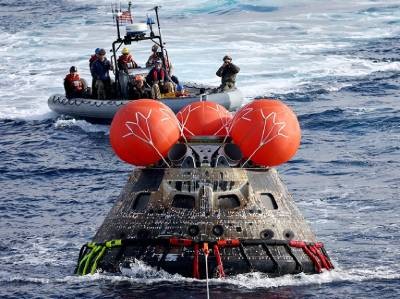
NASA’s Orion Moon capsule splashes down! Here’s what’s next
The OSIRIS-REx capsule slammed into the atmosphere above San Francisco, California, travelling east at 12 kilometres per second. Compressing the air in front of it like a piston, it created a glowing, superheated plasma of ionized gas and shock waves that emanated outwards.
The spacecraft is only the fifth non-lunar mission to return samples to Earth. Previous examples include two NASA missions in the mid-2000s, and the Japan Aerospace and Exploration Agency’s asteroid-sampling missions Hayabusa and Hayabusa2. Both of the Hayabusa capsules landed in the Australian outback, the first in 2010 and the second in 2020, and both landings were observed by researchers from Japan and elsewhere2.
Many of the same scientists used the same sensors this year in Utah to see how OSIRIS-REx’s return would compare with the descents of the much smaller Hayabusa capsules. A number of researchers headed to the tiny historic town of Eureka, Nevada, which was located beneath the spot in the sky where the capsule experienced the maximum amount of heating as it passed through the atmosphere.
Among the observers in Eureka were Yasuhiro Nishikawa, a planetary scientist at Kochi University of Technology in Kami, Japan, and his colleagues. To track the OSIRIS-REx re-entry, Nishikawa and other researchers used infrasound sensors, which pick up very-low-frequency vibrations; they had used the same technology to track the Hayabusa2 re-entry3. Such sensors are also used to listen for natural disturbances such as tsunamis, volcanic eruptions and landslides. “We are convinced that precision in meteorite energy estimation holds significant value for disaster prevention and various other applications,” Nishikawa says.
Several of Silber’s colleagues got up early on the morning of re-entry to deploy a variety of balloons into the atmosphere and await the capsule’s arrival. Infrasound sensors aboard several balloons captured the rumble as the OSIRIS-REx capsule passed, says Siddharth Krishnamoorthy, an aerospace engineer at the Jet Propulsion Laboratory in Pasadena, California. The balloons might even have captured infrasound signals bouncing off the ground. If confirmed, this would provide important information about how the energy of an incoming meteor interacts with the planet’s surface, says Danny Bowman, a geophysicist at Sandia National Laboratories.
The OSIRIS-REx capsule hurtles through the atmosphere in this footage captured by cameras aboard a NASA aeroplane.Credit: NASA's Goddard Space Flight Center
Just witnessing the OSIRIS-REx re-entry was an opportunity of a lifetime, says Ben Fernando, a seismologist at Johns Hopkins University in Baltimore, Maryland, who put out seismic sensors near Eureka. The capsule was not easily visible, because it was only a blip in the sky and was returning in daylight. But listening quietly as it passed overhead, Fernando and others heard a faint noise.
“I only heard a single sonic boom, so just a pop,” he says. But his sensitive seismic sensors recorded a double sonic boom, owing to the way that the plasma interacted with the air. Others heard it as a muffled thump-thump.