x






The nation currently allows institutes to investigate cases in-house — but calls to change this are mounting.
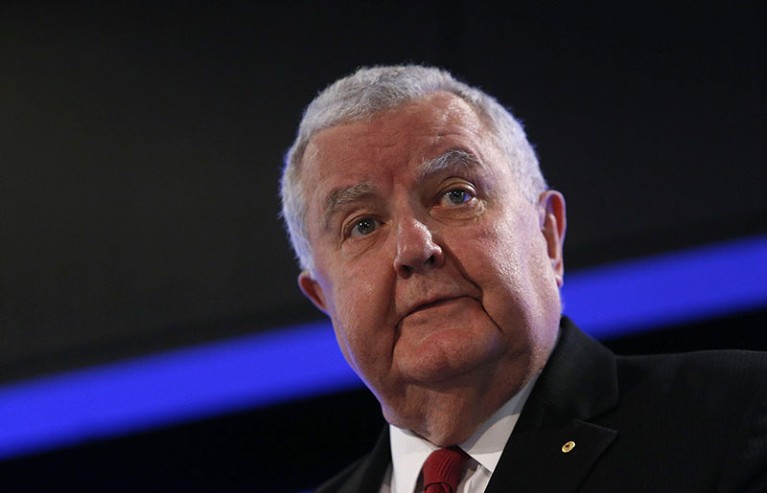
Ian Chubb, Australia's chief scientist from 2011 to 2016, has drafted a proposal for an integrity watchdog for the Australian Academy of Science.Credit: Daniel Munoz/AAP via Alamy
Australia’s academics are grappling with how to handle investigations into scientific misconduct. Unlike many other countries, the nation does not have an independent body to oversee such probes; instead, universities and research institutes carry them out themselves. Several high-profile misconduct cases are bolstering criticisms of the current system, and momentum is building to set up an independent research-integrity body — but university leaders are divided over whether one is needed.
“Australia is one of the only countries in the world that persists with the so-called self-regulation model,” says David Vaux, former deputy director of the Walter and Eliza Hall Institute of Medical Research in Parkville, Australia. For several years, Vaux has been campaigning for a research-integrity office to deal with misconduct allegations in the country, referring a number of complaints to universities for investigation. According to Vaux, more than 20 European nations, along with the United Kingdom, United States, Canada, Japan and China, have such offices.
Researchers in Australia are currently referred to ethical guidelines set out in the National Health and Medical Research Council (NHMRC)’s Australian Code for the Responsible Conduct of Research. In some cases, the Australian Research Integrity Committee (ARIC) reviews university investigations, but its scope is limited. It does not direct investigations itself; only cases in which research was funded by Australia’s main public funding bodies — the NHMRC and the Australian Research Council — fall in its remit, and there is a time limit on when the review can occur.
But some leaders at Australian universities maintain that in-house integrity units are adequate for rooting out cases of scientific misconduct, and that an over-arching integrity body would be wasteful.
Emma Johnston, the deputy vice-chancellor of research at the University of Sydney, Australia, says that a new research-integrity body would “create duplication, large expense and extensive delays in dispute resolution, as most integrity complaints involve confidential personnel matters that would need to be considered through other mechanisms”. Instead, she says, resources “could be more usefully directed into the creation of a research-integrity service to offer support for small research institutes”.
Two proposals for a national research-integrity body are being discussed. The first, by former head of South Australia’s Independent Commission Against Corruption, Bruce Lander, was published last September. According to Lander’s proposal, most investigations would still be carried out by the institution in which the alleged misconduct occurred, or by investigators commissioned by the institution. But unlike the ARIC, the integrity body would oversee the investigations and would have the power to designate who conducts the investigation and how.
Lander became convinced that such a body was necessary after the QIMR Berghofer Medical Research Institute in Brisbane asked him to investigate how it had dealt with a high-profile case of alleged misconduct. “A number of people found it difficult to report research misconduct because of the power imbalance that existed between them and the person to whom they had to report,” says Lander. It was also apparent, he says, that some institutions lack the resources to investigate cases. A statutory body would enable people to report alleged misconduct outside of their organization, and would work with institutions to define how a probe would run.
Arun Sharma, QIMR Berghofer council chair, supports Lander’s proposal because it “points a way towards ensuring that scientific research continues to enjoy the confidence of the community”.
Ian Chubb, who served as Australia’s chief scientist from 2011 until 2016, has also been working on a proposal to be released later this year for an integrity watchdog as the secretary of science policy at the Australian Academy of Science (AAS) in Canberra.
Similarly to the Lander proposal, Chubb envisages that most investigations into research misconduct would be conducted in-house, but the national integrity body would oversee those investigations and ensure that the institution adhered to any resulting recommendations. Chubb's proposal is wider-reaching than Lander's. Chubb says that a national body should be able to oversee investigations into research misconduct for all publicly funded research, including grants and tax concessions awarded to the private sector.
How soon either proposal could take shape isn’t clear. And so far, Australia’s wider research community remains split on whether a national integrity body is needed.
Vicki Thomson, chief executive of the Group of Eight (Go8) consortium of Australia’s leading research universities, questions whether such a body is necessary. “All Go8 universities have well-resourced research ethics and integrity units that educate researchers about complying with the Australian Code for the Responsible Conduct of Research,” she says.
Australia’s chief scientist, Cathy Foley, who last month released a statement on research integrity, describing it as “at the heart” of trust in science, is also lukewarm on the proposal. “I’m not opposed to an integrity body, but I haven’t seen a sufficiently robust case yet,” she says. “When questions of integrity arise, they need to be dealt with promptly, properly and transparently,” she adds, “but I am also convinced that Australian research is overwhelmingly of high integrity.”
But Nicholas Fisk, the deputy vice-chancellor of research and enterprise at the University of New South Wales in Sydney, supports the move. “The university would welcome a research-integrity national oversight body that is a light touch and co-designed with the higher education sector in an Australian context,” he says. He adds that “there are no national data, essential for monitoring the frequency, prevention and detection of serious research misconduct, while access to independent experts needed to undertake the more complex investigations is challenging”.
Virginia Barbour, the editor-in-chief of the Medical Journal of Australia, worries that debate about an integrity body might distract from broader questions of research integrity. “I don’t really come down on either side of whether Australia needs an office,” she says. “What would be my concern was it if it takes all the oxygen away from the bigger conversations that are happening about research quality and the culture at institutions,” she says.