x






In collecting genomic data for Indigenous Australians, scientists hope to expand knowledge of human genetic diversity and improve health for this group.
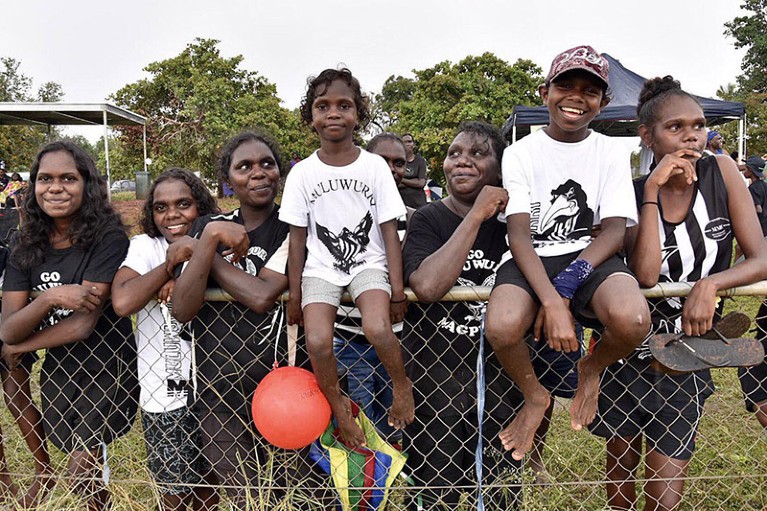
A group of Indigenous Australians watch a football match on the Tiwi Islands. Genomic analysis reveals that Indigenous Australians across the country have highly different genomes.Credit: Lucy Hughes Jones/AAP via Alamy
Australian Indigenous communities from different regions in the north and centre of the country are some of the most genetically distinct people on the planet, according to a pair of studies published in Nature today1,2. Indigenous Australian communities have the highest rate of genetic variation outside people in Africa.
Hundreds of thousands of human genomes have been sequenced since the Human Genome Project was launched in 1990, yet very few of these genomes are from Indigenous Australians.
“The history of genetic research has not proven to be kind to the interests of Indigenous and other diverse communities around the globe,” says study co-author Alex Brown, an Indigenous Australian from the Yuin nation and director of the National Centre for Indigenous Genomics at the Australian National University in Canberra.
As a result, Indigenous Australians are substantially under-represented in the genomic data sets that now underpin much research in medicine.
“Those data sets don’t contain any information about Indigenous peoples, and that creates bias in our interpretation of genomics,” says Hardip Patel, a co-author of both papers and a bioinformatics researcher at the National Centre for Indigenous Genomics.
There are health implications, too. Without Indigenous genomes in reference data sets, diagnosing genetic diseases in these groups is difficult. “If you’re trying to diagnose an Indigenous patient with a genetic disease, you’re comparing them to the wrong reference data set,” says Ira Deveson, a clinical genomics researcher at the Garvan Institute of Medical Research in Sydney, Australia.
However, the high degree of genomic variation between communities suggests that researchers need to do much more work to fully represent Australian Indigenous genetic diversity in these data sets, he says. “We actually need to cast the net wide and try to capture as many of the different community groups that are living in this country if we’re going to have truly inclusive reference data that will actually work,” he says.
One of the new studies1, which was led by the National Centre for Indigenous Genomics, has taken a step towards addressing that bias by sequencing the genomes of 159 individuals from geographically separate, remote Indigenous communities in four locations: the Tiwi Islands and Elcho Island, off the coast of the Northern Territory; Yarrabah in Queensland; and Titjikala in the central desert region. These were compared with a reference panel of individuals from Australia, Papua New Guinea, Eurasia and Africa. This analysis suggested that, as a whole, Indigenous Australians have almost as much genetic variation as Africa, but in some communities, particularly those on the Tiwi Islands, there is a relatively low rate of genetic variation.
The level of variation between Indigenous Australians and individuals from Papua New Guinea differed between communities, but suggested that the two populations diverged around 47,000 years ago.
The second study2 analysed the genomes of 121 individuals from the same Indigenous communities, and compared them with data from 18 Australians of European ancestry and two reference genomes. It revealed that around 12% of the structural variants — variations that are at least 50 base pairs in size — in the Indigenous genomes are unique to Indigenous Australians. “People have been living in Australia for at least 50,000 years, largely separate from the rest of the world, so it’s really no surprise that they're very genetically distinct,” says Deveson.
But the biggest surprise was the high degree of genetic diversity between the Indigenous communities. The majority of the Indigenous-specific genomic variants were found in only one community, rather than in all four. “We know that there is diversity in cultural diversity and traditions, and now we can show demonstratively that there is diversity in genomics as well,” Patel says.
The studies’ authors engaged with and consulted the Indigenous communities involved, to ensure that they were fully informed about the potential benefits and risks of providing their genomic data, how that information might be used, and what they did or did not consent to.
“We need to build relationships, we need to prove that we are careful and considered stewards of information data samples, and that we won’t make moves without communities being across the decisions that need to be made and have their voice heard in that process,” Brown says.
Maui Hudson, of the Whakatōhea people of New Zealand and director of the Te Kotahi Research Institute at the University of Waikato in Hamilton, New Zealand, says the study makes a significant contribution to starting to understand the variation that exists in Indigenous populations.