x






Scientists around the globe have expressed concern at reports that the Australian Antarctic Division will have its budget slashed by the government.
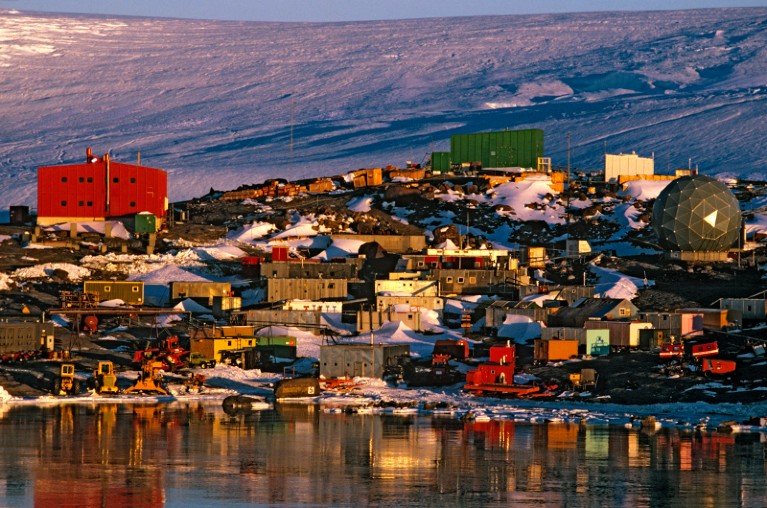
Mawson Station, one of the Australian Antarctic Division’s bases on the icy continent, will be run at a reduced staffing level in the summer of 2023–24.Credit: Auscape/Universal Images Group via Getty
Scientists worldwide fear that research tracking how climate change is affecting Antarctica will be disrupted, after it was reported that the Australian Antarctic Division (AAD) will cancel, postpone or strip back several of its research projects this summer because of a looming Aus$25-million (US$16.2-million) budget cut. The cut comes hot on the heels of the news that Antarctica’s sea ice has hit a drastic and surprising new low.
Among the projects on the chopping block are studies investigating how sea ice is changing in the warming climate. “It’s just a terrible blow for the science,” says Nerilie Abram, a palaeoclimate scientist at the Australian National University in Canberra who chairs the Australian Academy of Science’s National Committee for Antarctic Research.
The Mawson and Davis stations — two of Australia’s three permanent research bases on the icy continent — will not be staffed at normal summer capacity in the coming season, although many routine sea-ice and atmospheric measurements will continue to be made. Casey Station — Australia’s largest Antarctic research base — will support most of the research that is set to go ahead, including one project that aims to unravel past climate trends by studying ice cores that go back one million years and another that will investigate the Denman Glacier, one of the fastest-diminishing glaciers in East Antarctica.
In July, AAD management told staff by e-mail that it needed to reduce its annual operating budget for the next year by 16%. AAD staff have confirmed to Nature that several projects scheduled to be conducted from Davis and Mawson will not be supported this season, including surveys on sea-ice thickness and landfast sea ice — large ice sheets that are ‘fastened’ to the shoreline or sea floor.
Nathan Bindoff, a physical oceanographer at the University of Tasmania in Hobart, Australia, says he was “astonished” when he learnt about the cuts. “That’s a lot of money — even in a very big programme — to absorb,” says Bindoff, who leads the Australian Antarctic Program Partnership, which collaborates with the AAD to understand the role Antarctica has in the global climate system and the implications of this relationship on marine ecosystems.
On 27 June, data from the US National Snow and Ice Data Center showed that the sea ice surrounding Antarctica had reached a record low winter extent of 11.7 million square kilometres, more than 2.5 million square kilometres below the average for the same time of year between 1981 and 2010. Although researchers expect sea ice to dwindle as climate change intensifies, its drastic fall this year came as a surprise, says Abram.
Now, more than ever, researchers need to be on the ground in Antarctica to gain a better understanding of what’s driving the sudden decline in sea ice, she says. “We really need to get there to make those physical measurements.” Abram adds that gaps in long-term monitoring data will make it difficult for researchers to understand how Antarctic systems are changing as temperatures rise, particularly on the relatively understudied eastern side of the continent, where the Australian division is based.
Researchers at the AAD contacted by Nature who will be affected by the cuts declined to comment on the record about the impact on their work, although several expressed dismay.
Craig Stevens, a physical oceanographer at the National Institute of Water and Atmospheric Research in Auckland, New Zealand, says that tracking seasonal changes in sea-ice thickness is important for understanding how climate patterns are shifting. That requires measurements to be collected consistently over years, to provide the “critical information we need to understand how the planet is changing”, he says. “Scaling back sea-ice research I think is a real setback for all of us.”
Bindoff adds that the cuts will make it difficult for researchers to determine whether the recent changes in winter sea-ice extent are irreversible. Although some sea-ice measurements can be gathered using remote-sensing techniques, determining how thick the ice is and how it interacts with the ocean and atmosphere require measurements collected by researchers on the ground, he says. “We’re probably going to be too late to address some of these questions.”
Christian Haas, a sea-ice researcher at the Alfred Wegener Institute of the Helmholtz Centre for Polar and Marine Research in Bremerhaven, Germany, who collaborates with AAD researchers, says that it will be important for other nations to continue their sea-ice research in other parts of Antarctica. He adds that the upcoming AAD cuts will probably have a ripple effect on international researchers who rely on the Australian division for logistical support.
A spokesperson for the AAD did not respond to questions about how the projects to be cancelled or delayed were chosen, but said that the division “continues to prioritize critical science that supports understanding of climate, ecosystems and environmental stewardship”, and that there are no plans for redundancies.
Last week, the Australian senate established an inquiry into the reasons for the AAD’s reduced budget and the decision-making behind the cancellation of several research projects.
A spokesperson for the Australian Department of Climate Change, Energy, the Environment and Water — which oversees the AAD — said that the funding shortfall is due to the end of a temporary boost in funding related to the commissioning of the RSV Nuyina icebreaker, a research vessel that has faced a number of mechanical problems since it was delivered in 2021.
Wolfgang Rack, a glaciologist at the University of Canterbury in Christchurch, New Zealand, fears that the cuts will result in fewer opportunities for early-career researchers to build their skills in the field, which could lead to gaps in research capacity further down the track. “In the long-term, that can be significant,” says Rack, who works on New Zealand’s Antarctic Science Platform, a government-funded project that aims to understand how Antarctica influences global systems.
It’s a problem that’s all too familiar to Laura Dalman, a PhD candidate at the University of Tasmania focusing on sea-ice ecology. Dalman had been planning to conduct fieldwork with AAD researchers to understand how landfast sea ice supports algae and phytoplankton. But Dalman’s plans have been cancelled owing to the AAD’s slimmed-down budget, a disruption that will force her to change the direction of her project in the final year of her PhD. “With fieldwork in polar areas, from the get-go you work with a plan A and plan B,” says Dalman. “But I’m kind of on plan D.”
Dalman adds that because PhD students and early-career researchers are often on short contracts, cancellations and changes to plans can rob them of their only chance to gain experience in the field.