x






US president takes aim at China with proposal to invest big in manufacturing and clean energy.
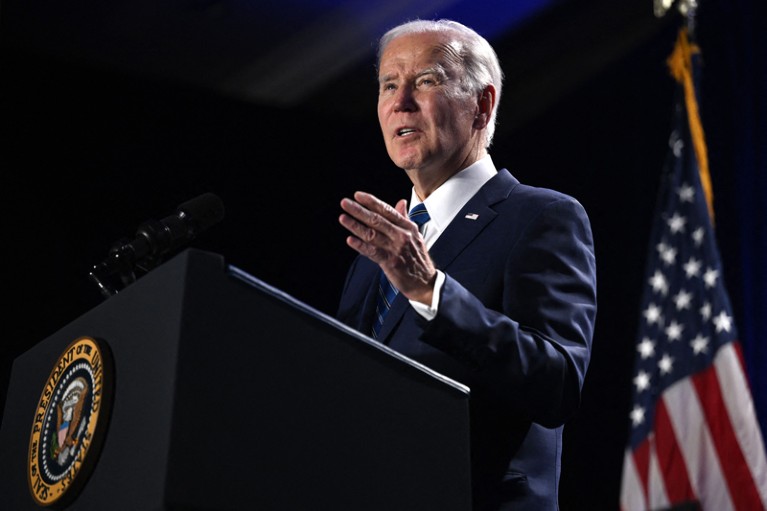
President Joe Biden released a budget proposal on 9 March that, he said, “outlines crucial investments to out-compete China globally”.Credit: Andrew Caballero-Reynolds/AFP/Getty
Facing a potential re-election battle next year, President Joe Biden laid out broad funding priorities for the US government on 9 March. His proposed budget for 2024 would invest new research funds into a range of programmes designed to achieve goals in scientific innovation, domestic manufacturing and clean energy, among others.
Biden’s budget was light on details, with funding specifics not yet available for many federal science agencies, but some clear winners emerged. In particular, the US National Science Foundation (NSF) would see its budget increase by nearly 19%, while the US Department of Energy’s office of science — a major investor in the physical sciences — would see its budget increase by nearly 9%.
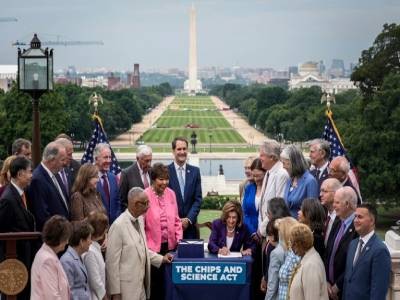
Billions more for US science: how the landmark spending plan will boost research
The amount of money going to federal agencies during fiscal year 2024, which begins on 1 October, will be decided by Congress, which is divided between a Republican-led House of Representatives and a Democrat-led Senate. It’s going to be a tough budget negotiation, says Neal Lane, former director of the NSF and senior fellow in science and technology policy at Rice University’s Baker Institute in Houston, Texas. But he says this budget, particularly the request for the NSF, emphasizes that Biden, a Democrat, is committed to innovation in science and technology, with an eye towards being competitive with China and other parts of Asia.
Adding to the tension, the United States is facing a looming fiscal crisis in the coming months. Congress must raise or suspend a self-imposed limit on the national debt if the country is to avoid defaulting on what it owes. However, Republicans are threatening to block any effort to raise the debt limit unless it is accompanied with significant spending cuts.
“We will see a battle over funding cuts, not just for research and development, but for the budget overall,” says Joanne Carney, chief government-relations officer for the American Association for the Advancement of Science in Washington DC. Citing recent breakthroughs in everything from fusion energy to the development of COVID-19 vaccines, she says it will be incumbent on the US scientific community to make the case for continuing investments in research, development and innovation.
Many of Biden’s fiscal requests point to his administration’s desire to ensure the United States remains competitive with China. They build on major legislation passed by Congress last year, known as the CHIPS and Science Act, which authorized US$280 billion to be doled out for domestic manufacturing of semiconductors and for research in the applied sciences, at agencies such as the NSF.
The NSF, which funds about a quarter of US academic research, would receive a budget boost of 18.6% over last year, to $11.3 billion under Biden’s plan. That includes $2 billion for research and development in technologies such as artificial intelligence, biotechnology and quantum computing, and $1.8 billion for programmes intended to expand — and diversify — the scientific workforce.