x




Observations of galaxy M87 show how the black hole at its centre relates to a long-seen stream of superheated matter.

The latest image of the black hole M87* shows a three-pronged jet emerging from it.Credit: R.-S. Lu (SHAO) and E. Ros (MPIfR), S.Dagnello (NRAO/AUI/NSF)
The first image of a black hole wowed the world in 2019. Fresh data could now help to explain what exactly radio astronomers were looking at — including details of the maelstrom it creates. And in an updated image, the black hole’s original orange ring now appears thinner, courtesy of a new way of analysing the existing data.
The first-ever image of a black hole is now a movie
The picture that graced the front pages of newspapers around the globe in 2019 showed the supermassive black hole at the centre of the galaxy M87, called M87* (see ‘Black-hole image evolves’). By themselves, black holes do not emit any radiation, so the orange doughnut (representing radio-wavelength emissions) must have been produced not directly by the black hole, but by matter in its vicinity that is ‘superheated’ and twisted by magnetic fields. “Without any matter around, you would not even see a ring,” says Thomas Krichbaum, a radio astronomer at the Max Planck Institute for Radio Astronomy in Bonn, Germany. “Something has to radiate.”
The black hole’s gravity bent rays of light to produce the ring shape, as expected from Albert Einstein’s general theory of relativity. But although astrophysicists had theories, there was no clear indication — on the basis of that image alone — as to the origin of the radiation. The most likely explanation was that the glow resulted from the same mechanism that causes a stupendously bright jet of superheated matter to protrude far out from the host galaxy. The existence of this jet was known long before the black hole was imaged, and it had been photographed with more conventional instruments including the Hubble Space Telescope.
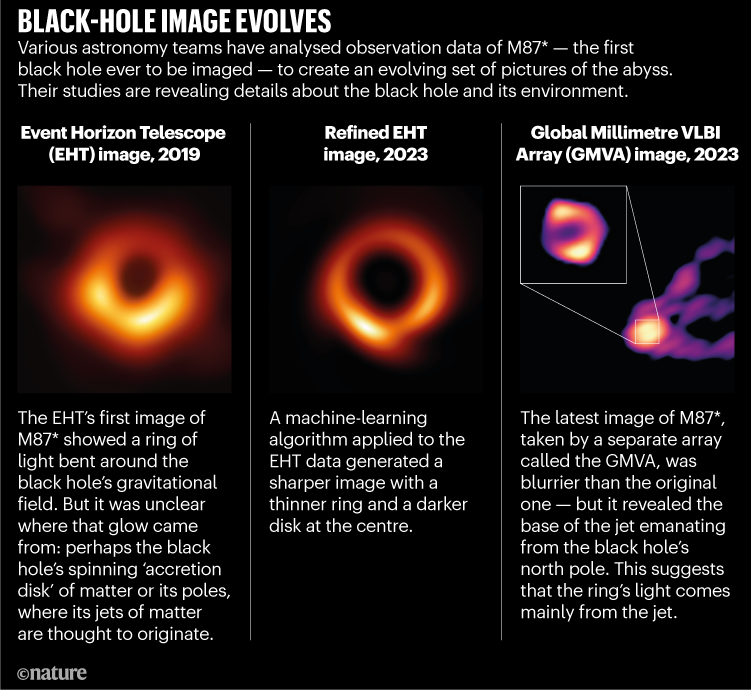
The original M87* image was blurry, and showed only the immediate vicinity of the black hole’s event horizon, the spherical surface that shrouds its interior. Any material that crosses the event horizon falls inwards, never to return. It was challenging to link the image to the larger-scale pictures of the jet.
In a paper published in Nature on 26 April1, radio astronomers including Krichbaum crunched through a separate data set and found a cone of radio emissions emanating from the black hole in the same direction as the jet.
The original M87* image used 2017 data from the Event Horizon Telescope (EHT), a network of observatories scattered across four continents that examined the black hole at a wavelength of 1.3 millimetres. The latest paper used data taken in 2018 with the Global Millimetre VLBI Array (GMVA), a separate and older network that shares many collaborators with the EHT and uses some of the same facilities, but observes at 3.5 millimetres.

Black hole pictured for first time — in spectacular detail
Both networks use a technique called interferometry, which combines data taken simultaneously at multiple locations. The larger the separation between the participating observatories, the better the resolution and the more details astronomers can discern; going to shorter wavelengths has the same effect. With its lower resolution, the GMVA cannot see the ring as sharply as the EHT, and it needs some extra data massaging. But the GMVA is able to see a wider picture. “For the first time, we see how the jet connects to the ring,” says Krichbaum.
In a separate paper, published in The Astrophysical Journal Letters on 13 April2, astrophysicist Lia Medeiros at the Institute for Advanced Study in Princeton, New Jersey, and her collaborators reanalysed the 2017 EHT data using a new machine-learning algorithm.
Algorithms that process the telescope data must overcome an intrinsic limitation of interferometry: even with observatories on opposite sides of the planet, the array does not truly gather data with an Earth-sized dish, but with shards of one. “There is an infinite number of images that are consistent with our data,” Medeiros says. “You need to make a choice about which one you think is most likely.”
In the 2019 results, the EHT team used conservative algorithms that artificially blurred the image. Medeiros’s team developed an algorithm based on a technique called dictionary learning that maximizes the resolution — and produces a substantially thinner ring. Medeiros is eager to apply the technique to data on Sagittarius A*, the black hole at the centre of our Galaxy. The EHT released an image of Sagittarius A* last year.
The EHT has also produced various versions of the M87* images, including one showing signatures of magnetic fields, and has used older data to show how the ring has evolved over the years, in images that can be combined into a movie. The collaboration conducted observation campaigns in 2018 and once a year between 2021 and 2023, but has not yet finished analysing those data. Most intriguingly, the 2023 campaign included observations at the challenging wavelength of 0.87 millimetres, which should further improve the resolution.