x






Scientists are devising ways to edit the genomes of immune cells without having to extract them from those being treated.
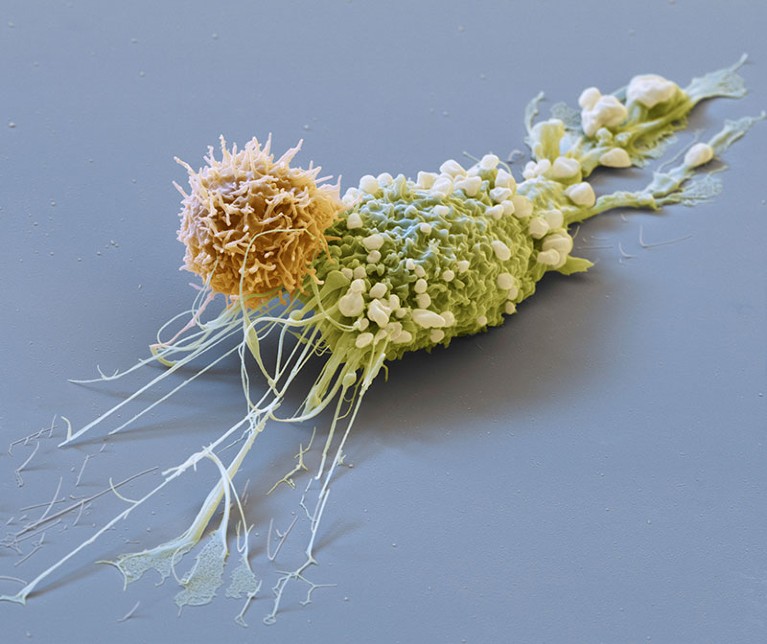
A breast cancer cell (green; artificially coloured) is attacked by a CAR T cell (orange).Credit: Eye of Science/Science Photo Library
Researchers are closing in on ways to produce CAR T cells in the body, raising hopes that the notoriously expensive and bespoke cancer therapies might one day become more accessible.
In CAR-T treatment, immune cells called T cells are removed from the person receiving treatment, engineered to target cancer cells and reintroduced to their body. The process has yielded dramatic recoveries from advanced forms of some blood cancers, but its high price and technical difficulty have placed it out of reach for many people.
Results presented at the American Society of Hematology annual meeting in San Diego, California on 11 December suggest that people undergoing treatment might eventually just get an injection of a virus that infects T cells. The virus would then insert the genes needed to guide the T cells to tumour cells.
“You don’t need to take the cells out, you don’t need to purify them,” says John DiPersio, a transplant immunologist and oncologist at Washington University in St. Louis, Missouri, who says that he was sceptical that the approach would work until he heard the talks at the meeting. “They convinced me that it’s possible.”
The key lies in finding ways to genetically engineer T cells to express chimeric antigen receptors (CARs), proteins that recognize cancer — without meddling with the genomes of other cells, says Els Verhoeyen, an INSERM research director at the International Center for Infectious Disease Research in Lyon, France, who develops viruses for use in gene therapies. To do so, she and other researchers have been modifying viruses to recognize molecules found only on the surface of T cells.
‘It’s all gone’: CAR-T therapy forces autoimmune diseases into remission
At the haematology conference, two companies presented the results of their efforts to use viruses to engineer T cells still inside the bodies of monkeys. Teams from both Interius BioTherapeutics in Philadelphia, Pennsylvania and Umoja Biopharma in Seattle, Washington, generated CAR-T treatments that target other immune cells called B cells, mimicking the action of approved CAR-T therapies that treat cancers caused by abnormal B cells.
In both companies’ experiments, the treatment was sufficient to deplete the monkeys’ B cells. Interius reported that B-cell counts were reduced by at least 75% in 15 out of 16 animals treated. The two companies plan to request authorization next year from the US Food and Drug Administration to begin trials on people.
“The goal now really is kind of within reach,” said Stephen Russell, the chief executive of Vyriad, a biotechnology company in Rochester, Minnesota, who presented similar results on mice at the meeting.
For DiPersio, the monkey results were a particular surprise. T cells tend to be in an inactive state as they circulate in the bloodstream, which makes them less likely to be infected by the viruses used to shuttle in the genes. As a result, DiPersio says that he had not expected that enough T cells would be engineered to produce such dramatic reductions in B-cell numbers.
“You just inject a virus that has all of these targeting molecules on it and that does the trick,” he says.
The hope is that the technique could expand the use of CAR-T therapies: the current cost of the treatment and necessary hospital care can together exceed half a million US dollars.
Could CAR-T-cell therapy offer hope to children with cancer?
A host of challenges awaits that approach as well, however. For one, regulators will want to see evidence that the process truly targets only T cells and leaves other cells untouched, says Verheoyen.
Researchers have also tried to generate CAR T cells from cells that have been donated by an unrelated person, and engineered to evade detection by the recipient’s immune system. If successful, that would allow cells from a single donor to be used to treat many people. That approach still holds promise, but the results from these therapies have thus far been disappointing, driving greater interest in approaches that can generate CAR-T cells directly in the body, says Andrew Scharenberg, chief executive of Umoja.
Less than a block away from Umoja, near the eastern shore of Lake Union in Seattle, sits Sana Biotechnology, a company that has been developing a virus designed by Verhoeyen to generate CAR T cells in the body. Earlier this year, Sana announced that it was scaling back that programme to concentrate on other projects, including CAR-T therapies made from donor cells.