x





Researchers publicly call out theory that they say is not well supported by science, but that gets undue attention.
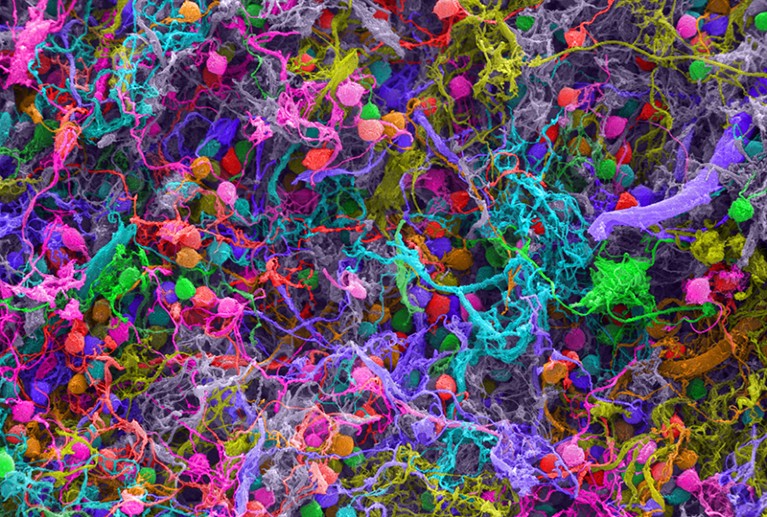
Some research has focused on how neurons (shown here in a false-colour scanning electron micrograph) are involved in consciousness.Credit: Ted Kinsman/Science Photo Library
A letter, signed by 124 scholars and posted online last week, has caused an uproar in the consciousness-research community. It argues that a prominent theory describing what makes someone or something conscious — called the integrated information theory (IIT) — should be labelled as pseudoscience. Since its publication on 15 September in the preprint repository PsyArXiv, the letter has resulted in some researchers arguing over the label and others worrying that it will increase polarization in a field that has grappled with issues of credibility in the past.
Decades-long bet on consciousness ends — and it’s philosopher 1, neuroscientist 0
“I think it’s inflammatory to describe IIT as pseudoscience,” says neuroscientist Anil Seth, director of the Centre for Consciousness Science at the University of Sussex near Brighton, UK, adding that he disagrees with the label. “IIT is a theory, of course, and therefore may be empirically wrong,” says Christof Koch, a meritorious investigator at the Allen Institute for Brain Science in Seattle, Washington, and a proponent of the theory. But he says that it makes its assumptions — for example, that consciousness has a physical basis and can be mathematically measured — very clear.
There are dozens of theories that seek to understand consciousness — everything that a human or non-human experiences, including what they feel, see and hear — as well as its underlying neural foundations. IIT has often been described as one of the central theories, alongside others such as global neuronal workspace theory (GNW), higher-order thought theory and recurrent processing theory. It proposes that consciousness emerges from the way information is processed within a ‘system’ (for instance, networks of neurons or computer circuits), and that systems that are more interconnected, or integrated, have higher levels of consciousness.
Hakwan Lau, a neuroscientist at the Riken Center for Brain Science in Wako, Japan, and one of the authors of the letter, says that some researchers in the consciousness field are uncomfortable with what they perceive as a discrepancy between IIT’s scientific merit and the considerable attention it receives from the popular media because of how it is promoted by advocates. “Has IIT become a leading theory because of academic acceptance first, or is it because of the popular noise that kind of forced the academics to give it acknowledgement?”, Lau asks.
If AI becomes conscious: here’s how researchers will know
Negative feelings towards the theory intensified after it captured headlines in June. Media outlets, including Nature, reported the results of an ‘adversarial’ study that pitted IIT against GNW. The experiments1, which included brain scans, didn’t prove or completely disprove either theory, but some researchers found it problematic that IIT was highlighted as a leading theory of consciousness, prompting Lau and his co-authors to draft their letter.
But why label IIT as pseudoscience? Although the letter doesn’t clearly define pseudoscience, Lau notes that a “commonsensical definition” would be “something that is not very scientifically supported, that masquerades as if it is already very scientifically established”. In this sense, he thinks that IIT fits the bill.
In addition, Lau says, some of his co-authors think that it’s not possible to empirically test IIT’s core assumptions, which they argue contributes to the theory’s status as pseudoscience.
Decoding the neuroscience of consciousness
Seth, who is not a proponent of IIT, although he has worked on related ideas in the past, disagrees. “The core claims are harder to test than other theories because it’s a more ambitious theory,” he says. But there are some predictions stemming from the theory, about neural activity associated with consciousness, for instance, that can be tested, he adds. A 2022 review found 101 empirical studies involving IIT.
Liad Mudrik, a neuroscientist at Tel Aviv University in Israel who co-led the adversarial study of IIT versus GNW, also defends IIT’s testability at the neural level. “Not only did we test it, we managed to falsify one of its predictions,” she says. “I think many people in the field don’t like IIT, and this is completely fine. Yet it is not clear to me what is the basis for claiming that it is not one of the leading theories.”
The same criticism about a lack of meaningful empirical tests could be made about other theories of consciousness, says Erik Hoel, a neuroscientist and writer based in Cape Cod, Massachusetts. Hoel is also a former student of Giulio Tononi, a neuroscientist at the University of Wisconsin–Madison who is a proponent of IIT. “Everyone who works in the field has to acknowledge that we don’t have perfect brain scans,” Hoel says. “And yet, somehow, IIT is singled out in the letter as this being a problem that’s unique to it.”
Lau says he doesn’t expect a consensus on the topic. “But I think if it is known that, let’s say, a significant minority of us are willing to [sign our names] that we think it is pseudoscience, knowing that some people may disagree, that’s still a good message.” He hopes that the letter reaches young researchers, policymakers, journal editors and funders. “All of them right now are very easily swayed by the media narrative.”
Mudrik emphasizes that she deeply respects the people who signed the letter, some of whom are close collaborators and friends, but says that she worries about the effect it will have on the way the consciousness field is perceived. “Consciousness research has been struggling with scepticism from its inception, trying to establish itself as a legitimate scientific field,” she says. “In my opinion, the way to fight such scepticism is by conducting excellent and rigorous research”, rather than by publicly calling out certain people and ideas.