x




Males of the notorious yellow crazy ant carry a mixture of genomes, a phenomenon unseen in other animals.
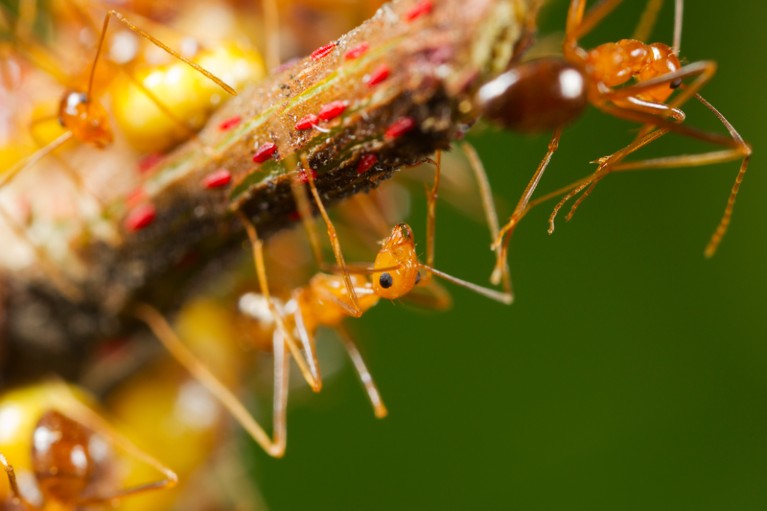
Credit: Stephen Belcher/Nature Picture Library
Yellow crazy ants get their name from the helter-skelter movements they make after a disturbance.
But there’s another reason to call these invasive ants crazy: males of the species are a mixture of two warring cell lineages, researchers report in a study1 published on 6 April in Science. Other creatures sometimes form such chimaeras — usually a developmental accident — but yellow crazy ants are the first known animal for which this property is an essential aspect of life.
“It’s a piece of biology that’s unparalleled as far as we know,” says Daniel Kronauer, a biologist at the Rockefeller University in New York City.
Yellow crazy ants (Anoplolepis gracilipes) are a notorious invasive species mainly distributed across southeast Asia and Oceania, threatening invertebrates and even some small mammals. On Christmas Island, an Australian territory south of Java, the ants have decimated populations of red crabs, which are endemic to the region.
The first clues to the ants’ weird biology came from studies of genetic markers peppered across their genomes. Males seemed to carry two versions of many genetic markers. This was a perplexing feature, because in most ant species, the males develop from unfertilized eggs and therefore have just one genome copy.
Some ant species occasionally have ‘diploid’ males with two genome copies, but these males are usually sterile. “It was really weird that all the males in this species would be diploid,” says Hugo Darras, an evolutionary biologist at the Johannes Gutenberg University Mainz in Germany. “It didn’t make sense at all.”
To determine what was going on, Darras and his colleagues analysed individual cells from yellow crazy ants collected across southeast Asia. This showed that each male cell contained just one version of the ant’s genome. But this genome differed between cells. Some harboured a lineage present in queens, and defined by an ‘R’ chromosome, whereas other cells carried a lone copy of a different genome, with a ‘W’ chromosome.
The cells of queen ants have two copies of the W genome, whereas sterile female worker ants have one copy of each lineage in every cell. Darras’s team found that males’ chimaerism has a crucial role in the ants’ caste system.
All the queen’s eggs carry one copy of the R genome. If this egg is fertilized by a sperm cell with an R genome, a queen develops. However, if the egg is inseminated with a W sperm, there are two possible outcomes. If the two genome-containing cell nuclei fuse, a diploid worker ant develops. If the nuclei do not fuse, the egg develops as a chimeric male, some cells carrying an R and others carrying a W genome.
“This is great,” says Monica Gruber, an applied ecologist at Wellington UniVentures in New Zealand, who co-authored a 2013 study2 that raised the possibility of chimaerism in males. “They finally cracked the enigma that kept me awake at night for much of my PhD.”
Crazy yellow ants’ chimaerism could contribute to the species ability to evade ecosystems, says Kronauer. Queens have specialized organs that store sperm from multiple males. That means a lone queen storing R and W sperm can start a new ant colony. Lori Lach, an ecologist at James Cook University in Cairns, Australia, wonders if researchers could take advantage of their quirky biology to keep small ant populations from turning into big ones.
But the discovery raises as many questions as it answers. It’s not clear why the nuclei of some sperm fail to fuse with the egg nucleus, resulting in chimeric males. Genes in W lineage cells — which are over-represented in sperm — might play a part, says Durras. “There’s so much we don’t know.”