x






Pathogens and pandemics have played a huge part in shaping human history right up to COVID-19 — but their exact effects remain highly debatable.
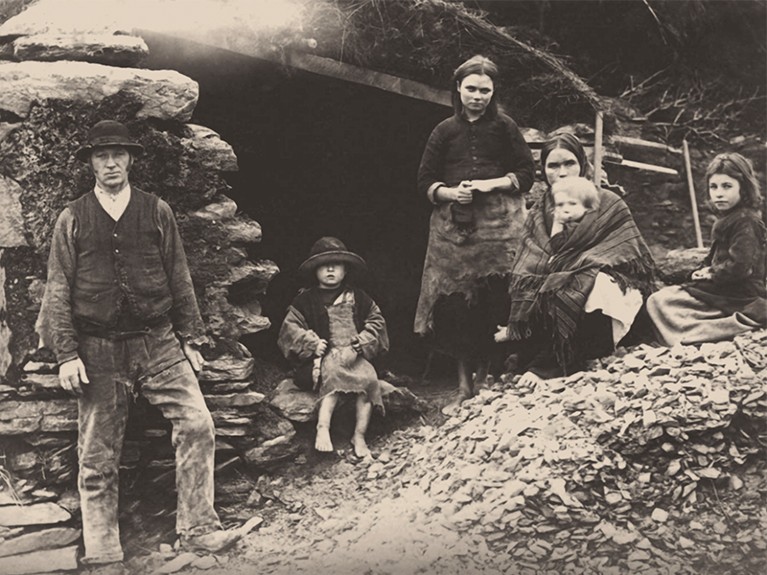
The ruinous effects of the 1840s potato famine were felt in Ireland for decades afterwards.Credit: Fine Art Images/Heritage Images/Getty
Pathogenesis: How Germs Made History Jonathan Kennedy Torva (2023)
Microorganisms have been key actors in human history. Take how US President Joe Biden describes himself as ‘Irish’. He traces this heritage back to ancestors in Ireland, including his great-great-great grandfather, who was involved in relief efforts in Ballina, during the Great Famine of the 1840s.
The famine was caused by the fungus-like potato pathogen Phytophthora infestans, which had spread from Mexico to the United States and, from there, to Europe. When it finally reached Ireland, it caused potato crop failures that killed around one million people between 1845 and 1852, mostly because of epidemics of typhus (caused by Rickettsia prowazekii bacteria) and a bacterial infection known as relapsing fever. Historically, typhus epidemics have usually been associated with famines and wars — poor nutrition leads to high mortality, and poor living conditions increase the number of bacteria-infected lice and, therefore, transmission of the disease. Between the census years 1841 and 1851, the Irish population decreased by 2 million; around 1.3 million of those people went to the United States between 1847 and 1854.
The political effects of the famine-stimulated diaspora continue. The direct lethal effect of typhus in Ireland has been matched only by the 2.5 million to 3 million deaths it caused during the 1917–23 Russian civil war that led to the establishment of the Soviet Union.
Jonathan Kennedy, a reader in politics and global health, does not cover typhus in Pathogenesis, his examination of microbes and their effects on human history. His approach springs less from microbiology than from a Marxist view of history, in which conflict between social groups is the prime motivator of change. Kennedy considers how prehistoric and medieval events, along with slavery, colonialism and the Industrial Revolution, might be linked to the spread of infectious diseases. He ends by considering the impact of the COVID-19 pandemic.
Coverage of events in prehistoric or medieval events is as detailed as the evidence allows. But speculation abounds because the quality of historical records is so poor. Did the Black Death sweep away 60% of the European population in 1348–49, as some historians contend? It is difficult to say. In England, the only census conducted before this time was for the Domesday Book in 1086, and this record tells us almost nothing about the number of peasants, the majority of the population. Nearly all estimates of the plague’s effects come from church archives; medieval records, in general, are characterized by hyperbole and a love of round numbers.
Kennedy’s contention is that a massive population decline in the English peasantry led to the demise of feudalism and the emergence of capitalism. But even if a decrease in population did occur on that scale — and there is plenty of circumstantial evidence that economic and other activities were not that severely affected — correlation is not causation. The Black Death didn’t end feudalism in eastern Europe and Russia. There, the feudal system got stronger, with the eventual introduction of serfdom by Russian tsar Boris Godunov at the turn of the seventeenth century, and the development of the ‘robot’ system of forced labour in parts of the Central European Habsburg empire during the eighteenth century.
But Kennedy is right to state that pandemics and plague outbreaks have had a big influence throughout human history. Such dramatic episodes get written up by historians, and Kennedy describes their accounts with verve. But concentrating on these well-documented events ignores many important human pathogens that don’t behave in this way. In the 1920s, most people became infected with Mycobacterium tuberculosis, but only some died from it. That minority had been dwindling steadily in England since the 1830s, evidence of the improvements in living standards eulogized by Steven Pinker in his 2018 book Enlightenment Now (whose arguments are characterized by Kennedy as “swaggering” and “booming”). I declare an interest: I have a lesion called a calcified Ghon focus in one of my lungs caused by M. tuberculosis and I test positive for the bacterium in a tuberculin test, although I have never had clinical symptoms.
Another non-dramatic but important pathogen is hookworm (Necator americanus). A century ago, this worm silently infected about 50% of children in the southern United States, impeding their — and the region’s — development. Worm larvae burrow between the toes of barefoot children when they walk over ground contaminated with human faeces. Housing improvements, and especially properly draining toilets, have played a crucial part in reducing infection rates about 50,000-fold.
The reduction in tuberculosis infections in the United Kingdom might be partly thanks to improved public-health regulations, but probably mainly because of the increased availability of affordable protein-rich food: by 1910, there were 25,000 fish and chip shops in the country. Glaswegians escaped cholera during the 1867 pandemic because their water came from a Highland loch by way of an aqueduct built a decade earlier to supply industry, fire hydrants and the burgeoning population. Oddly, Scotland is barely mentioned by Kennedy, despite being one of the first countries to urbanize, with more than one-third of the population in 1850 living in towns. Even so, feudalism had persisted despite the Black Death 500 years before — its coal miners were colliery-bound serfs until 1755.
Someone else is missing, too: the medical microbiologist. Kennedy takes their work for granted. Identifying HIV and turning infection by it into a non-lethal condition was a scientific tour de force that shaped human history, too. So was the use of penicillin to treat syphilis and scarlet fever. Kennedy limits himself to describing the difficulties that many African countries have in supplying HIV antiretroviral drugs to their populations, and the possibility that antimicrobial resistance might lead to the next pandemic.
He thinks that COVID-19 will be a crucial inflection point in human history. I would suggest it is too early to tell. Maybe its long-term influence will be no more than that of the 1918–19 influenza pandemic, which killed nearly as many people as did COVID-19 in the United Kingdom, and more than during the country’s cholera epidemics. Collectively, the cholera outbreaks have mostly slipped from our historical consciousness, and Kennedy mentions them only in passing. But for all the epoch-making quality of the current pandemic, he considers that there is nothing new or remarkable about it. I disagree. Never before have we responded to a virus with near-universal lockdowns or defined its progress genomically.
No other pathogen shows a straightforward linear relationship between age and mortality, either. The 1918–19 flu pandemic killed young adults. COVID-19 targeted care homes, but killed hardly any of the hundreds of thousands of infected university students. Only typhus comes close to having such marked age-related effects, killing mostly older people. Yet it still killed 15-year-old Anne Frank in the Bergen-Belsen concentration camp, Germany, in 1945.
Kennedy’s book is well written and controversial. Don’t read it to understand the science of pandemics; it doesn’t contain much about that. Read it for one take on their history and sociology.