x




Findings could help researchers to better understand ‘participation bias’ in studies that link genomics with health, behaviour and other traits.
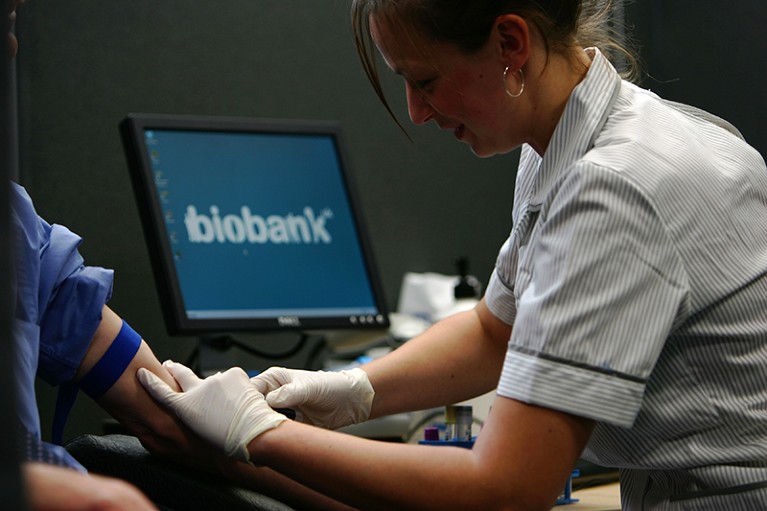
A nurse collects a study participant’s blood sample for the UK Biobank.Credit: Christopher Furlong/Getty
Researchers mining a genetic study of half a million people have found that participation in such studies could itself have a genetic component.
The discovery, published on 13 July in Nature Genetics1, could help researchers to account for some of the biases in large studies linking genomics with health, behaviour and other traits.
Such studies overwhelmingly represent people of European ancestry. And there are other types of ‘participation bias’ that can hamper efforts to identify robust genetic associations that apply to the wider population. For example, participants in the UK Biobank — a repository of genome and health data from more than 500,000 people in the United Kingdom — tend to be more educated, have lower body mass indexes and be less likely to smoke than the average for the UK population.
To better understand participation bias, Augustine Kong and Stefania Benonisdottir, statistical geneticists at the University of Oxford, UK, set out to identify genetic variants that distinguish people who participated in the UK Biobank from others who did not.
The researchers realized they could overcome the idea that, “by definition, that’s not possible”, says Kong. They analysed pairs of first-degree relatives in the database — siblings or parents and children — who share some identical stretches of DNA called haplotypes. By analysing shared haplotypes, they could glean information about other first-degree relatives who are not in the database.
For example, siblings who participate in the study each have two versions of a haplotype, one inherited from their mother and the other from the father (who themselves will pass on just one of their two versions of a haplotype to a child). Gene variants that boost study participation are more likely to lie on those haplotypes for which both siblings inherited the same version from one parent, the researchers realized. Variants in the parents’ genomes that discourage participation are less likely to end up on the stretches of DNA their children share.
Wide-ranging genetic study of severe COVID finds common risk factors
On the basis of this concept, the duo analysed the genomes of 4,427 pairs of parents and children and 16,668 sibling pairs in the UK Biobank, all of white British descent. None of the variants the researchers identified individually had a strong enough link with study participation to meet the stringent criteria used to avoid spurious genetic associations. So Kong and Benonisdottir developed a ‘polygenic score’ that combined the estimated effects that around 500,000 genetic variants have on study participation. Further analysis showed that these genes account for just a small fraction of someone's propensity to participate in the UK Biobank.
Using this polygenic score, the researchers also found that some other traits, especially level of education, are associated with some of the same genetic variations that influence study participation. But there was only partial overlap. “We can’t say that participation in genetic studies can be completely explained by other traits,” says Benonisdottir. Participating in studies, she adds, is complex trait in its own right.
Untangling all the different behavioural factors that go into study participation is tricky, says Andrea Ganna, a statistical geneticist at the University of Helsinki. His team found, in a study published earlier this year, that gene variants linked to COVID-19 vaccine uptake were also associated with participating in follow-up studies open to people enrolled in the UK Biobank2 and, in unpublished work, to adhering to prescribed drugs.