x




Experiments with C. elegans suggest that the mechanism by which cannabis affects appetite evolved 500 million years ago.
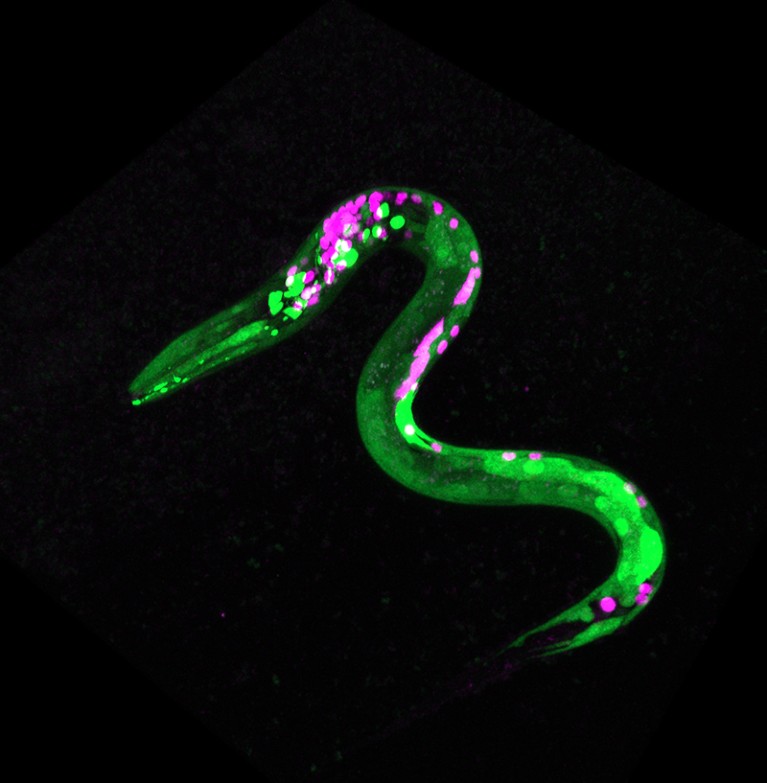
In this genetically engineered C. elegans, neurons that respond to cannabinoids appear green.Credit: Stacy Levichev(CC BY-SA)
Roundworms exposed to cannabis chemicals get the ‘munchies’ — a persistent hunger for tasty food — just like people do, a study has found. When under the influence, Caenorhabditis elegans worms choose to feed for longer than normal, and show a stronger preference for their favourite high-quality foods over less nutritious options.
The study, published on 20 April in Current Biology1, suggests that the mechanism by which cannabis affects appetite evolved more than 500 million years ago, when the evolutionary paths of C. elegans and humans diverged. This commonality across the animal kingdom suggests that C. elegans could be used to study how cannabis affects the human nervous system.
“The more we know at a basic level about drug physiology, the more healthy our society will ultimately be,” says Shawn Lockery, a neuroscientist at the University of Oregon in Eugene who led the research.
Lockery and his colleagues were inspired to carry out the experiments after the state of Oregon legalized the recreational use of cannabis in 2015. “We had marijuana on the brain, in a conceptual sense,” he says.
Cannabinoid molecules derived from the cannabis plant bind to the same receptors as molecules naturally found in the body, called endocannabinoids. Those receptors are found in the brain and many other tissues, and the endocannabinoid system is thought to regulate key functions, such as sleep, memory, anxiety and eating.
The research group already specialized in food-choice assays that involve putting C. elegans in a T-shaped maze containing two food options and observing which the worms choose to approach. To investigate the behavioural effects of cannabinoids, the researchers immersed the worms in a solution of the endocannabinoid anandamide before placing them in the maze.
Video of C. elegans worms in a T-maze (at 180x speed). Nutritionally superior food is at the end of the left arm; inferior food is at the end of the right arm. Credit: Aaron Schatz(CC BY-SA)
At first, it was just a quick test. “We soaked the worms just to see if they would — we were hoping — get the munchies,” Lockery said.
The worms that received this endocannabinoid bath did seem to develop a bigger appetite. When in the maze, they showed a stronger preference for nutritionally superior bacteria than did their sober peers, and spent more time eating. Worms under the influence also showed less interest in nutritionally inferior bacteria. These effects showed up only in C. elegans that had working endocannabinoid receptors.
“The thing that surprised me was how tightly it all fit together,” says Lockery.
In subsequent experiments, the researchers tested endocannabinoids on worms genetically engineered to have human cannabinoid receptors. The modified worms responded in the same way. The researchers pinpointed the effect of cannabinoids to one of the main food-detecting olfactory neurons, which, in worms given the drug, became more sensitive to the odours of preferred food and less sensitive to the smells of inferior food.
Past research has shown that cannabinoids cause this kind of ‘hedonic feeding’ in mammals other than humans, including rats and primates. The latest work adds C. elegans to the list, indicating that cannabinoid receptors and cannabinoid-influenced behaviours evolved a long time ago, says Kent Berridge, a neuroscientist at the University of Michigan in Ann Arbor.
“We did know that neurotransmitters are ancient and conserved going way, way back,” Berridge says. “But that it has this same function of promoting eating, especially, in this case, nutrient-rich foods … that’s remarkable.”
The similarities suggest that C. elegans could provide a cost-effective way to model how cannabis-derived compounds affect the nervous system in people.
Cannabis research will continue to expand as the drug becomes legal in more regions, says Anne Hart, a neuroscientist at Brown University in Providence, Rhode Island. “It used to be that studying these compounds was really hard,” says Hart. “We’re going to learn a lot more in this field over the next five or ten years as you let researchers figure out how these compounds really work.”