x






A massive gravitational-wave detector and the new solar telescope are among the priorities on funders’ latest roadmap.
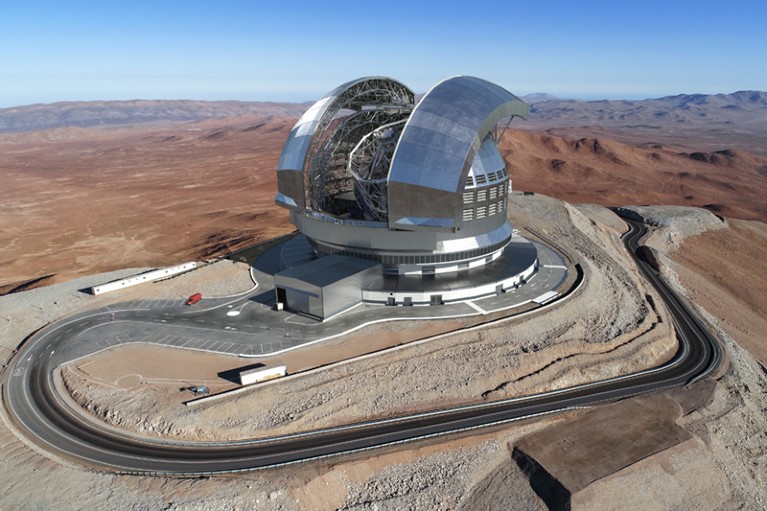
An artist’s impression of the Extremely Large Telescope — one of the projects supported in Astronet’s 2008 astronomy roadmap that is currently under construction.Credit: ESO
A list of the astronomy projects that European funders should prioritize has been unveiled by Astronet, a network of European funding agencies and research organizations.
Among the recommended projects are a new wide-field spectroscopic telescope, support for the Einstein Telescope — a gravitational-wave detector still in development — and the European Solar Telescope, which will study the Sun’s magnetic field. Space-based missions include a follow-up to the Gaia spacecraft that is mapping billions of stars.
US astronomy's 10-year plan is super-ambitious
“I was particularly excited to see the nature of dark matter and dark energy marked out as key unanswered questions,” says Priyamvada Natarajan, an astronomer at Yale University in New Haven, Connecticut.
Astronet came up with its 2022–2035 astronomy roadmap after consulting with the academic community for nearly three years, says Amélie Saintonge, an astrophysicist at University College London who edited the final report. The consultation process involved several working groups of researchers who advised on the scientific priorities in their fields and the technology needed to achieve their research goals.
Balancing the needs and wishes of the entire community was a big part of the process, says Saintonge. “If you look at some of our top recommendations in terms of ground-based facilities, you have, for example, the European Solar Telescope, which is a facility that really is most of interest for the solar-physics community,” she says. “Next to that we have recommendations of other facilities that are far more general,” she adds, for example a spectroscopic telescope that could see really distant galaxies in large spectroscopic surveys. “One of the reasons we prioritize that is because it is of appeal to essentially all science areas, it would be a very versatile facility,” she says. “At this time, strategically, you need that kind of spectroscopy facility to follow up and make the most of many other things that are upcoming.”
This is the second time Astronet has produced a roadmap for European astronomy. The first was published in 2008, and updated in 2015. Since then, Astronet has become independent of the European Commission, which hosted the network until 2015.
The network’s 2008 roadmap recommended that funders prioritize the 42-metre Extremely Large Telescope on Cerro Armazones, Chile, and the Square Kilometre Array in Meerkat National Park, South Africa and Boolardy, Australia. Both are large infrastructure projects that are currently being built. The latest report recommends providing ongoing support to these telescopes. “It’s a bit of a continuum from previous reports,” says Colin Vincent, chair of Astronet’s board, and associate director for astronomy at the UK Science and Technology Facilities Council, based in Swindon.
The roadmap has overlap with other long-term planning reports such as the European Space Agency’s Voyage 2050 programme and the US National Academies of Science, Engineering, and Medicine’s decadal survey, released in 2021, which sets out research priorities in astronomy and astrophysics.
Space-weather forecast to improve with European satellite
This report is in some ways the European counterpart to the decadal survey, explains Saintonge, “but at the same time, it’s quite a different exercise”. The US version has a budget attached to it, and is often seen as binding: the recommendations are the projects that will be funded. “This is much more of a community-driven effort and much more European astronomers establishing a wish list of what they would like to see.”
“It’s not just about the big facilities, it’s about [the whole] ecosystem of facilities,” adds Saintonge. “That means funding computing, machine learning, artificial intelligence,” she says, along with investment in training.
The roadmap also recommends that sustainability and diversity are prioritized in funding decisions. “Everybody wanted to see in there a strong component about sustainability, and the impact of astronomy research on society and the planet.”
Jean-Marie Hameury, an astrophysicist at the Observatory of Strasbourg in France, led the creation of the first Astronet roadmap and is pleased that a follow-up has been produced. European astronomy needs long-term planning in the broadest sense, he says. “There is a need for such a thing that covers both ground and space aspects. And also all wavelengths.”