x






Vega C launch failure, tracked to a Ukraine-made part, could further delay a handful of missions.
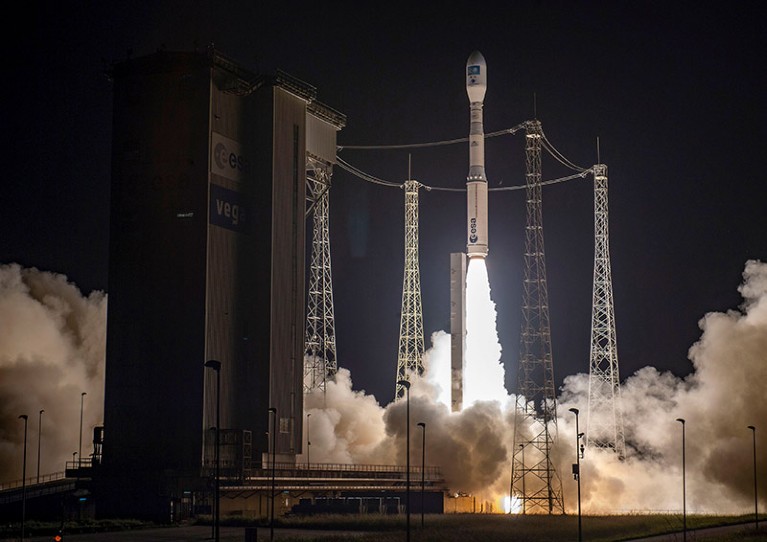
The Vega C rocket failed a few minutes after launching on 20 December.Credit: JM Guillon/AP/Shutterstock
A European rocket’s launch failure last December was caused by a defective part produced in Ukraine, an official investigation has found. The Vega C, which had its debut flight only last July, will now be grounded at least until the end of the year, which could exacerbate a backlog of missions waiting to launch.
The delay is the latest in a series of setbacks that have severely limited Europe’s launch capabilities. “This is a moment when we need to reflect deeply how we regain independent access to space for Europe,” said Josef Aschbacher, director-general of the European Space Agency (ESA), headquartered in Paris, at a press briefing on 3 March.
Ukraine conflict jeopardizes launch of Europe’s first Mars rover
Vega C’s smaller and less powerful sibling Vega has also experienced two launch failures in the past four years. Production of the heavy-lifting rocket Ariane 5 has been discontinued, and its successor Ariane 6 has been delayed and won’t have its first flight until later this year at the earliest. And following Russia’s full-scale invasion of Ukraine more than a year ago, European countries have cancelled contracts for launches with Russia’s Soyuz rockets.
Only two Ariane 5 rockets are still available: one is scheduled to launch ESA’s Jupiter Icy Moons Explorer in April. Another major ESA mission, the Euclid space telescope, had to be reassigned from a Soyuz to a SpaceX Falcon 9, and will therefore lift off in July from Cape Canaveral, Florida, instead of ESA’s Kourou spaceport in French Guyana. “It is not really easy to move a spacecraft from one launcher to another,” says Euclid mission manager Giuseppe Racca, at ESA in Noordwijk, the Netherlands, “but we managed.”
The Vega and Vega C programmes are managed by ESA and Arianespace, based in Évry-Courcouronnes, France. Both rockets are built by a European consortium led by Avio in Colleferro, outside Rome.
The first stage of the Vega C — a solid booster of the same design as those used by Ariane’s bigger launchers — performed flawlessly after lift-off on 20 December. The engine on the second stage — a Zefiro 40 liquid-fuel motor designed and assembled by Avio — then ignited as planned, said Pierre-Yves Tissier, chief technical officer of Arianespace and co-chair of the investigation into the failed launch.
European space telescope to launch new era of exoplanet science
But 144 seconds into the flight, pressure in the hoses that feed the nozzle started to drop. The investigation panel traced the problem to a component made of a carbon–carbon composite, which was manufactured by Ukrainian company Yuzhnoye, based in Dnipro, before the war began.
The component, which feeds fuel into the nozzle, has to withstand high mechanical stresses and thermal gradients, but its density was not sufficiently homogeneous, which led to its rupture. The investigation did not find any weakness in the design of the Zefiro motor.
Aschbacher said that the ESA will reallocate €30 million (US$32 million) to replace the defective part and perform a fresh series of tests of the motor on the ground. ESA and Arianespace aim to resume Vega launches by September 2023 and Vega C launches by the end of the year. It will not be a moment too soon: Vega and Vega C now have a backlog of 15 flights, in which they are meant to carry payloads including ESA’s Earth-mapping probe Sentinel-2C and EarthCARE, a climate and weather satellite, ESA will operate the latter with the Japan Aerospace Exploration Agency, based in Tokyo, and the National Institute of Information and Communications Technology, based in Koganei, Japan.