x






Physicist-turned-politician Sylvie Retailleau speaks to Nature about her ambitions for the country’s scientific research.
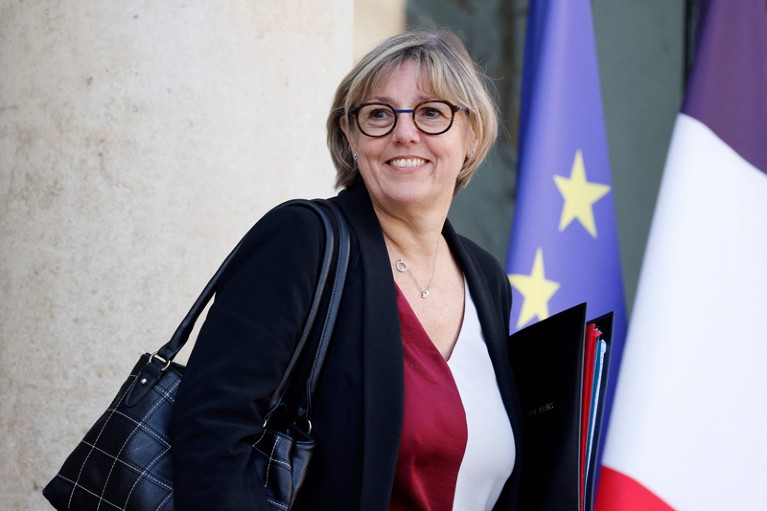
Sylvie Retailleau took up the post of minister of higher education and research in the French government last year.Credit: Ludovic Marin/AFP/Getty
A physicist by training, France’s minister of higher education and research Sylvie Retailleau was no stranger to the scientific community when she took office last May. Before entering politics, she honed her negotiation skills by bringing together different collaborators at Paris–Saclay University and by helping to put together France’s first ten-year plan for research.
In her first interview published in English since taking up the post, Retailleau speaks to Nature about her ambitions for science in France.
My objective is evolution, not revolution, and to strike a balance between the three pillars of my portfolio — research, training and innovation. Academia is tired of new structures and the top-down approach of the past 15 years. It wants stability and a clear vision of where, why and how we are going. One of my first tasks was to establish closer collaboration with my education, health, agriculture and industry colleagues.
We have a number of programmes in the pipeline that will bring new money to research, such as a €7 billion plan for health innovation including €1.3 billion for research, as well as a ‘risky research’ plan that will be unveiled soon. We will continue to increase pay to attract young people to careers in science. Basic pay and bonuses have risen sharply for all categories of scientific staff since the research plan came into force. Researchers are not always aware of that.
The idea is to clarify the relationship between major research universities, small regional niche universities and national research agencies such as the CNRS [the French National Centre for Scientific Research]. Universities will have more autonomy, but not independence, and agencies will have a national role, deciding on strategy piloting and coordinating programmes by theme. Mixed university–research agency laboratories will continue to exist, but each lab will be managed by one person instead of several. Research programmes will probably be centralized, for example, by the CEA [the French Alternative Energies and Atomic Energy Commission] for energy and INSERM [the National Institute of Health and Medical Research] for biomedical research, along the lines of the approach taken by the US National Institutes of Health. Philippe Gillet, former president of the ANR, the French National Research Agency, will present proposals in the spring on how this is to be achieved.
The new landscape should simplify scientists’ lives. I would like researchers to have more time to devote to research. This means simplifying the management of laboratories that report to more than one organization and, as I mentioned, having a single boss. Management tools must be the same across the board and be shared among labs’ supervisory bodies to avoid duplication of administrative tasks. This would also simplify the introduction and follow-up of research programmes.
Basic research is crucial, because it shapes our future. Funding for this comes from both government grants to research agencies and the ANR. Most ANR funding goes to non-specific projects, the majority of which involve basic research. The success rate for these project tenders has risen sharply in the past two years.
Several projects already exist, such as the annual Science Festival. A new project will be launched soon in conjunction with the education and equal-opportunities ministries to attract young people to science. That will be introduced gradually between September and summer 2024. One problem is that many schoolteachers have no science background, but that will change when science becomes a compulsory subject in the teacher training bachelor’s course, starting in the 2024–5 academic year.
My cabinet colleagues do listen to me and ask for explanations. This has been a pleasant surprise. I wish the media showed as much interest in research as the cabinet does. President Emmanuel Macron understands that science is a continuum and questions me in detail about technology and innovation.