x




Most detailed analysis yet pinpoints the contagious tumours’ origins.
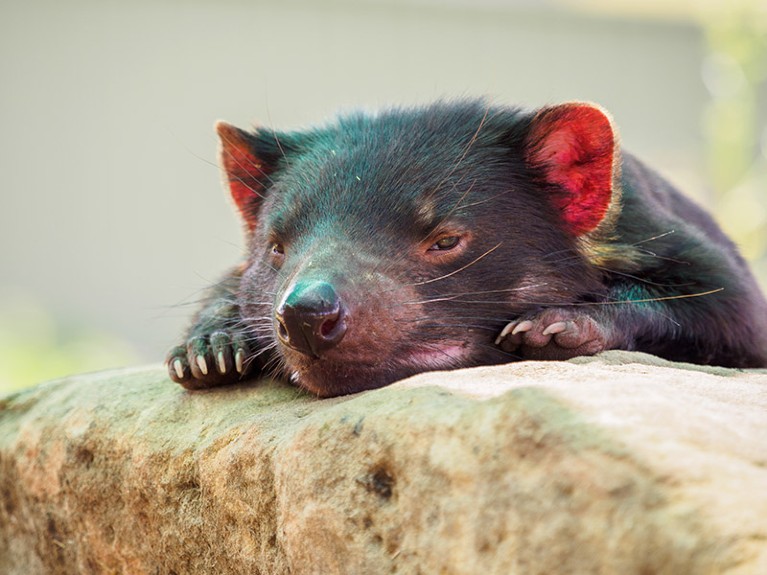
Tasmanian devils are susceptible to facial cancers that are spread by biting.Credit: Gapvoy/Shutterstock
For three decades, Tasmanian devils have battled contagious facial cancers that result in debilitating tumours. Now, a comprehensive genetic analysis of these cancers has tracked their evolution, offering clues about how they could spread in future.
The study, published on 20 April in Science1, offers some of the first detailed insights into how the diseases emerged, evolved and spread. This lays the groundwork for modelling how they could affect Tasmanian devil populations in future, says Janine Deakin, a genomicist at the University of Canberra. “Looking at the genomics does give us that insight into the past as well as potentially into the future,” says Deakin. “We need to understand the enemy that we’re working with.”
Tasmanian devils (Sarcophilus harrisii) are carnivorous marsupials native to the island of Tasmania in southeast Australia. They are susceptible to two cancers that emerged separately: devil facial tumour 1 (DFT1) and devil facial tumour 2 (DFT2), which are both spread by biting. Cancers that pass from one host to another are rare in nature, but can have devastating effects, says study co-author Rodrigo Hamede, a disease ecologist at the University of Tasmania in Hobart. “In a matter of 10 years, we lost between 60–70% of the overall [devil] population,” he says.
Although scientists have been aware of the two cancers for some time, little has been known about their evolution. To investigate, Hamede and his colleagues assembled a Tasmanian devil reference genome and compared it with DNA sequenced from 78 DFT1 and 41 DFT2 tumours. The team then constructed ‘family trees’ of these tumours to track their origin and mapped their mutations to build a picture of how the diseases have evolved.
The results show that DFT1 — which has spread across most of Tasmania — emerged in 1986, around a decade before it was first detected in a female devil in the northeast of the island. That individual seems to have been a superspreader, passing its tumour cells on to at least six other devils. This eventually resulted in six major variants of DFT1.
The team found that DFT2 didn’t arise until 2011, roughly three years before it was first detected in a male devil in southeast Tasmania. Unlike DFT1, DFT2 is found in only a small region of the island. The cancer is genetically similar to DFT1, but it mutates around three times faster. This could be due to the tumour cells dividing more quickly, providing more opportunity for mutations to occur, says Hamede. “The big question is whether these mutations are selective or not,” he says.
In most cases, the facial cancers don’t become contagious until tumours appear, 6–12 months after infection. But the fast-growing DFT2 cancer could shrink this window, leading to more infections that spread faster, says Hamede. This could give the cancer and its variants a competitive edge over less transmissible types. “That will be a long-term evolutionary advantage,” says Hamede.
Previous research2 has shown that Tasmanian devil populations are becoming more resilient, but the relatively recent emergence of DFT2 is concerning, says Hannah Siddle, a geneticist at the University of Queensland in Brisbane, Australia. “It leaves the devil vulnerable in the wild, particularly in those regions where both tumours circulate,” she says. “This could induce local population crashes or as-yet unknown selection on the host population.”
Hamede says that more work needs to be done before researchers can predict how the cancers will evolve and spread through remaining Tasmanian devil populations. “This is an ongoing evolutionary process that we have been witnessing in action,” says Hamede. “This second transmissible cancer will make things more complex.”