x




Parts of the brain associated with habit formation seem unusually active in people with eating disorders.
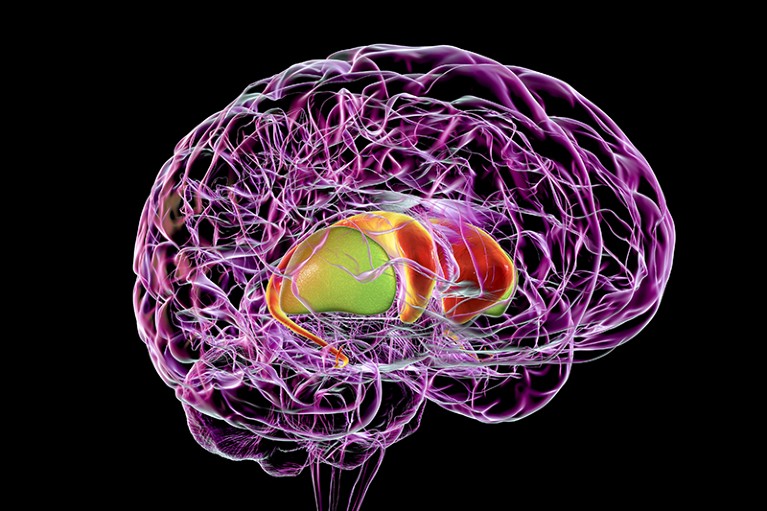
The putamen (highlighted green) has been associated with habit formation, following brain scans of women with binge-eating disorder or bulimia.Credit: Kateryna Kon/SPL
Brain scans of people with binge-eating disorder or bulimia show altered activity in areas linked to habit formation and hint at new possibilities for eating-disorder treatments1.
A habitual behaviour is automatically triggered by external cues — for example, reaching for the seat belt as soon as you get into the car. Scientists have identified two areas in a part of the brain called the striatum that are active in laboratory rats when they perform habitual behaviours. Although the human brain is somewhat similar to the rat brain, neuroscientists weren’t sure what the analogous structures in the human brain were — or whether such structures even existed.
Allan Wang, a neuroscientist at the Stanford University School of Medicine in California, and his colleagues looked at which areas of the rat brain cortex were connected to the striatum. Then, using high-resolution magnetic resonance imaging data from 178 participants in the Human Connectome Project, an initiative to map the human brain, they worked backwards from the cortex to identify the candidate human brain regions.
This led them to two structures: the sensorimotor putamen and the associative caudate.
Because habitual behaviours probably play a part in binge-eating disorder and bulimia nervosa, the team then examined the brains of 34 women with either of these disorders to see whether there was altered activity in the two structures.
Functional magnetic resonance imaging uncovered changes in these areas in people with eating disorders, compared with those without them. The imaging showed alterations in the structure of the grey matter and in dopamine signalling in the sensorimotor putamen in particular.
In people with binge-eating disorder or bulimia, the connections between some parts of the cortex and the habit-reinforcing sensorimotor putamen were much stronger than in healthy controls: connectivity to the anterior cingulate cortex was decreased, but it was increased to the orbitofrontal cortex and motor cortex.
“Connectivity with the sensory motor putamen was the main differentiating factor between the controls that we were looking at and the binge-eating group,” says Wang.
“This study adds pretty nicely to some mounting evidence suggesting that brain circuitry that involves the putamen is likely implicated in binge-eating behaviour,” says psychiatrist Laura Berner at the Icahn School of Medicine at Mount Sinai in New York City.
The extent to which the brain scans differed was directly related to self-reported accounts of the severity of the eating disorder.
Dopamine is a a neurotransmitter released in response to reward, and the researchers expected the brains of people with eating disorder to show the effects of repeated exposure to reward. The putamen seemed to have fewer receptors for dopamine than did healthy brains, and the researchers suspect that increased release of dopamine might dial down the sensitivity of the dopamine receptors and reduce their number.
The researchers caution that they cannot definitively say that the sensorimotor putamen and the associative caudate are the human equivalents of the habit-forming areas of the rat striatum, but the work opens new pathways for exploring habit formation.
It also suggests that new treatments for binge-eating disorder and bulimia should be explored. In the past, these conditions have been resistant to treatment. Psychiatrist Joanna Steinglass at the Columbia University Irving Medical Center in New York City says binge eating is perhaps the most common eating disorder, but “it is the least studied in terms of the bio-behavioural mechanisms”.
Wang says this work could pave the way for treatments that target the brain regions implicated in such disorders, using techniques such as deep-brain stimulation or transcranial magnetic stimulation. He speculates that future treatments for many psychiatric illnesses — not just binge-eating disorder and bulimia — might directly target the brain circuits.