x






Wildfires are not new to Hawaii but they are becoming increasingly devastating. More traditional land use and better data dissemination could help to prevent future tragedies.
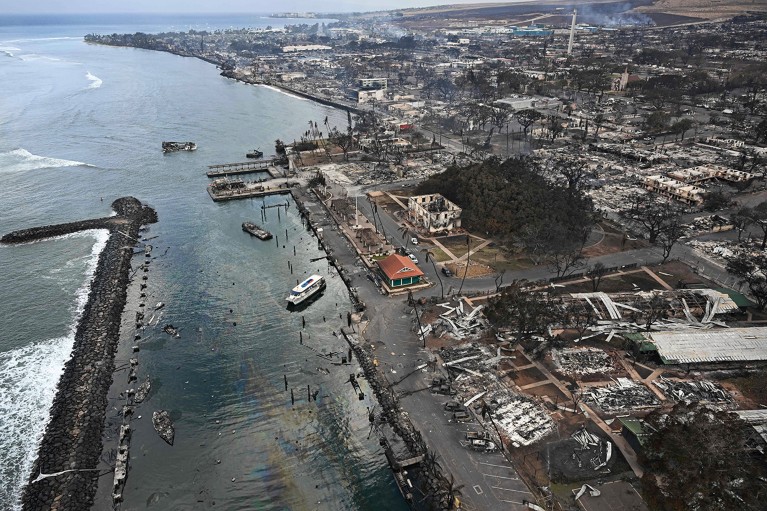
Lahaina, Hawaii, after a fast-moving wildfire caused devastation and deaths.Credit: Patrick T. Fallon/AFP via Getty
Maui is reeling from wildfires that devastated the Hawaiian island last week. They have taken at least 106 lives and caused more than US$5.52 billion dollars of damage. But did the fires take scientists by surprise and how can Hawaii guard against such disasters in future?
Wildfires are not new to Hawaii. Although outsiders tend to think of the Pacific archipelago as a place of lush tropical vegetation, each island has a drier leeward side that is sheltered from the wind — this is where tourism tends to be concentrated, because of the sunny weather. Lahaina, where the most lethal fire broke out on 8 August, means ‘cruel sun’ in Hawaiian; this part of Maui has always been hot and dry.
What’s more, Hawaiian fires are getting worse and more frequent. “We’ve been seeing a pretty steady increase, and in the last few decades, an exponential increase in the amount of area that burns in Hawaii every year,” says climatologist Abby Frazier at Clark University in Worcester, Massachusetts.
A 2021 report by Maui County found that “the number of incidents from a combination of wild/brush/forest fires appears to be increasing, and that this increase poses an increased threat to citizens, properties and sacred sites”.
The three main ingredients of a wildfire are a fuel, dryness and an ignition source. Hawaii’s key fuel is grass, which proliferated in former agricultural areas as the economy shifted from ranching and sugar and pineapple cultivation to tourism. When dry grasses burn, they can carry fire to forested areas, which tend to become grasslands after the fire, in a self-perpetuating cycle.
The dryness required for the wildfires came from droughts, which are “lasting longer and getting more severe” across Hawaii, according to Frazier, who studied how rainfall patterns have changed in the islands over the past century. Temperatures have increased, owing to climate change, which dries vegetation faster. Whether climate change is also causing a reduction in rainfall is harder to confirm, Frazier says. The difficulty stems in part from several complex periodic weather patterns that dominate the Pacific’s natural climate, such as the El Niño–Southern Oscillation (ENSO) and the Pacific Decadal Oscillation.
The Pacific experienced a La Niña phase of the ENSO from the end of 2022 to early 2023, which meant a very damp wet season. Maui saw rainfall that was 90–120% of normal, leading to robust grass growth. In June, El Niño — which typically brings warmer, drier weather — returned.
El Niño doesn’t always bring drought during Hawaii’s dry season, which runs between May and October. But forecasters at the US National Atmospheric and Oceanic Administration (NOAA) were predicting below-average precipitation and drought for Hawaii — and for the leeward side of Maui in particular — as early as May.
The ignition source for the fires last week is still not known, although one possibility is sparks from downed power lines or other electrical systems. What is clear is that high winds from Hurricane Dora, which was just 800 kilometres offshore at one point, would have helped to turn localized fires into a fast-moving inferno. As early as 4 August, the US National Weather Service said that Dora’s winds, combined with drought, would create dangerous fire-weather conditions. On 7 August, the agency issued a Red Flag Warning for fire danger for the leeward areas of all Hawaiian Islands.
What could be done to guard against future disasters? The 2021 Maui County report recommended that, among other actions, the island emphasize the prevention of ignition through public education and tackling the grasses that serve as fuel for many Hawaiian fires. It called for an “aggressive plan to replace these hazardous fuel sources with native plants to reduce combustible fuel while increasing water retention”.
The flammable grasses in question — including kikuyu grass (Cenchrus clandestinus), fountain grass (Cenchrus setaceus), molasses grass (Melinus minutiflora) and guinea grass (Megathyrsus maximus) — were introduced around the turn of the twentieth century as forage or ornamental plants. But native Hawaiian dryland plants are not necessarily more fire resistant, says Katie Kamelamela, an ethnoecologist at Arizona State University in Tempe. What matters is how much dry fuel is on land and how it is arranged. Grazing can reduce fuel loads. Bare areas, wet vegetation as found on active farms, or even fish ponds can help stop or slow fires.
Kamelamela, who is Native Hawaiian, says that whether the plants in an area are native or introduced is less important than how carefully land is cared for. In the past, people who gathered resources from a forest would also tidy it up, removing undergrowth or even replanting important plants. But such labour-intensive traditional work is hard to fit into a hectic modern life. “Most people in Hawaii have two to three jobs and are just trying to take their kids to soccer practice,” she says.
Interest is increasing among many Native Hawaiians and Hawaiian residents in reinvesting in traditional forms of agriculture and aquaculture. Groups such as ‘Ao‘ao O Nā Loko I‘a O Maui (the Maui Fishpond Association) and Kipahulu Ohana are trying to revitalize traditional food production, which would create a landscape that is much less flammable than the untended grasslands and shrublands that currently cover 24% of the state’s total land area. A 2019 study1 found that Hawaii’s traditional agroecosystems could support nearly all of the islands’ current population.
Kamelamela says that changing how Hawaii manages its lands could create a deeper relationship between people and place. “That’s why these fires started: because no one had a relationship to these places.”
Climatologists and meteorologists also want the collection and dissemination of Hawaii’s climate data to come into line with that in the contiguous United States. There are no daily or monthly data for soil moisture or potential evapotranspiration available for Hawaii, and the state is not included in many of the scientific products issued by the US federal government, such as the Crop Moisture Index. But the University of Hawaiʻi, in Honolulu, has high-resolution grid data on temperature, rainfall and other variables, says Frazier.